Association Marocaine de Planification Familiale (AMPF),
Morocco Family Planning Association
Follow the Money: Why Gender Equality Is Still Missing in Climate Finance in Asia and the Pacific
An analysis of the Belém Gender Action Plan, climate finance, and why gender-responsive climate action remains underfunded across Asia and the Pacific.
At Climate Week 3, the UNFCCC convened its dialogue on financing the Belém Gender Action Plan (GAP). The framing was familiar: how do we mobilise resources, strengthen capacity, and accelerate implementation (UNFCCC, 2026a)? But beneath this technical language lies a harder truth, one that the women’s movements across Asia and the Pacific have been naming for years:
Climate finance is not failing because there isn’t enough money. It is failing because power shapes where money goes, who controls it, and whose lives are valued.
The Belém GAP (2026–2034) arrives at a moment when gender equality is widely acknowledged in climate discourse, yet it remains structurally underfunded and politically diluted. This blog does not ask whether the GAP is a step forward. It asks a more uncomfortable question:
Will it actually change anything on the ground?
The Promise of Belém and Its Limits
The Belém Gender Action Plan, adopted at COP30, is ambitious on paper. It outlines 27 activities and 98 deliverables across governance, finance, participation, and accountability (UNFCCC, 2025a; UNFCCC, 2025b). It explicitly recognises:
Intersectionality
Women’s leadership
The need for gender-responsive climate finance
The importance of data and accountability systems
This matters because advocates fought hard for this language over decades: from the Lima Work Programme to the enhanced GAP. But here is the tension: The GAP is politically progressive, yet it is being implemented through systems that are not. Climate finance institutions such as the Green Climate Fund and the Global Environment Facility remain structured around risk, scale, and returns, not justice (OECD, 2023; GCF, 2024). So the question becomes: can a gender-just agenda survive within systems that were never designed for it?
Follow the Money: Where Gender Falls Apart
The UNFCCC dialogue highlighted familiar barriers: limited capacity, lack of awareness, and weak coordination (UNFCCC, 2026a). These are real, but they are not the root cause. The deeper issues are:
Climate Finance Rewards Scale, Not Equity
Large infrastructure projects, such as those in renewable energy, transport, and mitigation, dominate funding portfolios. These projects are easier to quantify, de-risk, and justify. Meanwhile, investments in care systems, community health, gender-based violence prevention, and local adaptation strategies are seen as “soft,” difficult to measure, and therefore less fundable (UN Women, 2023; OECD, 2023).
What gets funded reflects what is valued. And right now, gender-responsive priorities are still treated as secondary.
Access Is Structured to Exclude
To access major climate funds, organisations must navigate complex accreditation processes, fiduciary standards, and reporting requirements. For grassroots and local organisations across Asia and the Pacific, this is not just difficult; it is often impossible. Even “direct access” mechanisms remain mediated through national or international intermediaries (UNFCCC, 2026a; GCF, 2024). Those closest to the problem are the furthest from the money.
Gender Becomes a Checkbox
Gender mainstreaming has, in many cases, become procedural gender action plans attached to projects, gender indicators added at the reporting stage, and consultations conducted without real influence. This creates the appearance of progress without redistributing power (UNDP, 2022; Women and Gender Constituency, 2025).
Asia-Pacific: A Region Carrying the Burden and the Solutions
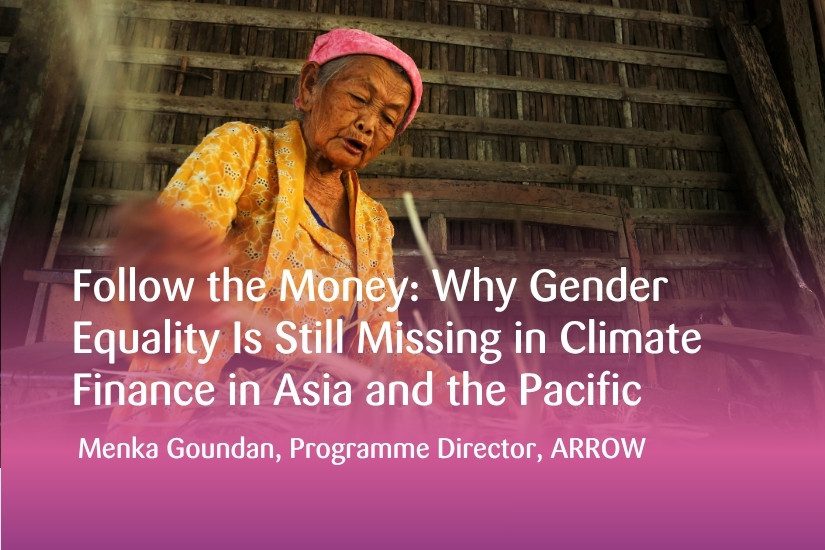
Asia and the Pacific is among the most climate-affected regions globally. It is also a region where gender movements have long developed sophisticated, intersectional approaches to resilience. Across the region, women lead community-based adaptation in Bangladesh and the Philippines (ADB, 2022); Pacific Island women are advancing climate justice frameworks rooted in Indigenous knowledge (SPC, 2023); and women’s organizations are linking climate change with sexual and reproductive health and rights (SRHR), migration, and labour (ARROW, 2021). Yet these approaches remain underfunded because they do not fit dominant funding models. They are long-term, not project-bound; relational, not purely technical; and justice-oriented, not profit-oriented. Hence, they remain marginal despite their effectiveness.
What Feminist Climate Finance Actually Requires
From ARROW’s perspective, the issue is not how to “add gender” to climate finance. It is about transforming climate finance.
Fund Social Protection and Reproductive Health as Climate Infrastructure
Care work, health systems, and bodily autonomy are not peripheral issues; they are the foundation of resilience. Climate impacts heighten care burdens, maternal health risks, and exposure to gender-based violence. Yet these remain largely invisible within climate finance flows (UNFPA, 2023; WHO, 2023). A gender-responsive approach would treat care as infrastructure, not charity.
Shift Power, Not Just Participation
Women’s participation is often celebrated, but participation without power changes little. To shift this rhetoric, we need decision-making authority for diverse, gender-inclusive actors, direct funding for grassroots organisations, and co-design of funding criteria. This is what intentional redistribution of power looks like.
Fund Movements, Not Just Projects
Short-term, project-based funding undermines sustained change. Organisations advancing gender-responsive climate action need core, flexible funding, long-term investment, and support for movement-building. Without these supports, gender-responsive climate action remains fragmented.
Redefine Accountability
Current accountability systems prioritize donors over communities. A gender-responsive approach would incorporate community-defined indicators, participatory monitoring, and transparency in funding flows. Accountability must flow downward, not only upward.
The Risk We Don’t Talk About: Co-optation
There is a growing risk that “gender-responsive climate finance” becomes a widely used label, rarely transformative. We are already seeing financial instruments branded as gender-responsive with minimal impact, private-sector-led initiatives framed as empowerment, and gender language integrated without structural change. This is how systems absorb critique by adopting its language while maintaining its logic. The Belém GAP could suffer the same fate unless it is actively contested. Not in its mid-term or end-term evaluation, but starting now, in its first year of implementation.
Where Change Is Still Possible
Despite these risks, opportunities remain:
Strengthening National Gender and Climate Change Focal Points (UNFCCC, 2025b)
Reforming funding criteria within major climate funds (GCF, 2024)
Building regional alliances, such as the Gender Responsive Climate Action in Asia and the Pacific: Community of Practice, to influence policy and finance.
Asia and the Pacific networks are already doing this by bridging global frameworks and local realities.
The Real Question
The Belém Gender Action Plan is not the end of the story; it is a test! Not of whether gender can be integrated into climate policy, but of whether climate governance can be reshaped to advance justice. Ultimately, this is not about gender. It is about whose lives are made visible, whose knowledge counts, and whose futures are financed.
Conclusion: Finance Is Power
Climate finance is often discussed in numbers: billions, trillions, gaps. But finance is not just money. It is power, the power to decide which solutions matter, who leads, and what futures are possible. In Asia and the Pacific, gender-responsive climate action is not a niche agenda. It is a necessary one. As reflected in the work of ARROW, the challenge is not simply to access climate finance. It is to change what climate finance is for.