
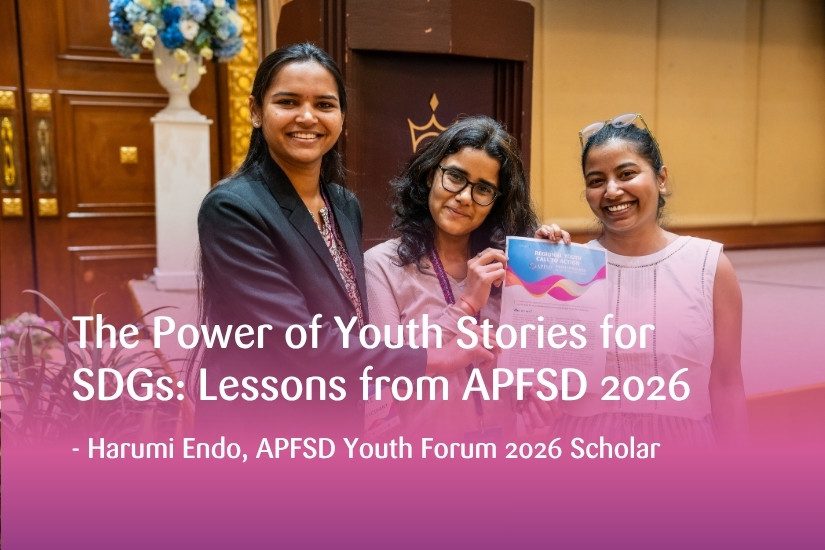
Harumi Endo, APFSD Youth Forum 2026 Scholar
When we try to understand the Sustainable Development Goals (SDGs), we often do so through numbers – the targets, indicators, and percentages of progress. These are essential as they tell us where we are and where we need to go. But the force that moves us from where we are toward those goals does not come from numbers alone. It comes from empathy, passion, and the emotions that accompany the youth stories we share. During this year’s APFSD Youth Forum 2026, my fellow young activists reminded me of this once again: behind each goal lies a story – a person, a life, a struggle that cannot be captured by statistics alone.
The Value of Your Story
I first joined the APFSD Youth Forum virtually in 2021. At that time, I remember feeling overwhelmed. I felt that I did not know enough. I was unsure what I could contribute in a space where so many participants seemed deeply knowledgeable and experienced. Looking back now, I wish I could tell my 2021 self, “The stories you carry already have value.”
This year, the forum was held in Bangkok over three days, before the Asia-Pacific Forum on Sustainable Development (APFSD) in February. The Asia and the Pacific region is home to around 60% of the world’s youth populatio (approximately 750 million people) aged 15 to 24. Reflecting this, more than 700 young people participated, both online and in person, with around 70 gathering on-site. We came from diverse backgrounds. We were students, researchers, humanitarian practitioners, and community leaders. We spoke different languages, carried different beliefs, and lived in very different realities.
What connected us were the stories each one of us shared during sessions, over breakfast tables, in between sessions, and even in late-night discussions. Each of us was constantly learning, finding connections and similarities, and exploring ways to contribute from our own experiences. And through that process, many of them became not just colleagues, but friends.
Giving the SDGs a Human Face
What resonated most was how each story gave a human face to the SDGs. I heard about a young woman in India who was forced into marriage, in part to provide labour in a household struggling with water scarcity. Carrying heavy loads daily, women in these conditions face severe health risks, including miscarriage. I learned how current energy systems continue to harm indigenous communities. Issues that once felt distant became deeply personal. The SDGs were no longer abstract goals but became lived realities.
During the APFSD Youth Forum, I also had the opportunity to share stories from the Tohoku Future Research initiative promoted by the Youth Division of Soka Gakkai Japan, in a session focused on Goal 11: Sustainable Cities and Communities.
Lessons from Tohoku: Hope as a Resource
On March 11, 2011, a devastating earthquake struck northeastern Japan, triggering a tsunami and leading to the accident at the Fukushima nuclear power plant. Many lives were lost, and countless people were forced to leave their homes. Even today, communities continue to face long-term challenges, including displacement, aging populations, and the decline of younger generations. Nearly 75% of municipalities in the region are considered at risk of disappearing.
And yet, within this reality, young people chose to take the lead. In 2023, youth members in the region launched the Tohoku Future Research initiative. They began with a simple but powerful question: What can we contribute as members of this community? The initiative includes fieldwork, in-person surveys, and community dialogue meetings. Young people visit residents directly, sometimes sitting in their homes, listening to their life stories. Through these interactions, they begin to rediscover the beauty, history, and identity of their communities.
In Tomioka Town in Fukushima Prefecture, where all residents were once forced to evacuate due to the nuclear accident, and only about 16% have returned, youth members helped facilitate dialogue around a shared question: What are the treasures we want to carry forward 100 years from now?
Around 80 residents, including the vice mayor, gathered for this dialogue. One local member who supported youth reflected: “What this town needed most was hope and a sense of the future. The youth brought that.” Through these efforts, communities begin to transform, not through external solutions alone, but through shared ownership, dialogue, and renewed hope. This experience reinforced something important for me: sustainable development cannot be driven by systems alone. It must be rooted in human connection.
The Power of Dialogue
This idea resonates deeply with the philosophy of the Soka Gakkai movement. In his peace proposals to the United Nations, Daisaku Ikeda, the third president of Soka Gakkai, consistently emphasised the importance of dialogue and mutual understanding in addressing global challenges. In his 2016 proposal, he writes:
“Society as a whole has seen a lessening of our capacity to appreciate others—as they are and for who they are. I believe that the surest way to change this is by carefully attending to the stories of each other’s lives through one-on-one dialogue.”
The conversations at the APFSD Youth Forum 2026 reflected exactly this spirit. Through sharing our experiences – from climate anxiety to gender inequality to post-disaster recovery – we began to understand not only our differences, but also how deeply interconnected our challenges are. When we see the SDGs through stories, they are no longer something we can give up on or compromise.
Creating the Future Together
Together, we also developed National and Regional Calls to Action, which are collective messages that carry our voices into policymaking spaces. The APFSD Youth Forum 2026 Regional Youth Call to Action was shared during the APFSD, and the dialogue will continue toward the High-Level Political Forum. It is encouraging to see our discussions and exchanges take shape as tangible outcomes. But more than that, what we built goes beyond any document: trust, solidarity, and a shared determination that continues to grow even after the Forum.
It does not have to be a global forum for these connections to happen. It can begin in our own communities, in everyday conversations, in moments where we truly listen to one another. Even now, on social media, I continue to see fellow scholars take steps, carrying forward their own stories and actions.
If I could return to the online forum in 2021 and speak to the person I was then, I would say this: You do not need to know everything. You do not need perfect words. Just bring your story and open ears. Because the most powerful tools we have are not weapons or political power. They are the stories we carry, the hope we nurture, and our ability to connect. And when young people across Asia and the Pacific, home to the largest youth population in the world, stand together in that spirit, we can begin to build the future from where we are, in solidarity with fellow youth around the world.
