2025

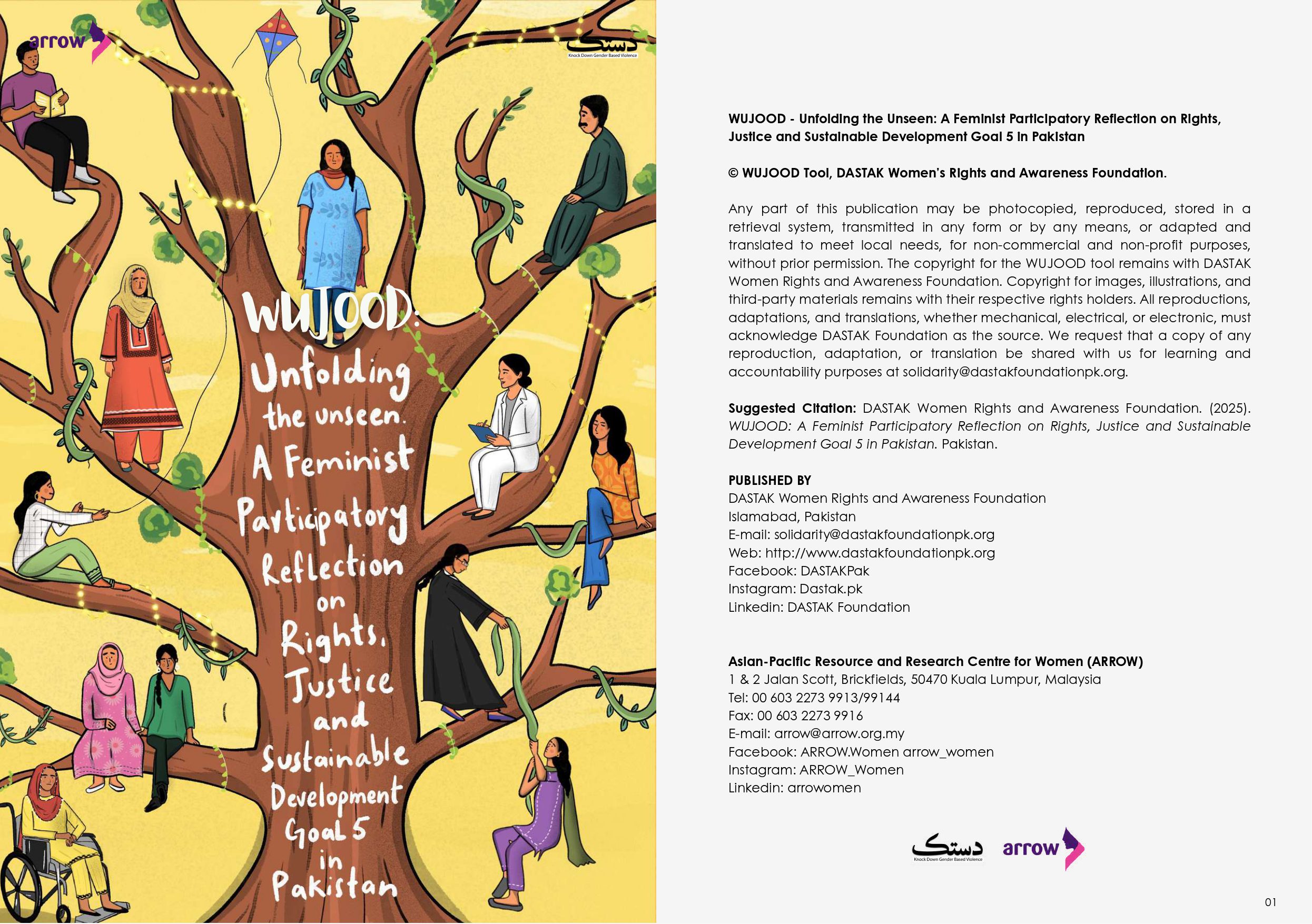
WUJOOD – Unfolding the Unseen: A Feminist Participatory Reflection on Rights, Justice and Sustainable Development Goal 5 in Pakistan

Categories:

Some truths cannot be captured in tables or charts, they must be seen, felt, and remembered. The visual executive summary brings to life the core findings of the WUJOOD care-centred feminist participatory research, conducted for this SDG-5 monitoring report.

Guided by our core research questions, How do women, men, and transgender persons experience gender-based violence and SRHR barriers across institutional, relational, and cultural domains? Where do systems enable protection, and where do they reproduce harm? How do survivors navigate access, denial, resilience, and silence across Pakistan’s diverse contexts?, the visuals translate statistical patterns, lived insights and recommendations into an illustrated journey across Pakistan’s socio-ecological landscape.

Each frame visualises how gender-based violence, sexual and reproductive health and rights violations, and restrictions on bodily autonomy are produced through the interplay of cultural norms, institutional failures, and relational power structures. Rooted in Heise’s socio-ecological model and Galtung’s violence framework, the visuals shift our gaze from numbers to the lived realities uncovered through WUJOOD’s community research revealing what policies, data points, and institutional structures feel like inside the bodies, memories, and daily life of women, transgender persons, men and marginalised communities. They portray not only the forms of violence that are visible, but also those that are normalised, dismissed, and justified.

Vietnam

  • Centre for Creative Initiatives in Health and Population (CCIHP)

Sri Lanka

  • Bakamoono;
  • Women and Media Collective (WMC),
  • Youth Advocacy Network – Sri Lanka (YANSL)

Singapore

  • End Female Genital Cutting Singapore
  • Reproductive Rights (WGNRR)

Philippines

  • Democratic Socalist Women of the Philippines (DSWP);
  • Galang;
  • Healthcare Without Harm;
  • Institute for Climate and Sustainable Cities;
  • Likhaan Centre for Women’s Health;
  • Nisa UI Haqq Fi Bangsamoro;
  • PATH Foundation Inc. (PFPI);
  • Women’s Global Network for
    Reproductive Rights (WGNRR)

Pakistan

  • Aahung, Centre for Social Policy Development (CSPD);
  • Forum for Dignity Initiative (FDI);
  • Gravity Development Organization; Green Circle Organization;
  • Indus Resources Center (IRC);
  • Idara-e-Taleem-O-Aaghai (ITA);
  • Rehnuma – Family Planning Association Pakistan;
  • Shelter
    Participatory Organisation;
  • Shirkat Gah;
  • The Enlight Lab

Nepal

  • Beyond Beijing Committee (BBC);
  • Blind Youth Association of Nepal;
  • Blue Diamond Society (BDS);
  • Nepalese Youth for Climate Action (NYCA);
  • Visible Impact;
  • Women’s Rehabilitation Centre (WOREC);
  • YPEER Nepal;
  • YUWA

Myanmar

  • Colourful Girls Organization;
  • Green Lotus Myanmar

Maldives

  • Hope for Women;
  • Society for Health Education (SHE)

Malaysia

  • Federation of Reproductive Health Associations of Malaysia (FRHAM);
  • Joint Action Group for Gender Equality (JAG);
  • Justice for Sisters (JFS);
  • Reproductive Health Association of
    Kelantan (ReHAK);
  • Reproductive Rights Advocacy Alliance Malaysia (RRAAM);
  • Sisters in Islam (SIS)

Lao PDR

  • Lao Women’s Union;
  • The Faculty of Postgraduate Studies at the University of Health
    Sciences (UHS)

Indonesia

  • Aliansi Satu Visi (ASV);
  • CEDAW Working Group;
  • Hollaback! Jakarta;
  • Institut Kapal Perempuan;
  • Kalyanamitra;
  • Komnas Perempuan;
  • Remaja Independen Papua/Independent Youth
    Forum Papua (FRIP/IYFP);
  • Perkumpulan Keluarga Berencana Indonesia (PKBI);
  • Perkumpulan Lintas Feminis Jakarta;
  • Perkumpulan Pamflet Generasi;
  • RUTGERS Indonesia;
  • Sanggar SWARA;
  • Women on Web;
  • Yayasan Kesehatan Perempuan (YKP); 
  • YIFOS Indonesia

India

  • CommonHealth;
  • Love Matters India;
  • Pravah;
  • Rural Women’s Social Education Centre (RUWSEC);
  • SAHAYOG;
  • Sahaj;
  • Sahiyo;
  • SAMA – Resource Group for Women and Health;
  • WeSpeakOut;
  • The YP Foundation (TYPF)

Morocco

  • Association Marocaine de Planification Familiale (AMPF),
  • Morocco Family Planning Association
WUJOOD - Unfolding the Unseen: A Feminist Participatory Reflection on Rights, Justice and Sustainable Development Goal 5 in Pakistan

Some truths cannot be captured in tables or charts, they must be seen, felt, and remembered. The visual executive summary brings to life the core findings of the WUJOOD care-centred feminist participatory research, conducted for this SDG-5 monitoring report.

Guided by our core research questions, How do women, men, and transgender persons experience gender-based violence and SRHR barriers across institutional, relational, and cultural domains? Where do systems enable protection, and where do they reproduce harm? How do survivors navigate access, denial, resilience, and silence across Pakistan’s diverse contexts?, the visuals translate statistical patterns, lived insights and recommendations into an illustrated journey across Pakistan’s socio-ecological landscape.

Each frame visualises how gender-based violence, sexual and reproductive health and rights violations, and restrictions on bodily autonomy are produced through the interplay of cultural norms, institutional failures, and relational power structures. Rooted in Heise’s socio-ecological model and Galtung’s violence framework, the visuals shift our gaze from numbers to the lived realities uncovered through WUJOOD’s community research revealing what policies, data points, and institutional structures feel like inside the bodies, memories, and daily life of women, transgender persons, men and marginalised communities. They portray not only the forms of violence that are visible, but also those that are normalised, dismissed, and justified.

Maldives

  • Hope for Women
  • Society for Health Education (SHE)

Mongolia

  • MONFEMNET National Network