2017

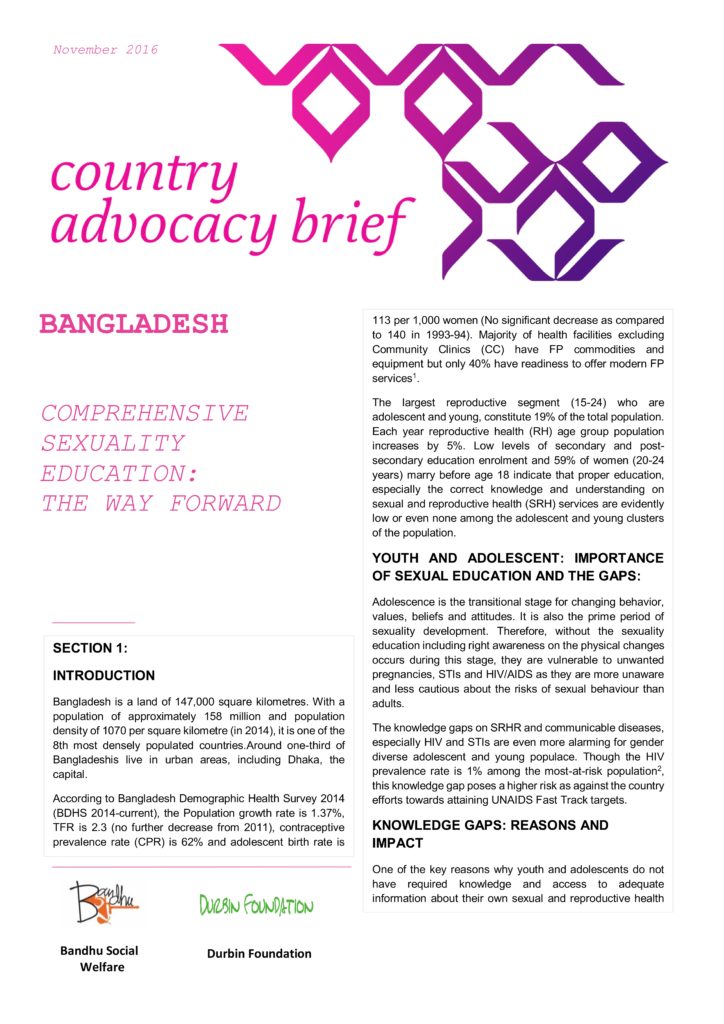
Bangladesh Country Advocacy Brief – Comprehensive Sexuality Education: The Way Forward

Categories:

Bangladesh – the 8th most densely populated country in the world – has a population growth rate of 1.37%, TFR of 2.3, contraceptive prevalence rate (CPR) of 62%, and adolescent birth rate of 113 per 1,000 women. The largest reproductive segment (15-24) who are adolescent and young, constitute 19% of the total population. This demographic is most at risk from a lack of comprehensive sexuality education (CSE), making them more vulnerable to unwanted pregnancies, STIs and HIV/AIDS as they are unaware and less cautious about the risks of sexual behaviour than adults. The current brief looks at the state of CSE in the national context, knowledge gaps, the reasons and impacts, as well as recommendations to government on creating inclusive programs that projects sex-positive attitudes.

Vietnam

  • Centre for Creative Initiatives in Health and Population (CCIHP)

Sri Lanka

  • Bakamoono;
  • Women and Media Collective (WMC),
  • Youth Advocacy Network – Sri Lanka (YANSL)

Singapore

  • End Female Genital Cutting Singapore
  • Reproductive Rights (WGNRR)

Philippines

  • Democratic Socalist Women of the Philippines (DSWP);
  • Galang;
  • Healthcare Without Harm;
  • Institute for Climate and Sustainable Cities;
  • Likhaan Centre for Women’s Health;
  • Nisa UI Haqq Fi Bangsamoro;
  • PATH Foundation Inc. (PFPI);
  • Women’s Global Network for
    Reproductive Rights (WGNRR)

Pakistan

  • Aahung, Centre for Social Policy Development (CSPD);
  • Forum for Dignity Initiative (FDI);
  • Gravity Development Organization; Green Circle Organization;
  • Indus Resources Center (IRC);
  • Idara-e-Taleem-O-Aaghai (ITA);
  • Rehnuma – Family Planning Association Pakistan;
  • Shelter
    Participatory Organisation;
  • Shirkat Gah;
  • The Enlight Lab

Nepal

  • Beyond Beijing Committee (BBC);
  • Blind Youth Association of Nepal;
  • Blue Diamond Society (BDS);
  • Nepalese Youth for Climate Action (NYCA);
  • Visible Impact;
  • Women’s Rehabilitation Centre (WOREC);
  • YPEER Nepal;
  • YUWA

Myanmar

  • Colourful Girls Organization;
  • Green Lotus Myanmar

Maldives

  • Hope for Women;
  • Society for Health Education (SHE)

Malaysia

  • Federation of Reproductive Health Associations of Malaysia (FRHAM);
  • Joint Action Group for Gender Equality (JAG);
  • Justice for Sisters (JFS);
  • Reproductive Health Association of
    Kelantan (ReHAK);
  • Reproductive Rights Advocacy Alliance Malaysia (RRAAM);
  • Sisters in Islam (SIS)

Lao PDR

  • Lao Women’s Union;
  • The Faculty of Postgraduate Studies at the University of Health
    Sciences (UHS)

Indonesia

  • Aliansi Satu Visi (ASV);
  • CEDAW Working Group;
  • Hollaback! Jakarta;
  • Institut Kapal Perempuan;
  • Kalyanamitra;
  • Komnas Perempuan;
  • Remaja Independen Papua/Independent Youth
    Forum Papua (FRIP/IYFP);
  • Perkumpulan Keluarga Berencana Indonesia (PKBI);
  • Perkumpulan Lintas Feminis Jakarta;
  • Perkumpulan Pamflet Generasi;
  • RUTGERS Indonesia;
  • Sanggar SWARA;
  • Women on Web;
  • Yayasan Kesehatan Perempuan (YKP); 
  • YIFOS Indonesia

India

  • CommonHealth;
  • Love Matters India;
  • Pravah;
  • Rural Women’s Social Education Centre (RUWSEC);
  • SAHAYOG;
  • Sahaj;
  • Sahiyo;
  • SAMA – Resource Group for Women and Health;
  • WeSpeakOut;
  • The YP Foundation (TYPF)

Morocco

  • Association Marocaine de Planification Familiale (AMPF),
  • Morocco Family Planning Association
Bangladesh Country Advocacy Brief - Comprehensive Sexuality Education: The Way Forward

Bangladesh – the 8th most densely populated country in the world – has a population growth rate of 1.37%, TFR of 2.3, contraceptive prevalence rate (CPR) of 62%, and adolescent birth rate of 113 per 1,000 women. The largest reproductive segment (15-24) who are adolescent and young, constitute 19% of the total population. This demographic is most at risk from a lack of comprehensive sexuality education (CSE), making them more vulnerable to unwanted pregnancies, STIs and HIV/AIDS as they are unaware and less cautious about the risks of sexual behaviour than adults. The current brief looks at the state of CSE in the national context, knowledge gaps, the reasons and impacts, as well as recommendations to government on creating inclusive programs that projects sex-positive attitudes.

Maldives

  • Hope for Women
  • Society for Health Education (SHE)

Mongolia

  • MONFEMNET National Network