From Youth Advocacy to Legal Reforms: Why Intersectionality Must Be at the Heart of Gender Justice in South Asia

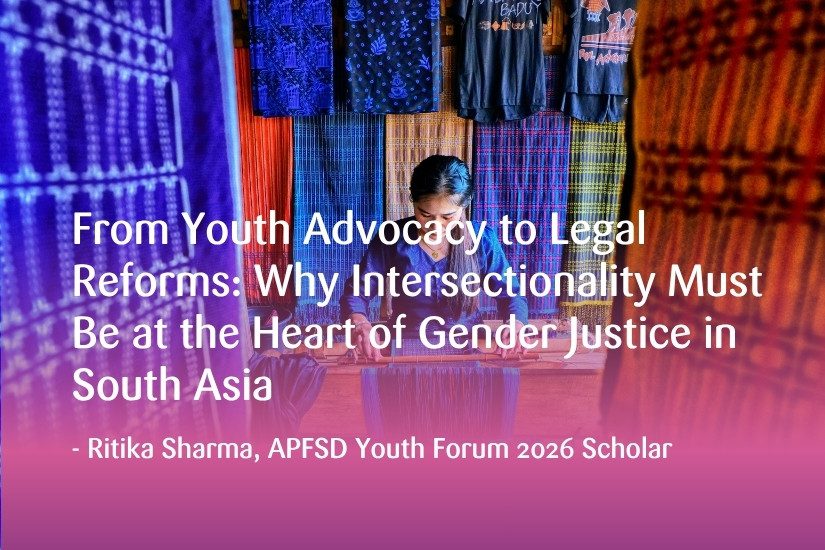
A young woman is pictured weaving on a traditional loom surrounded by vibrant blue and orange textiles. Text overlay: "From Youth Advocacy to Legal Reforms: Why Intersectionality Must Be at the Heart of Gender Justice in South Asia - Ritika Sharma, APFSD Youth Forum 2026 Scholar." The article focuses on Gender Justice in South Asia.

Ritika Sharma, APFSD Youth Forum 2026 Scholar

A few weeks before the Asia-Pacific Forum on Sustainable Development (APFSD) 2026 and the APFSD Youth Forum 2026, a news piece from Haryana, India, stayed with me. A woman went through eleven pregnancies before giving birth to a son, and his birth became a huge celebration for the family and the village. This also finally ended the taunts she had faced from people in her village for not having a son.

It is a reminder that behind gender equality are the ground realities where gender discrimination is layered with poverty, social pressure, and structural inequalities. In my research and public engagements, I have always encountered moments when I realised that the real question is not if gender equality is being discussed, but if it is being discussed deeply enough. Intersectionality is one such lens that helps us dive into the depths of the issue and understand all layers of discrimination.

As a participant in the APFSD Youth Forum 2026 and the following Feminist Forum, I had the opportunity to contribute to discussions around Sustainable Development Goals (SDG) 6, 7, 9, and 11.

  • SDG 6: Clean Water and Sanitation

  • SDG 7: Affordable and Clean Energy

  • SDG 9: Industry, Innovation and Infrastructure

  • SDG 11: Sustainable Cities and Communities

During the Youth Forum, I was involved in drafting India’s National Youth Call to Action 2026 and at the Feminist Forum, I primarily contributed to discussions around SDG 11 (Sustainable Cities and Communities), engaging in the issues around safety and inclusion.

This experience was especially meaningful as the collective effort of young advocates ensured that our drafts and contributions reflected the ground realities and grassroots perspectives. For me, this meant consistently bringing intersectionality into the conversations as a necessary lens for understanding why some women remain far more vulnerable to violence and exclusion than others.

Defining Intersectionality in the South Asian Context

“Intersectionality” is a term coined by the American advocate Kimberlé Crenshaw to point out how gender and race are two intertwined factors that lead to layered discrimination. Intersectionality is neither solely an academic concept nor limited only to racism. In South Asia, especially, gender intersects with caste, class, religion, disability, place of birth, migration status, and conflict. For instance,

  • A woman living in an urban area may face gender discrimination.
  • A Dalit woman may face gender discrimination and casteism.
  • A refugee woman may face gender discrimination and legal invisibility.
  • A disabled woman may face gender discrimination and structural and judicial ignorance.

When one or more of these identities intersect, inequalities in accessing justice multiply, thereby making it essential to include these in our policy and justice frameworks.

Research realities

In April last year, together with my team, I published a research report, “Intersectionality and Sexual Violence in South Asia”, analysing legal and policy gaps in the intersection of gender with caste, disability, ethnicity, religion and socio-economic status in sexual violence cases.

Our study, based on case analysis, clearly highlighted that there are structural impediments that prevent women with intersectional identities from accessing justice. In India, there are several intersectional factors that affect women, the dominant being caste and disability. In Bangladesh, Nepal, Pakistan and Sri Lanka, factors such as religion, ethnicity, poverty, and conflict exposure lead to greater vulnerability.

Legal Gaps: Intersectionality and Sexual Violence in South Asia

A particularly important example from India is the Supreme Court’s decision in the Patan Jamal Vali v State of Andhra Pradesh (2021) case, which recognised the concept of intersectionality in the context of sexual violence. While this is one case, it reflects the challenge within judicial approaches to intersectionality. The case involved the rape of a visually impaired Dalit woman, highlighting how gender, caste, and disability can combine and lead to heightened vulnerability. The Court observed,

“When the identity of a woman intersects with, inter alia, her caste, class, religion, disability and sexual orientation, she may face violence and discrimination due to two or more grounds… it becomes imperative to use an intersectional lens to evaluate how multiple sources of oppression operate cumulatively to produce a specific experience of subordination for a blind Scheduled Caste woman” (para 12).

This recognition was important because Indian courts have rarely looked into the intersectionality aspect before.

However, the case also illustrates a broader problem. While the Court impressively acknowledged intersectionality, it ultimately set aside the conviction under the Scheduled Castes and Scheduled Tribes (Prevention of Atrocities) Act (a legislation that aims at preventing caste-based discrimination and violence in India) due to evidentiary limitations, even while affirming the rape conviction under the Penal Law. In addition to this, the disability-related legal provision was not invoked at all.

Key Lessons for Implementing SDG 5 in South Asia

SDG 5 aims to achieve gender equality. However, gender equality cannot be achieved through gender-neutral solutions. If policies assume all women face the same barriers, they would only help those already closest to opportunity or those who are already in a privileged position, while leaving the most marginalised behind. Intersectionality reminds us that equality is achieved when those at the margins are included. My research across South Asia suggests three important lessons.

First, there are patterns of violence which often reflect existing hierarchies owing to the different backgrounds, rather than random acts. Understanding this helps shift focus from individual incidents to systematic failures.

Second, although several necessary legal protections exist across South Asian countries, implementation gaps persist because of social norms and stereotypes, which include judicial stereotyping and administrative/policy stereotyping.

Third, there is an urgent need for reforms in order to achieve gender equality in its true essence. There must be better judicial training and intersection-sensitive investigations and procedures, which means that the justice frameworks need to be transformed to incorporate an intersectional lens.

Without these changes, intersectionality will only remain symbolic rather than transformative.

SDG 5 and the Way Forward

For me, the APFSD and the APFSD Youth Forum was not just a conference, it was a reminder of why I entered this field. What made it particularly meaningful for me was seeing how advocacy and research spaces can reinforce each other. I saw how youth advocates coming from different parts of the Asia and Pacific region were bringing intersectional issues to the forefront with their own unique experiences. One of the most encouraging aspects of APFSD was seeing that many youth participants were already working at the grassroots level and understood these intersectional complexities intuitively.

It reaffirmed that policy spaces and research spaces must speak to each other. It also endorses that legal reform must take into account the grassroots experiences, and sustainable development must include those who are most often excluded. This also brings me back to where I began.

Stories like the woman in Haryana remind us that gender inequality is rarely about gender alone. It is also about the social structures that surround women’s lives and the unique realities they experience owing to their different intersectional identities. Therefore, intersectionality must not be treated as an optional analytical tool. Without it, policies risk exclusion, legal systems risk serving only the privileged, and true gender equality becomes unachievable. When it comes to SDG 5, intersectionality must be at the heart of how we design laws, policies, and advocacy.

Do not miss

Vietnam

  • Centre for Creative Initiatives in Health and Population (CCIHP)

Sri Lanka

  • Bakamoono;
  • Women and Media Collective (WMC),
  • Youth Advocacy Network – Sri Lanka (YANSL)

Singapore

  • End Female Genital Cutting Singapore
  • Reproductive Rights (WGNRR)

Philippines

  • Democratic Socalist Women of the Philippines (DSWP);
  • Galang;
  • Healthcare Without Harm;
  • Institute for Climate and Sustainable Cities;
  • Likhaan Centre for Women’s Health;
  • Nisa UI Haqq Fi Bangsamoro;
  • PATH Foundation Inc. (PFPI);
  • Women’s Global Network for
    Reproductive Rights (WGNRR)

Pakistan

  • Aahung, Centre for Social Policy Development (CSPD);
  • Forum for Dignity Initiative (FDI);
  • Gravity Development Organization; Green Circle Organization;
  • Indus Resources Center (IRC);
  • Idara-e-Taleem-O-Aaghai (ITA);
  • Rehnuma – Family Planning Association Pakistan;
  • Shelter
    Participatory Organisation;
  • Shirkat Gah;
  • The Enlight Lab

Nepal

  • Beyond Beijing Committee (BBC);
  • Blind Youth Association of Nepal;
  • Blue Diamond Society (BDS);
  • Nepalese Youth for Climate Action (NYCA);
  • Visible Impact;
  • Women’s Rehabilitation Centre (WOREC);
  • YPEER Nepal;
  • YUWA

Myanmar

  • Colourful Girls Organization;
  • Green Lotus Myanmar

Maldives

  • Hope for Women;
  • Society for Health Education (SHE)

Malaysia

  • Federation of Reproductive Health Associations of Malaysia (FRHAM);
  • Joint Action Group for Gender Equality (JAG);
  • Justice for Sisters (JFS);
  • Reproductive Health Association of
    Kelantan (ReHAK);
  • Reproductive Rights Advocacy Alliance Malaysia (RRAAM);
  • Sisters in Islam (SIS)

Lao PDR

  • Lao Women’s Union;
  • The Faculty of Postgraduate Studies at the University of Health
    Sciences (UHS)

Indonesia

  • Aliansi Satu Visi (ASV);
  • CEDAW Working Group;
  • Hollaback! Jakarta;
  • Institut Kapal Perempuan;
  • Kalyanamitra;
  • Komnas Perempuan;
  • Remaja Independen Papua/Independent Youth
    Forum Papua (FRIP/IYFP);
  • Perkumpulan Keluarga Berencana Indonesia (PKBI);
  • Perkumpulan Lintas Feminis Jakarta;
  • Perkumpulan Pamflet Generasi;
  • RUTGERS Indonesia;
  • Sanggar SWARA;
  • Women on Web;
  • Yayasan Kesehatan Perempuan (YKP); 
  • YIFOS Indonesia

India

  • CommonHealth;
  • Love Matters India;
  • Pravah;
  • Rural Women’s Social Education Centre (RUWSEC);
  • SAHAYOG;
  • Sahaj;
  • Sahiyo;
  • SAMA – Resource Group for Women and Health;
  • WeSpeakOut;
  • The YP Foundation (TYPF)

Morocco

  • Association Marocaine de Planification Familiale (AMPF),
  • Morocco Family Planning Association
From Youth Advocacy to Legal Reforms: Why Intersectionality Must Be at the Heart of Gender Justice in South Asia

Ritika Sharma, APFSD Youth Forum 2026 Scholar

A few weeks before the Asia-Pacific Forum on Sustainable Development (APFSD) 2026 and the APFSD Youth Forum 2026, a news piece from Haryana, India, stayed with me. A woman went through eleven pregnancies before giving birth to a son, and his birth became a huge celebration for the family and the village. This also finally ended the taunts she had faced from people in her village for not having a son.

It is a reminder that behind gender equality are the ground realities where gender discrimination is layered with poverty, social pressure, and structural inequalities. In my research and public engagements, I have always encountered moments when I realised that the real question is not if gender equality is being discussed, but if it is being discussed deeply enough. Intersectionality is one such lens that helps us dive into the depths of the issue and understand all layers of discrimination.

As a participant in the APFSD Youth Forum 2026 and the following Feminist Forum, I had the opportunity to contribute to discussions around Sustainable Development Goals (SDG) 6, 7, 9, and 11.

  • SDG 6: Clean Water and Sanitation

  • SDG 7: Affordable and Clean Energy

  • SDG 9: Industry, Innovation and Infrastructure

  • SDG 11: Sustainable Cities and Communities

During the Youth Forum, I was involved in drafting India’s National Youth Call to Action 2026 and at the Feminist Forum, I primarily contributed to discussions around SDG 11 (Sustainable Cities and Communities), engaging in the issues around safety and inclusion.

This experience was especially meaningful as the collective effort of young advocates ensured that our drafts and contributions reflected the ground realities and grassroots perspectives. For me, this meant consistently bringing intersectionality into the conversations as a necessary lens for understanding why some women remain far more vulnerable to violence and exclusion than others.

Defining Intersectionality in the South Asian Context

“Intersectionality” is a term coined by the American advocate Kimberlé Crenshaw to point out how gender and race are two intertwined factors that lead to layered discrimination. Intersectionality is neither solely an academic concept nor limited only to racism. In South Asia, especially, gender intersects with caste, class, religion, disability, place of birth, migration status, and conflict. For instance,

  • A woman living in an urban area may face gender discrimination.
  • A Dalit woman may face gender discrimination and casteism.
  • A refugee woman may face gender discrimination and legal invisibility.
  • A disabled woman may face gender discrimination and structural and judicial ignorance.

When one or more of these identities intersect, inequalities in accessing justice multiply, thereby making it essential to include these in our policy and justice frameworks.

Research realities

In April last year, together with my team, I published a research report, “Intersectionality and Sexual Violence in South Asia”, analysing legal and policy gaps in the intersection of gender with caste, disability, ethnicity, religion and socio-economic status in sexual violence cases.

Our study, based on case analysis, clearly highlighted that there are structural impediments that prevent women with intersectional identities from accessing justice. In India, there are several intersectional factors that affect women, the dominant being caste and disability. In Bangladesh, Nepal, Pakistan and Sri Lanka, factors such as religion, ethnicity, poverty, and conflict exposure lead to greater vulnerability.

Legal Gaps: Intersectionality and Sexual Violence in South Asia

A particularly important example from India is the Supreme Court’s decision in the Patan Jamal Vali v State of Andhra Pradesh (2021) case, which recognised the concept of intersectionality in the context of sexual violence. While this is one case, it reflects the challenge within judicial approaches to intersectionality. The case involved the rape of a visually impaired Dalit woman, highlighting how gender, caste, and disability can combine and lead to heightened vulnerability. The Court observed,

“When the identity of a woman intersects with, inter alia, her caste, class, religion, disability and sexual orientation, she may face violence and discrimination due to two or more grounds… it becomes imperative to use an intersectional lens to evaluate how multiple sources of oppression operate cumulatively to produce a specific experience of subordination for a blind Scheduled Caste woman” (para 12).

This recognition was important because Indian courts have rarely looked into the intersectionality aspect before.

However, the case also illustrates a broader problem. While the Court impressively acknowledged intersectionality, it ultimately set aside the conviction under the Scheduled Castes and Scheduled Tribes (Prevention of Atrocities) Act (a legislation that aims at preventing caste-based discrimination and violence in India) due to evidentiary limitations, even while affirming the rape conviction under the Penal Law. In addition to this, the disability-related legal provision was not invoked at all.

Key Lessons for Implementing SDG 5 in South Asia

SDG 5 aims to achieve gender equality. However, gender equality cannot be achieved through gender-neutral solutions. If policies assume all women face the same barriers, they would only help those already closest to opportunity or those who are already in a privileged position, while leaving the most marginalised behind. Intersectionality reminds us that equality is achieved when those at the margins are included. My research across South Asia suggests three important lessons.

First, there are patterns of violence which often reflect existing hierarchies owing to the different backgrounds, rather than random acts. Understanding this helps shift focus from individual incidents to systematic failures.

Second, although several necessary legal protections exist across South Asian countries, implementation gaps persist because of social norms and stereotypes, which include judicial stereotyping and administrative/policy stereotyping.

Third, there is an urgent need for reforms in order to achieve gender equality in its true essence. There must be better judicial training and intersection-sensitive investigations and procedures, which means that the justice frameworks need to be transformed to incorporate an intersectional lens.

Without these changes, intersectionality will only remain symbolic rather than transformative.

SDG 5 and the Way Forward

For me, the APFSD and the APFSD Youth Forum was not just a conference, it was a reminder of why I entered this field. What made it particularly meaningful for me was seeing how advocacy and research spaces can reinforce each other. I saw how youth advocates coming from different parts of the Asia and Pacific region were bringing intersectional issues to the forefront with their own unique experiences. One of the most encouraging aspects of APFSD was seeing that many youth participants were already working at the grassroots level and understood these intersectional complexities intuitively.

It reaffirmed that policy spaces and research spaces must speak to each other. It also endorses that legal reform must take into account the grassroots experiences, and sustainable development must include those who are most often excluded. This also brings me back to where I began.

Stories like the woman in Haryana remind us that gender inequality is rarely about gender alone. It is also about the social structures that surround women’s lives and the unique realities they experience owing to their different intersectional identities. Therefore, intersectionality must not be treated as an optional analytical tool. Without it, policies risk exclusion, legal systems risk serving only the privileged, and true gender equality becomes unachievable. When it comes to SDG 5, intersectionality must be at the heart of how we design laws, policies, and advocacy.

Do not miss

Maldives

  • Hope for Women
  • Society for Health Education (SHE)

Mongolia

  • MONFEMNET National Network