HRC59: Interactive Dialogue with the Working Group on Discrimination against Women and Girls

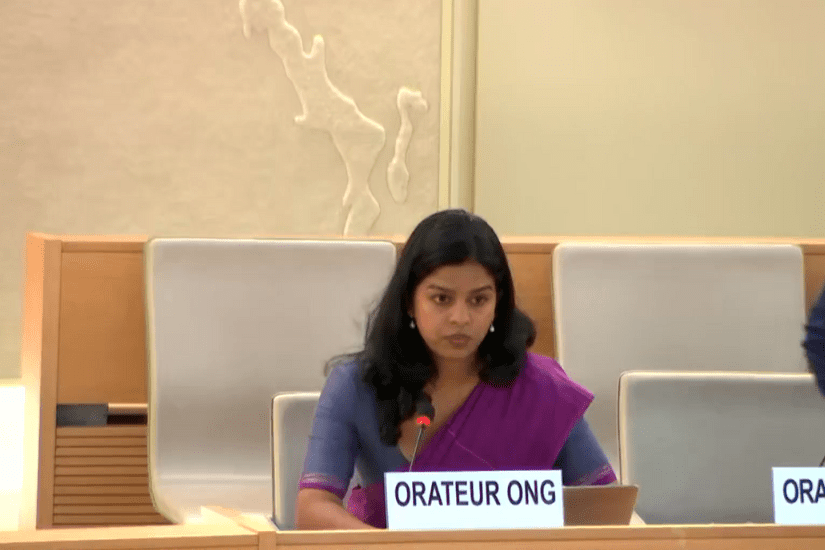
This oral statement was delivered in-person at the 58th Session of the Human Rights Council Interactive Dialogue with the Working Group on Discrimination against Women and Girls. Click here to watch the statement.

Interactive Dialogue with the Working Group on Discrimination against Women and Girls

Thank you, Mr. Vice President

I am making this statement on behalf of the Asian-Pacific Resource and Research Centre for Women, ARROW.

Unpaid and underpaid care and support work remains a major source of gendered inequality in our region. Women and girls disproportionately shoulder care-giving responsibilities, including productive and reproductive care burden, often without recognition or support. A care-responsive, rights-based approach to Sexual and Reproductive Health and Rights (SRHR) must go hand-in-hand with efforts to reduce and redistribute unpaid care work, especially in post-pandemic recovery and social protection systems.

We are also deeply alarmed by the accelerating global backlash against SRHR, including rollbacks on hard-won rights, attacks on comprehensive sexuality education, restrictions on abortion and contraception, and increasing criminalization of SRH services.

We echo the Working Group’s call for transformative change and urge the Member states to:

  1. Ensure the full realization and access of SRHR for women and girls in all their diversity, including access to safe abortion, comprehensive sexuality education (CSE), and quality SRH services, free from discrimination, coercion and violence within Universal Health Coverage packages.
  2. Remove all legal and policy barriers., and
  3. Integrate SRHR within care and support systems, ensuring public investment in SRH—such as contraception, maternal health, gender-affirming care, and services for survivors of gender-based violence—as core components of gender-responsive care economies.

Thank You! 

Vietnam

  • Centre for Creative Initiatives in Health and Population (CCIHP)

Sri Lanka

  • Bakamoono;
  • Women and Media Collective (WMC),
  • Youth Advocacy Network – Sri Lanka (YANSL)

Singapore

  • End Female Genital Cutting Singapore
  • Reproductive Rights (WGNRR)

Philippines

  • Democratic Socalist Women of the Philippines (DSWP);
  • Galang;
  • Healthcare Without Harm;
  • Institute for Climate and Sustainable Cities;
  • Likhaan Centre for Women’s Health;
  • Nisa UI Haqq Fi Bangsamoro;
  • PATH Foundation Inc. (PFPI);
  • Women’s Global Network for
    Reproductive Rights (WGNRR)

Pakistan

  • Aahung, Centre for Social Policy Development (CSPD);
  • Forum for Dignity Initiative (FDI);
  • Gravity Development Organization; Green Circle Organization;
  • Indus Resources Center (IRC);
  • Idara-e-Taleem-O-Aaghai (ITA);
  • Rehnuma – Family Planning Association Pakistan;
  • Shelter
    Participatory Organisation;
  • Shirkat Gah;
  • The Enlight Lab

Nepal

  • Beyond Beijing Committee (BBC);
  • Blind Youth Association of Nepal;
  • Blue Diamond Society (BDS);
  • Nepalese Youth for Climate Action (NYCA);
  • Visible Impact;
  • Women’s Rehabilitation Centre (WOREC);
  • YPEER Nepal;
  • YUWA

Myanmar

  • Colourful Girls Organization;
  • Green Lotus Myanmar

Maldives

  • Hope for Women;
  • Society for Health Education (SHE)

Malaysia

  • Federation of Reproductive Health Associations of Malaysia (FRHAM);
  • Joint Action Group for Gender Equality (JAG);
  • Justice for Sisters (JFS);
  • Reproductive Health Association of
    Kelantan (ReHAK);
  • Reproductive Rights Advocacy Alliance Malaysia (RRAAM);
  • Sisters in Islam (SIS)

Lao PDR

  • Lao Women’s Union;
  • The Faculty of Postgraduate Studies at the University of Health
    Sciences (UHS)

Indonesia

  • Aliansi Satu Visi (ASV);
  • CEDAW Working Group;
  • Hollaback! Jakarta;
  • Institut Kapal Perempuan;
  • Kalyanamitra;
  • Komnas Perempuan;
  • Remaja Independen Papua/Independent Youth
    Forum Papua (FRIP/IYFP);
  • Perkumpulan Keluarga Berencana Indonesia (PKBI);
  • Perkumpulan Lintas Feminis Jakarta;
  • Perkumpulan Pamflet Generasi;
  • RUTGERS Indonesia;
  • Sanggar SWARA;
  • Women on Web;
  • Yayasan Kesehatan Perempuan (YKP); 
  • YIFOS Indonesia

India

  • CommonHealth;
  • Love Matters India;
  • Pravah;
  • Rural Women’s Social Education Centre (RUWSEC);
  • SAHAYOG;
  • Sahaj;
  • Sahiyo;
  • SAMA – Resource Group for Women and Health;
  • WeSpeakOut;
  • The YP Foundation (TYPF)

Morocco

  • Association Marocaine de Planification Familiale (AMPF),
  • Morocco Family Planning Association
HRC59: Interactive Dialogue with the Working Group on Discrimination against Women and Girls

This oral statement was delivered in-person at the 58th Session of the Human Rights Council Interactive Dialogue with the Working Group on Discrimination against Women and Girls. Click here to watch the statement.

Interactive Dialogue with the Working Group on Discrimination against Women and Girls

Thank you, Mr. Vice President

I am making this statement on behalf of the Asian-Pacific Resource and Research Centre for Women, ARROW.

Unpaid and underpaid care and support work remains a major source of gendered inequality in our region. Women and girls disproportionately shoulder care-giving responsibilities, including productive and reproductive care burden, often without recognition or support. A care-responsive, rights-based approach to Sexual and Reproductive Health and Rights (SRHR) must go hand-in-hand with efforts to reduce and redistribute unpaid care work, especially in post-pandemic recovery and social protection systems.

We are also deeply alarmed by the accelerating global backlash against SRHR, including rollbacks on hard-won rights, attacks on comprehensive sexuality education, restrictions on abortion and contraception, and increasing criminalization of SRH services.

We echo the Working Group’s call for transformative change and urge the Member states to:

  1. Ensure the full realization and access of SRHR for women and girls in all their diversity, including access to safe abortion, comprehensive sexuality education (CSE), and quality SRH services, free from discrimination, coercion and violence within Universal Health Coverage packages.
  2. Remove all legal and policy barriers., and
  3. Integrate SRHR within care and support systems, ensuring public investment in SRH—such as contraception, maternal health, gender-affirming care, and services for survivors of gender-based violence—as core components of gender-responsive care economies.

Thank You! 

Maldives

  • Hope for Women
  • Society for Health Education (SHE)

Mongolia

  • MONFEMNET National Network