Architecting a Just Digital Future: Reflections from the APFSD 2026

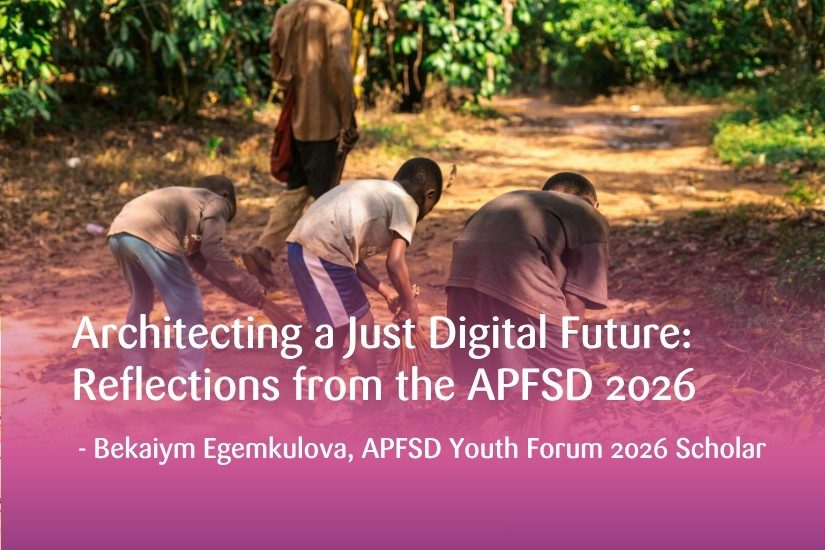
Three young people work together to clean a path. Text overlay: "Architecting a Just Digital Future: Reflections from the APFSD 2026 - Bekaiym Egemkulova, APFSD Youth Forum 2026 Scholar."

Bekaiym Egemkulova, APFSD Youth Forum 2026 Scholar

Growing up in the Kyrgyz Republic, I observed how weak infrastructure limits opportunities for many communities. In a landlocked and mountainous country, the gap between national development policies and everyday realities in rural areas often remains large. These gaps affect access to services, economic participation, and basic rights, particularly for marginalised groups.

Addressing these barriers requires rethinking how development systems are designed. This perspective shaped my academic and professional path. I moved from studying economic theory to working in technology as a Data Science and DevOps fellow. My aim has been to contribute to digital systems that reflect inclusion from the start.

As Central Asia undergoes rapid digital transformation, technical design decisions will influence whose voices, languages, and needs are represented. These ideas shaped my participation in the APFSD Youth Forum 2026. I also joined the 13th Asia-Pacific Forum on Sustainable Development (APFSD) in Bangkok, where I served as the sub-regional facilitator for Central Asia.

The Intersection of Infrastructure Design and Gender Equality

At the United Nations Conference Centre, my contribution focused on Sustainable Development Goal 9 on Industry, Innovation, and Infrastructure. Infrastructure policies are often framed as gender neutral. Yet research shows that design choices frequently overlook the realities of women’s lives.

Across Central Asia, women perform nearly four times more unpaid care work than men. Transport systems are often designed around a single daily commute between home and work. In practice, many women make multiple shorter trips related to caregiving responsibilities. When infrastructure planning ignores these patterns, women face greater time burdens and reduced access to formal employment. Safety also reflects historical design biases. Studies show that vehicle safety systems developed primarily around male body data increase the risk of injury for women in traffic accidents. These examples illustrate how infrastructure design affects gender equality in tangible ways.

Digital Transformation and the Risks of Algorithmic Bias

The digital transformation of economies raises similar concerns. During the Forum, I highlighted the growing “AI data gap” affecting Central Asia. Languages from the region account for less than 0.1 percent of datasets used to train many global artificial intelligence models. When languages and cultural contexts remain absent from training data, digital systems struggle to serve those populations accurately. This issue extends to financial and human resource (HR) technologies as well. Some algorithmic credit or HR hiring models penalise applicants whose work histories include career interruptions related to caregiving. Without careful oversight, automated systems risk reinforcing existing inequalities.

Participating in the APFSD reinforced an important lesson – effective policy requires both technical knowledge and an understanding of social realities. During the Forum, I had the opportunity to brief the President of United Nations Economic and Social Council (ECOSOC), His Excellency Mr. Lok Bahadur Thapa of Nepal. As representatives of two landlocked and mountainous countries, we discussed the importance of including youth perspectives in development planning. Young professionals across the region are ready to contribute not only as beneficiaries of development programs but also as policy participants and technical specialists. Our Regional Youth Call to Action from the APFSD Youth Forum 2026 reflects this perspective. The document recommends gender impact assessments for infrastructure projects, stronger investment in digital inclusion, and national Artificial Intelligence (AI) strategies that protect linguistic diversity. It also calls for youth advisory councils within technical ministries to support more inclusive policy development.

Architecting Equity into Future Systems

Conversations in Bangkok highlighted the need for greater representation of women and young professionals in technical fields. Engineers, data scientists, financial experts, and public administrators all play a role in shaping development outcomes. When diverse perspectives participate in these sectors, public systems reflect a wider range of social realities. As preparations continue toward the 2027 SDG Summit, the challenge for governments and institutions in Asia and the Pacific is clear – infrastructure and digital technologies must support inclusive development across diverse societies. Building systems with equity in mind from the start will help ensure that the benefits of technological progress reach all communities.

Vietnam

  • Centre for Creative Initiatives in Health and Population (CCIHP)

Sri Lanka

  • Bakamoono;
  • Women and Media Collective (WMC),
  • Youth Advocacy Network – Sri Lanka (YANSL)

Singapore

  • End Female Genital Cutting Singapore
  • Reproductive Rights (WGNRR)

Philippines

  • Democratic Socalist Women of the Philippines (DSWP);
  • Galang;
  • Healthcare Without Harm;
  • Institute for Climate and Sustainable Cities;
  • Likhaan Centre for Women’s Health;
  • Nisa UI Haqq Fi Bangsamoro;
  • PATH Foundation Inc. (PFPI);
  • Women’s Global Network for
    Reproductive Rights (WGNRR)

Pakistan

  • Aahung, Centre for Social Policy Development (CSPD);
  • Forum for Dignity Initiative (FDI);
  • Gravity Development Organization; Green Circle Organization;
  • Indus Resources Center (IRC);
  • Idara-e-Taleem-O-Aaghai (ITA);
  • Rehnuma – Family Planning Association Pakistan;
  • Shelter
    Participatory Organisation;
  • Shirkat Gah;
  • The Enlight Lab

Nepal

  • Beyond Beijing Committee (BBC);
  • Blind Youth Association of Nepal;
  • Blue Diamond Society (BDS);
  • Nepalese Youth for Climate Action (NYCA);
  • Visible Impact;
  • Women’s Rehabilitation Centre (WOREC);
  • YPEER Nepal;
  • YUWA

Myanmar

  • Colourful Girls Organization;
  • Green Lotus Myanmar

Maldives

  • Hope for Women;
  • Society for Health Education (SHE)

Malaysia

  • Federation of Reproductive Health Associations of Malaysia (FRHAM);
  • Joint Action Group for Gender Equality (JAG);
  • Justice for Sisters (JFS);
  • Reproductive Health Association of
    Kelantan (ReHAK);
  • Reproductive Rights Advocacy Alliance Malaysia (RRAAM);
  • Sisters in Islam (SIS)

Lao PDR

  • Lao Women’s Union;
  • The Faculty of Postgraduate Studies at the University of Health
    Sciences (UHS)

Indonesia

  • Aliansi Satu Visi (ASV);
  • CEDAW Working Group;
  • Hollaback! Jakarta;
  • Institut Kapal Perempuan;
  • Kalyanamitra;
  • Komnas Perempuan;
  • Remaja Independen Papua/Independent Youth
    Forum Papua (FRIP/IYFP);
  • Perkumpulan Keluarga Berencana Indonesia (PKBI);
  • Perkumpulan Lintas Feminis Jakarta;
  • Perkumpulan Pamflet Generasi;
  • RUTGERS Indonesia;
  • Sanggar SWARA;
  • Women on Web;
  • Yayasan Kesehatan Perempuan (YKP); 
  • YIFOS Indonesia

India

  • CommonHealth;
  • Love Matters India;
  • Pravah;
  • Rural Women’s Social Education Centre (RUWSEC);
  • SAHAYOG;
  • Sahaj;
  • Sahiyo;
  • SAMA – Resource Group for Women and Health;
  • WeSpeakOut;
  • The YP Foundation (TYPF)

Morocco

  • Association Marocaine de Planification Familiale (AMPF),
  • Morocco Family Planning Association
Architecting a Just Digital Future: Reflections from the APFSD 2026

Bekaiym Egemkulova, APFSD Youth Forum 2026 Scholar

Growing up in the Kyrgyz Republic, I observed how weak infrastructure limits opportunities for many communities. In a landlocked and mountainous country, the gap between national development policies and everyday realities in rural areas often remains large. These gaps affect access to services, economic participation, and basic rights, particularly for marginalised groups.

Addressing these barriers requires rethinking how development systems are designed. This perspective shaped my academic and professional path. I moved from studying economic theory to working in technology as a Data Science and DevOps fellow. My aim has been to contribute to digital systems that reflect inclusion from the start.

As Central Asia undergoes rapid digital transformation, technical design decisions will influence whose voices, languages, and needs are represented. These ideas shaped my participation in the APFSD Youth Forum 2026. I also joined the 13th Asia-Pacific Forum on Sustainable Development (APFSD) in Bangkok, where I served as the sub-regional facilitator for Central Asia.

The Intersection of Infrastructure Design and Gender Equality

At the United Nations Conference Centre, my contribution focused on Sustainable Development Goal 9 on Industry, Innovation, and Infrastructure. Infrastructure policies are often framed as gender neutral. Yet research shows that design choices frequently overlook the realities of women’s lives.

Across Central Asia, women perform nearly four times more unpaid care work than men. Transport systems are often designed around a single daily commute between home and work. In practice, many women make multiple shorter trips related to caregiving responsibilities. When infrastructure planning ignores these patterns, women face greater time burdens and reduced access to formal employment. Safety also reflects historical design biases. Studies show that vehicle safety systems developed primarily around male body data increase the risk of injury for women in traffic accidents. These examples illustrate how infrastructure design affects gender equality in tangible ways.

Digital Transformation and the Risks of Algorithmic Bias

The digital transformation of economies raises similar concerns. During the Forum, I highlighted the growing “AI data gap” affecting Central Asia. Languages from the region account for less than 0.1 percent of datasets used to train many global artificial intelligence models. When languages and cultural contexts remain absent from training data, digital systems struggle to serve those populations accurately. This issue extends to financial and human resource (HR) technologies as well. Some algorithmic credit or HR hiring models penalise applicants whose work histories include career interruptions related to caregiving. Without careful oversight, automated systems risk reinforcing existing inequalities.

Participating in the APFSD reinforced an important lesson – effective policy requires both technical knowledge and an understanding of social realities. During the Forum, I had the opportunity to brief the President of United Nations Economic and Social Council (ECOSOC), His Excellency Mr. Lok Bahadur Thapa of Nepal. As representatives of two landlocked and mountainous countries, we discussed the importance of including youth perspectives in development planning. Young professionals across the region are ready to contribute not only as beneficiaries of development programs but also as policy participants and technical specialists. Our Regional Youth Call to Action from the APFSD Youth Forum 2026 reflects this perspective. The document recommends gender impact assessments for infrastructure projects, stronger investment in digital inclusion, and national Artificial Intelligence (AI) strategies that protect linguistic diversity. It also calls for youth advisory councils within technical ministries to support more inclusive policy development.

Architecting Equity into Future Systems

Conversations in Bangkok highlighted the need for greater representation of women and young professionals in technical fields. Engineers, data scientists, financial experts, and public administrators all play a role in shaping development outcomes. When diverse perspectives participate in these sectors, public systems reflect a wider range of social realities. As preparations continue toward the 2027 SDG Summit, the challenge for governments and institutions in Asia and the Pacific is clear – infrastructure and digital technologies must support inclusive development across diverse societies. Building systems with equity in mind from the start will help ensure that the benefits of technological progress reach all communities.

Maldives

  • Hope for Women
  • Society for Health Education (SHE)

Mongolia

  • MONFEMNET National Network