
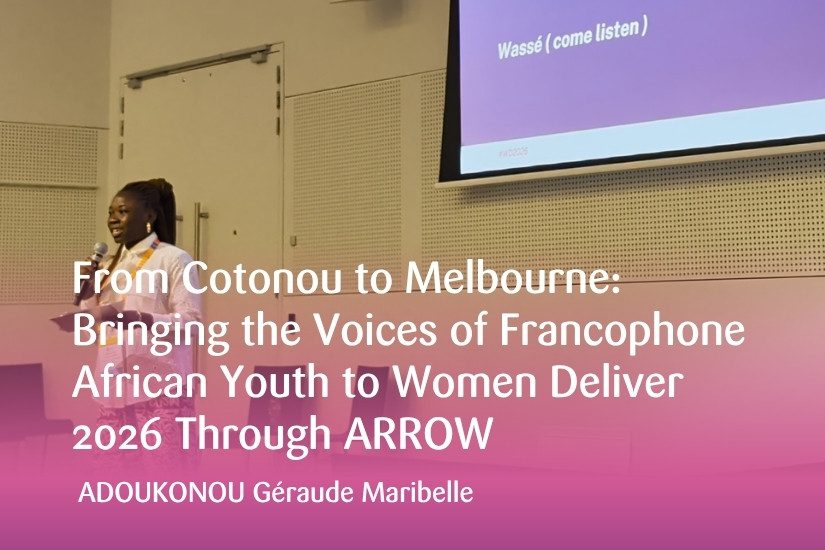
Living History in Narrm
By ADOUKONOU Géraude Maribelle
From 27-30 April 2026, I had the privilege of attending the Women Deliver 2026 Conference (WD2026) in Melbourne (Narrm), on the unceded lands of the Wurundjeri Woi Wurrung people. It was a historic moment: for the very first time, the world’s largest gathering for gender equality was hosted in the Pacific region. The energy of more than 6,000 activists, policymakers, and youth leaders from 180 countries was simply electric. I left deeply transformed, carrying with me a renewed vision of our collective struggle.
This historic opportunity would not have been possible without the unwavering support and trust of the Asian-Pacific Resource and Research Centre for Women (ARROW) and COJAS-Benin. By sponsoring our participation, ARROW and COJAS demonstrated that international solidarity knows no borders and that the leadership of young people from Francophone Africa and the Global South deserves to be placed at the center of global decision-making.
What If Talking About Access to Safe Abortion Was Already a Political Act?
On Tuesday, April 28, 2026, from 2:00 PM to 3:30 PM, in Room 204, the official side event of the Safe Abortion Advocacy Initiative – A Global Engagement from the South (SAIGE) took place under the title: “Advocating for Power: Transforming Narratives for a Transformed Abortion Landscape.”
In this high-level space dedicated to storytelling and advocacy strategies, I had the honor of presenting and defending the Wassé Project.
Faced with the alarming realities in Benin where ‘three out of four abortions are performed under unsafe conditions’ according to the ODAS Center, and where approximately 15% of maternal deaths are linked to unsafe abortion according to the Ministry of Health. I highlighted an essential truth: even the most progressive law is not enough when fear, stigma, and shame continue to drive women into secrecy and unsafe practices.
It is within this context that Wassé was born as part of our collective feminist response: a digital brigade and a multilingual podcast series bringing together lawyers, medical professionals, and psychologists. The objective is clear: to occupy digital spaces with reliable information, challenge harmful taboos, and place dignity, safety, and women’s rights back at the center of public discourse.
Beyond presenting the project, this moment marked an important milestone: the official introduction of Wassé within an international advocacy space where narratives shape social and political change. The project captured the attention of the jury and was selected among the six award-winning initiatives, confirming the relevance and innovation of solutions led by young people from the Global South in global conversations on women’s rights and health.
But beyond the project itself, the real challenge was personal.
This pitch represented a moment of tremendous intensity for me. Standing on stage before an international audience of activists, decision-makers, and experts required much more than mastering the content. It meant carrying a voice, embodying a message, and accepting the responsibility of telling stories and realities that are too often overlooked.
The days leading up to the presentation were filled with preparation, rehearsals, and constant pressure to make every word count, every piece of data meaningful, and every idea powerful enough to convey the urgency of the situation.
By the time I took the stage, I was no longer simply defending a project. I was speaking for real stories, real lives, and critical issues of health, dignity, and social justice.
This experience transformed the way I approach advocacy. It reminded me that speaking out is a political act, that courage is built in the moment, and that international spaces must be occupied with conviction especially when representing communities whose voices are too often marginalized.
For me, this will remain one of the most formative moments of the conference, both professionally and personally.
Women Deliver 2026 Conference Was More Than What Happened on Stage
While Wassé’s pitch was undoubtedly one of the most memorable moments of my experience at Women Deliver 2026 Conference, WD2026 began long before the official opening ceremony.
On 26 and 27 April, I had the opportunity to participate in two pre-conferences that enriched my reflections and strengthened my commitment to human rights and gender justice.
The first, titled “United for Action: Global Solidarity to End FGM/C,” brought together activists, survivors, civil society organisations, and institutional partners committed to ending Female Genital Mutilation/Cutting (FGM/C).
This gathering served as a powerful reminder of a reality that continues to affect millions of girls and women around the world. Behind the statistics are lives disrupted, childhoods stolen, lasting physical and psychological trauma, serious health complications sometimes irreversible and, in some cases, preventable deaths.
But beyond the numbers are our sisters, daughters, friends, and communities. People whose fundamental rights continue to be violated in the name of deeply rooted social norms. This pre-conference underscored the urgency of strengthening collective action, transnational solidarity, and community-based strategies to bring this harmful practice to an end once and for all.
The second pre-conference, “Queers Deliver: Building the Future of Inclusive Global Feminist Gatherings,” gave me the opportunity to engage in essential discussions on inclusion, diversity, and the place of LGBTQIA+ people within global feminist spaces.
The conversations highlighted the growing challenges faced by many communities around the world. As anti-rights movements gain momentum, hard-won achievements come under threat, and restrictive legislation is introduced in several countries particularly across Africa the need to build inclusive and united movements has never been more urgent.
This gathering also reaffirmed that human rights are not divisible. Defending the rights of women, girls, and marginalized communities requires collective resistance against all forms of exclusion, discrimination, and violence.
These two days of pre-conferences set the tone for Women Deliver 2026. They reminded me that our struggles are deeply interconnected. Whether addressing female genital mutilation, sexual and reproductive health and rights, LGBTQIA+ inclusion, or resistance to anti-rights movements, we are ultimately confronting the same challenge: building a world where every person can live freely, with dignity, and in safety.
More Than Connections: A Global Community in Motion for Human Rights, Gender Equality, and Inclusion
From April 28 to 30, Women Deliver 2026 truly came into its own. With more than 6,000 participants from nearly 180 countries, the conference served as a vibrant space for dialogue, learning, and collective action.
Networking played a central role throughout the event. People from Africa, Asia, the Pacific, Europe, North America, Latin America, and the Caribbean came together around a shared ambition: advancing human rights, gender equality, and social justice.
Through countless conversations, we built connections, shared experiences, challenged perspectives, and discovered realities that, while different in context, were often shaped by the same underlying challenges. These exchanges reinforced an essential truth: our struggles may be local in how they manifest, but they are deeply global in their implications.
One of the moments that particularly stood out to me was the opportunity to collaborate with Nikita Kathayat from Nepal during the session titled “Equitable Access for Youth to Sexual, Reproductive, and Mental Health: Rethinking Funding Towards Integrated Models.” The experience was both enriching and inspiring. Discussions focused on the challenges young people face in accessing quality sexual, reproductive, and mental health services, as well as the need to rethink funding mechanisms in order to provide more integrated and responsive solutions.
I also had the privilege of moderating this discussion alongside Nikita Kathayat from Nepal and Ibula Melchie Bwanga from the Democratic Republic of the Congo, with the support and guidance of Shiwa from ARROW. This experience demonstrated that young people are no longer simply invited to participate in conversations that affect them, instead they are helping to design them, facilitate them, and propose concrete solutions. Our expertise, grounded in lived experience, is an indispensable resource for building policies and programs that are truly effective.
For me, one of the most powerful lessons I take away from Women Deliver 2026 Conference is that young people no longer need permission to occupy decision-making spaces. They are creating those spaces, transforming them, and bringing forward tangible solutions. Whether in mental health, sexual and reproductive rights, climate justice, gender equality, or civic participation, young people continue to demonstrate their ability to imagine, build, and implement meaningful responses to the challenges of our time.
I am leaving Narrm with far more than business cards or new contacts. I leave with a global community, promising collaborations, invaluable lessons, and the certainty that change happens when people from diverse backgrounds come together around a shared vision of justice, dignity, and equality.
From Cotonou to Melbourne, this experience has strengthened my conviction that the voices of young people from Francophone Africa belong in global spaces. Not only to participate in the conversations, but also to influence them, enrich them, and help shape the solutions of tomorrow.
Do not Miss:
The Moment I Realised Youth Voices Belong in Global Rooms – Women Deliver 2026 Conference