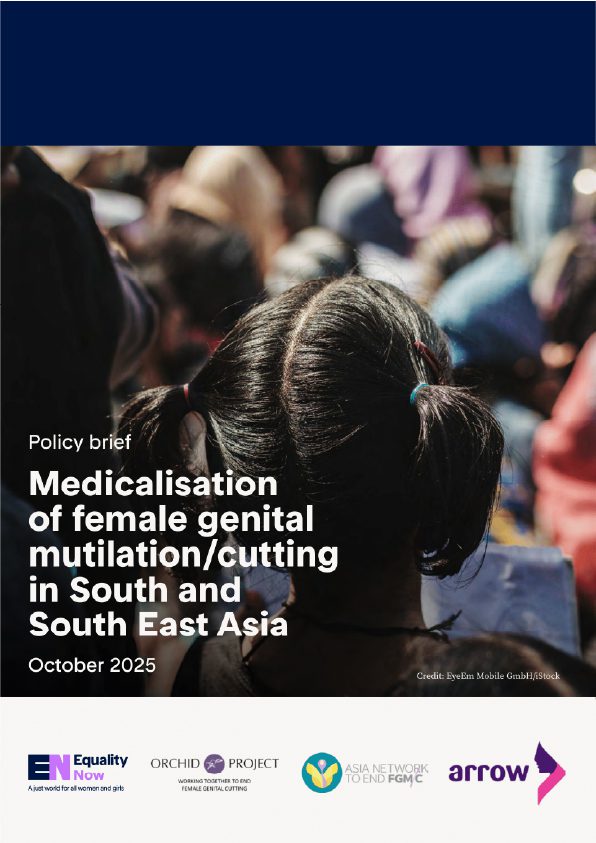
Medicalisation of Female Genital Mutilation/Cutting (FGM/C) is an increasing yet under-recognised trend across South and South-East Asia. In many countries, the practice is no longer confined to traditional settings – it is now being carried out by healthcare professionals, including doctors, nurses, and midwives, in clinical or semi-clinical environments.
This newly released regional policy brief – developed jointly by Equality Now, ARROW, Orchid Project, and the Asia Network to End FGM/C – present the first multi-country analysis focused specifically on medicalised FGM/C in Asia. The report explores how the involvement of health workers is contributing to the continued normalisation of this harmful practice, often under the false perception of safety or hygiene.
Drawing on evidence, legal analysis, and country-level insights, the brief offers clear recommendations to governments, medical associations, UN agencies, and civil society to address this growing issue and protect the rights and wellbeing of women and girls.
Who should read this?
This brief is intended for a wide range of stakeholders working to end gender-based violence and promote rights-based healthcare, including:
Download the full policy brief here.