Introduction to the ARROW Resource Kit
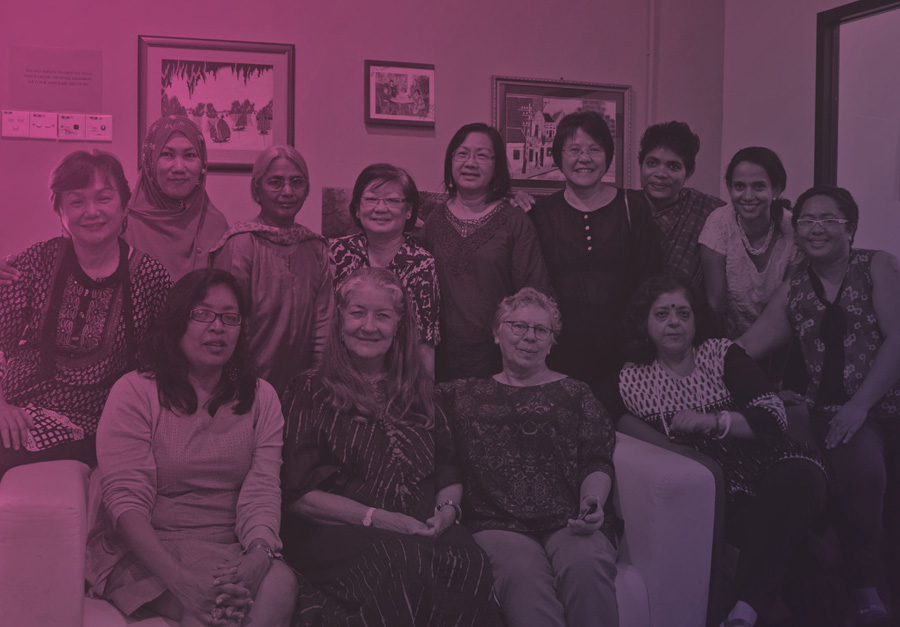
ARK Steering Committee members meeting with Malaysian colleagues and activists to review the ARK in August 2013.
The ARROW Resource Kit on Leadership and Management (ARK) is a compilation of some of ARROW's most effective governance and management tools and resources that have been developed by the organisation over the past 20 years. The Board of Directors (BOD) of ARROW first discussed the idea of this publication nearly a decade ago, and although enthusiasm for the project never waned, it took a significant amount of energy, resources and time to finally get the project off the ground. We see ARK as part of ARROW's long-term objective of strengthening women's NGOs and the women's movement at large.
History of the resources of ARROW
All of what we offer in this book are tried and tested resources that have been developed by us, with generous contributions from our BOD, Programme Advisory Committee (PAC) members, partners and consultants. ARROW started out with core policies and procedures in place, and continued to build its documentation of policies and practices over the years. In a BOD meeting in 2007, it was decided that all the key documents that outline policies, guidelines and procedures, namely the Work Conditions and Entitlements, Management Manual, Human Resource Development, and Administration Procedures should be pulled together into one large document.
This new document, known as the ARROW Management and Administrative Policies and Procedures Manual (MAPP) was developed over a period of a year, and finalised in April 2008.
The MAPP is seen as a working document that is reviewed and revisited on a fairly regular basis. There are still new policies that are being developed even as this publication is completed, and we are aware of a number of areas for further policy development. We commit to this process, because we believe that all organisations need clear policies, procedures and practices to carry out their work of social change effectively. A transformed society begins with a transformed organisation.
What is the purpose of the ARK?
For at least a decade now, ARROW has received information requests from other organisations, particularly women's activist organisations and other NGOs from the Asia-Pacific region and beyond, to share some of our lessons, tools and processes that have supported our growth. Our partners and colleagues in the movement wanted to know what led ARROW to being an effective and successful organisation, able to maintain excellent staff and Board, do cuttingedge work and also raise funds needed to expand our programmes and reach.
Many have expressed a desire to learn from ARROW's model and to cross-fertilise ideas and tools that might strengthen their own organisations. Over the years, we have responded to requests for Terms of References, selection criteria, meeting formats and evaluation criteria for various bodies and positions within the organisation, staff competency models, recruitment, appraisal and rewards systems, Conflict of Interest (COI) policy, Code of Ethics (COE), financial and budget management systems, and so forth.
Who is the intended audience of the ARK?
Our foremost audience includes our partners and colleagues in the women's and sexual and reproductive health and rights movement. We hope that by documenting and sharing of our organisational practices, we can support and encourage other organisations interested in enhancing their own.
We also see this publication as a resource for leaders and managers working in women's movement or movement-based organisations. We believe that an awareness of the need for congruence between values and organisational practice and the capacity to enhance this congruence is a key strength of effective organisations.
This publication may also be useful to scholars and organisational development practitioners who are interested in ARROW's practices as an example of one women's NGO journey towards more effective organisational governance and management.
Some of our colleagues in the women's movement have expressed how they have benefitted from ARROW's resources. Here is one such sentiment:
AWAM [All Women's Action Society, Malaysia] has benefitted from ARROW's resources because we've been consulting Sham since she left ARROW, and she's introduced a number of tools that were from ARROW. We have been discussing in AWAM how to better focus our strategy and plans and she introduced us to the planning, management and evaluation (PME) cycle. We've also tried to implement ARROW's staff meeting process, and now start our meetings with expressing what was good in the past week, what could be better as well, who we appreciate and what challenge we faced. This exercise was effective to build rapport and address conflicts. I think that the ARROW Resource Kit will provide useful doable activities which can really help the organisation.
— Betty Yeoh, Senior Programme Manager, AWAM
ARROW turned 20 years old in 2013. In these 20 years, ARROW has grown from a bold vision of two feminist activists for a regional research, information and documentation centre on women's health to influence change in health policies and programmes to a reputable respected regional organisation with capacity to effectively advocate women's sexual and reproductive health and rights (SRHR) across the Asia-Pacific and globally. Recognising the importance of sharing what we have gained and learned from others through our own organisational journey, we see our 20th year anniversary as an opportunity for us to share with our partners and colleagues in the movement the best of what we have learned through our experience so far.
We believe that ARROW is one of relatively few women's organisations in the region that have devoted much time into thinking through organisational policies, processes and practices. We have always believed in investing time, thought and resources into developing organisational processes and practices that are fair, equitable, clear, transparent and accountable. We see genuine investment in the organisation's core systems of governance, accountability, efficiency and sustainability in the medium- and long-term as essential for building and sustaining effective advocacy organisations.
ARROW deliberately chose a hierarchical structure of organisation, even though we were founded by feminists, because we believed that we could better ensure accountability and efficiency towards responsibilities and programme implementation if our decision-making processes were unambiguous, transparent and functional. We pay attention to our practices and try to keep checking them against our core values, which we believe are essentially feminist. We have also created much space for reflexivity in our organisational life, so that we do not forget our core values, and check against them on a regular basis.
As such, we believe that our processes and practices are imbued with our values, and believe that this makes the difference. One might review this publication and say that there is little that distinguishes us from a mainstream organisation, but we believe that our investment in “how” we do things makes us different. So we're feminist, not so much as a declaration of ideology, but rather in “how” we do what we do.
ARROW is a regional women's non-profit organisation based in Kuala Lumpur, Malaysia. Since our establishment in 1993, ARROW has been working on advancing women's SRHR, and empowering women through information and knowledge, engagement, advocacy and mobilisation. We work in partnership with national level and other Global South regional partners to generate evidence for advocacy, including monitoring international agreements related to women's health and rights. We also work with them to form strong advocacy platforms that seek to influence national and regional policy agendas on women's health, sexuality and rights, and to hold governments and international agencies accountable for commitments to ensuring women's SRHR. While we are based and operating primarily in the Asia-Pacific region, we also do global advocacy and information and communications work, which has significance and impact.
Our core values are the foundation of our practice. We see them as fundamental in all our organisational processes, from simple logistical arrangements to strategic decision-making and planning processes. Although they were only codified a decade after we began as an organisation, we believe that they have provided an inner compass to our governance, management and leadership practices since our founding.
ARROW's core values are:
- Commitment to quality: Striving to produce high quality in everything we do (both in terms of outputs and processes) as high quality is critical to effectiveness.
- Fairness: Respecting peoples' equal right to participate and to be treated equally well, and to develop as human beings regardless of their differences in position, education, religious beliefs, personality, body size, class, race, sexual preference, etc. (this value is an important component of equity), and to remain secular and non-sectarian.
- Social justice: Striving to recognise and address the various power hierarchies of class, gender, race, sexuality etc., and being aware of power relations and the ways in which patriarchy and other social and economic systems manifests themselves, and the importance of the origins of the feminist movement in subverting patriarchy.
- Generosity: Sharing information, resources and time wholeheartedly and responsively, rather than hoarding or clinging, believing that ARROW will not be depleted by sharing.
- Honesty: Being straightforward and to tell the truth, but to ensure appropriateness of venue, delivery and methodology, and to be aware of and listen to all perspectives.
- Innovation or creativity: Constantly doing new things or trying new processes in order to be more effective.
- Participation: Consulting and involving staff, the BOD, PAC and partners in strategic and operational decisions and sharing information in the belief that more informed and active contributions will lead to organisational effectiveness and quality as well as work satisfaction and commitment to ARROW.
- Transparency: Being open and honest about information and decisions as critical to achieving real participation and fairness.
Each of these values have been further elaborated in our COE with clear definitions of what each value would translate to in terms of behaviours and actions in the context of ARROW's work and activities.
ARROW strongly believes in the principles of generosity, transparency and participation. These are foundational to the kind of work we have chosen to do, and the way we have organised both internally and in terms of our programmes and partnerships. ARROW started out with a regional information and documentation resource centre because we believed that there was a wealth of information in existence that was not reaching many women's health and rights advocates who needed it the most. We continue to run our programme with the same ethos, believing that our best work happens when we are able to put strategic, timely, well-researched information in the hands of SRHR advocates and policy decision-makers.
This publication follows in the same spirit. By sharing freely and openly of what could be defined the best of our organisational practices and tools with our partners and colleagues, we are keeping aligned with our core values of generosity, transparency and participation. Some of the resources we offer are fairly simple, but they have worked for us, and we hope that they can also work for others. We see this publication as a contribution towards our collective task of building stronger, more viable and effective organisations and social movements.
The ARROW Resource Kit on Leadership and Management has been divided into four chapters. Each chapter begins with an introduction that explains the rationale of the theme of the chapter, and why it is being shared. Each chapter, except Chapter 1, contains a number of topics under which we cluster our resources. Each topic is introduced and linked to the main theme of the chapter, and as much as possible, we provide our values that underpin this.
Under each topic, a number of resources are included, either in the form of a process or a tool. Each process and tool is introduced, and we explain:
- How and why each resource was developed;
- What are the key components or steps of that resource;
- How the resource can be used;
- Challenges faced using the resource; and,
- Tips from lessons learned.
In this manner, we hope to make each resource more accessible to our reader. Where the tool or process being shared is longer than 2–3 pages, it is provided in full as an annexe.
Stories are also provided to illustrate the use and effectiveness of the processes and tools and to describe the experiences of the people of ARROW.
Chapter 1 provides a brief history of the founding of ARROW as an organisation, the context of the women's movement that ARROW was responding to when it started, and a summary of our key contributions to promoting women's SRHR in the past twenty years. We also highlight specific events in the history of ARROW in terms of organisational growth and development.
Chapter 2 looks at the theme of power and participation, and clusters our resources under five topics: i) Ethical Frameworks for Organisational Practice; ii) Board Governance; iii) Executive Director (ED), Management Team (MT) and staff accountability; iv) PAC; and, v) Valuing staff. This chapter shares ARROW's governance and management structures, and how our accountability processes are structured so power is mediated and participation is maximised.
Chapter 3 looks at the theme of partnership, and clusters our resources under three topics: i) Selection of partners; ii) Sharing power in partnerships; and iii) Capacity building: Nurturing and sustaining partnerships. While our experiences in partnerships are very diverse and rich, we have focused on a few key topics that illustrate the way we have succeeded in building our partnerships over the years.
Chapter 4 focuses on the broad theme of building for the future, and clusters our resources under four topics: i) Strategic planning, monitoring and evaluation; ii) Ensuring quality and relevance of programmes; iii) Financial sustainability; and, iv) Investing in people. In this chapter, we present what we have identified as the core components of ARROW's organisational sustainability strategies and the key resources under each component that we have found useful in building a sustainable organisation.