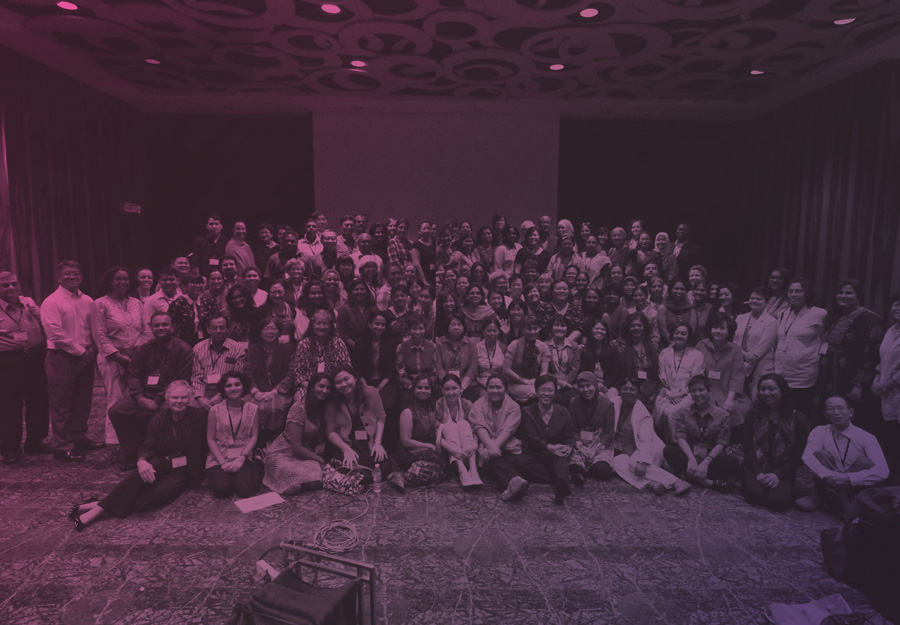
ARROW, partners and key stakeholders at the regional meeting, Beyond ICPD and the MDGs: NGOs Strategising for Sexual and Reproductive Health and Rights in the Asia-Pacific Region, May 2012, Kuala Lumpur, Malaysia.
ARROW believes that its mission and the long-term objectives of its Strategic Plan will be best achieved in partnership with other like-minded women's NGOs at national, regional and global levels. What began as an effective programme strategy has become an integral way of working—today all of ARROW's programme and projects have a partnership component. ARROW's partners are called upon for their advice and strategic input and all of what ARROW does is rooted in the realities of our partners' country context and realities.
ARROW defines partnership as working in collaboration with individuals and organisations towards achieving agreed upon goals. Partners are organisations that ARROW invites into an agreement to work collaboratively on specific tasks, projects or programmes, with a clear understanding of how and what we will achieve together. While ARROW has evolved different kinds of working relationships with its partners,
ARROW maintains a core set of beliefs that holds true in every partnership. We believe that partnerships:
- Are equal relationships in which different roles are played at different levels and yet equally valued;
- Provide very good collective learning opportunities both on programme and organisational development matters and are mutually beneficial for ARROW and its partners;
- Improve and deepen over time in terms of trust, equality, commitment, effectiveness and friendship, so we prefer long-term relationships;
- Need conscious nurturing and capacity building in order to develop full potentials for effectiveness;
- Usually develops into solid long-term friendships with individuals and organisations which are very beneficial;
- Provide opportunities for very valuable perspectives and strategic inputs for developing ARROWs programme and organisation; and,
- Are vital for feminist and NGO movement building, social change and collective action.
These core beliefs combine with ARROW's core values, as stated in our Code of Ethics, to lay the foundation of our working relationships in each partnership.
Following are some of the key ways in which we express our core values in our dealing with partners:
- Fairness: We respect our partners' equal right to participate and to be treated equally well in all aspects of programme planning, monitoring and implementation. We seek to provide equal opportunities for each partner to develop both at an individual and organisational level.
- Generosity: We share information, resources and time wholeheartedly and responsively, rather than hoarding or clinging, believing that ARROW will grow in abundance, not be depleted by sharing with others.
- Social justice: We put at the forefront women's SRHR in all aspects of advocacy work that we engage in with our partners.
- Participation: We consult and involve partners in key strategic and operational decisions and sharing information in the belief that more informed and active contributions will lead to programme effectiveness and quality, as well as work satisfaction and commitment to ARROW.
- HONESTY: ARROW seeks to be straightforward with our partners and speak the truth in all instances, and to stay aware of, and listen to, all perspectives.
- Transparency: We share all financial matters in relation to project funding with partners, and involve them, where possible, in all strategic decisions related to the project.
- Accountability: We involve partners in decisionmaking, as well as monitoring and evaluation of our initiatives, including documenting and actively reporting on all that is accomplished together and sharing best practices and results. This is to ensure that we are jointly responsible for fulfilling our goals and addressing the needs of our constituencies.
Given that partners and partnerships play a defining role in the work of ARROW, it is also an area that ARROW has developed some useful processes and tools that we would like to share. There are three topics we have identified that are critical to ARROW's partnership strategy:
- Selecting partners;
- Sharing power with partners; and
- Developing and strengthening capacity of partners
Each of these topics point to a conscious choice making that happens in ARROW's partnerships. As with all human relationships, partnerships need a good measure of the intangibles—warmth, caring, flexibility, good will, mutuality and respect.
What ARROW has understood through experience, however, is that the best partnerships are ones that are built upon clear agreements, open discussion of needs and expectations, a dedication to democratic and transparent processes however time consuming, and a long-term commitment to the partnership. Under each of the three topics chosen for discussion, we will share the ways in which ARROW laid the foundation for all these elements of good partnerships.
TOPIC 6: Selection of partners
Introduction
Partners play an integral role in ARROW's achievement of its mission and the implementation of our Strategic Plan. As such, the first critical step in developing a partnership is the selection of the right partners. This step is important to the overall partnership because it provides a base of commonality from which clear agreements can be reached.
ARROW understood the importance of developing a simple, but clear list of criteria for the selection of partners to ensure a level of consistency and effectiveness in the partnership. Below is the list of criteria ARROW uses as general guideline when considering who to work with:
- Commitment to ICPD and Beijing implementation of women's health and rights, particularly SRHR;
- Commitment to achieve gender equality and operate as a gender-sensitive organisation;
- Involvement in policy advocacy backed by research and monitoring (or planning to be) nationally and/or at a state level;
- An organisation that is regarded as a credible and professional NGO respected by government and NGOs;
- Ability to work well with other NGOs, and preferably playing a leading role nationally or at state level;
- NGOs which work with poor communities directly, or who support the work of NGOs/CBOs who do so;
- Organisations, which operate an information resource centre or have an information programme on women's health and rights;
- NGOs that are led by women preferably or have a strong gender equality perspective.
- An established NGO of at least three years which is able to communicate and manage finance and administration aspects reliably and professionally.
This list of criteria remains as a set of essentials that ARROW looks for in its partners even as our assessment tools for checking other organisational capacities and priorities have become quite extensive. Under this topic, we share one process—Process 6: Assessment and selection of partners, a process of assessment and selection of country partners for collaborative work on research and advocacy for the post-ICPD monitoring process. We hope to provide the reader with an understanding of the detail involved in the partner selection process.
PROCESS 6: Assessment and selection of partners
Introduction
This process1 describes the steps involved in the assessment and selection of partners in a particular ARROW project, though the steps are applied now in all partners' selection. The step-by-step framework was first written up for partner selection for the Women's Health Rights Advocacy Partnership South Asia project (WHRAP South Asia). An assessment tool was further developed as part of the Knowledge, Information with and between Counterparts (KIC) project. This project was aimed at raising the standards of ARROW's work around monitoring by doing a full assessment of ARROW's past research and monitoring methodologies, as well as partners capacities to engage in this collaborative research and advocacy project. What resulted was a practical self-assessment tool for SRHR NGOs by ARROW's consultant to help assess partner capacities, strengths and challenges.2 Although the tool itself is not included in this publication, the following are the key steps in the process of partner assessment and selection:
- Develop a partnership selection framework: Partner selection has to be framed by the overall objectives of the project at hand, as well as a clear understanding of the national context, economic, social and political broadly, and the SRHR context in particular.
- Conduct a background desk research and mapping: An initial mapping of the political and SRHR contexts is first conducted by ARROW staff. When exploring a new country context, a consultant is commissioned to do a more in-depth study of the new countries, both context analysis and mapping of relevant organisations, in consultation with partners and other organisations.
- Conduct a field visit, where possible: ARROW staff personally visit a particular country to become familiar with the context, as well as key SRHR stakeholders. This includes government officials, UN agencies, SRHR NGOs, other social movement organisations, and key individuals working in that context. It is a valuable step as it provides ARROW with a fuller picture of potential partners and the contexts in which ARROW seeks to make an impact.
- Conduct a general consultation with new potential partners: Hold dialogues with organisations identified as potential partners. It is useful to have an interactive dialogue with potential partners in a larger consultation that aims to understand country contexts and challenges of women's and SRHR NGOs, while also getting to know the potential partner organisations.
- Do an analysis of the potential partner organisation's capacities: ARROW utilises its existing criteria and the SRHR Organisational Capacity Assessment Tool. ARROW also uses another tool known as Mango's Health Check, an open source financial assessment tool that examines the financial processes and systems that are in place in these organisations. In the WHRAP-South Asia initiative, a tool known as the Advocacy Capacity Assessment Tool (ACAT) developed by Alliance for Justice is also now being used. This measures the advocacy capacity of the partners. Results are used to gauge capacity building needs.
- Make a selection in consultation with existing partners and ARROW's Board: In most of our partnership projects, a Steering Committee is formed, and this body makes decisions based on recommendations from ARROW. The new partner organisation would also have to fulfil ARROW partnership criteria as well as the project criteria. The Board also gives their opinion on the selection of new partners.
TOPIC 7: Sharing power in partnerships
Introduction
To be effective as a regional organisation, ARROW understands very clearly that it needs to work in solidarity with national SRHR organisations in the region. Over the years, the bond between ARROW and our partners has grown strong and ARROW sees its partners as fundamental to the life and existence of the organisation. Given this, how these partnerships are forged and how power is shared within them is critical.
Being founded by feminists rooted in the ideals of the women's movement, ARROW has always viewed partnerships as being a relationship amongst equals, where respect, transparency and mutual support are equally important elements. Even so, many of the programmes and projects in which we engage with partners include financial resources, with ARROW as the budget holder and custodian of funds with the responsibility to report on the project and ensure that it is implemented well at national and regional levels.
This means that there is a hierarchy of responsibility and accountability, of one organisation having “power over” the other in relation to the control and management of resources. Finding balance between this formal relationship of power with partners with the essential principle that ARROW sees itself as an equal with its partners has been done in a number of ways.
One of the key ways in which ARROW has sought to share power in their partnership relationships is to establish a partnership or project steering committee that makes substantive decisions on matters related to the implementation of a partnership project.
This steering committee, made up of representatives (usually the heads of organisation) of partner organisations, ensure the accountability, smooth management and effectiveness of the different partnership projects. These steering committees are very much in keeping with ARROW's partnership principles of participation, transparency and accountability. There are several such steering committees in place, amongst them, the WHRAP-South Asia Working Group, the WHRAP-South Asia Steering Committee, and the International Management Committee of the WHRAP-Southeast Asia. Each one of these Steering Committees develop their own Terms of Reference (TOR) and ARROW staff take charge of ensuring that the Steering Committee meets and takes up their roles and responsibilities within the project.
Under this topic, we share one process and two tools:
- PROCESS 7: Sharing power in partnerships, which describes the different ways that ARROW creates conditions for sharing power in partnership relationships;
- TOOL 14: Partnership agreement; and,
- TOOL 15: WHRAP-South Asia Steering Committee TOR as an example of a project steering committee and how it establishes clear guidelines and agreements that support transparency, accountability and power sharing within their partnerships.
PROCESS 7: Sharing power in partnerships
Introduction
ARROW is strongly committed to sharing power in our partnerships. By sharing power in partnerships, we mean:
- Recognising power differentials and hierarchies as they may exist in a partnership relationship; and,
- Establishing practices and processes that seek to balance the power differentials, and ensure the maximum degree of equality and mutuality in the relationship.
The following are some of the key practices and processes that ARROW has put in place to support power sharing in our partnerships:
- Making strong commitments to inclusive and consultative processes: Partners play a defining role in setting ARROW's strategic priorities through their active participation in ARROW's strategic planning processes. As such, partners identify the context and priorities that ARROW seeks to respond to through its Strategic Plan expressed in our five-yearly Work Programme and Budget. Select partners that become Programme Advisory Committee (PAC) members continue to give active inputs into ARROW's annual programme plans and directions. ARROW often chooses its Board members from its partner organisations.
- Investing in participatory meeting processes: ARROW invests heavily in planning meetings with partners that are run in a highly participatory and democratic manner. All of ARROW's regional projects begin with a planning meeting, where all those involved in a programme or project get involved in decisions related to the objectives, outputs and budgets of the project.
- Paying attention to decision-making processes: ARROW is conscious that participatory decisionmaking processes are central to sharing power in relationships.
- Negotiating partnership agreements: Written agreements are developed when working together on projects that involve finances. Such agreements include clear statement of expectations, objectives and work outputs, budgets and relationship commitments from both parties. This way, relationships of accountability over resources are clearly delineated and unambiguous, and there is transparency on the nature of the relationship.
- Staying transparent in budgeting and fundraising: Partners have access to relevant details of finances related to a project. Budget decisions regarding compensation for work are conducted in a transparent and fair manner so that work at all levels is given equal respect and value. In long-term partnerships such as the WHRAP-South Asia, partners are consulted even prior to fundraising to ensure that the fundraising is fully aligned with the collective agreements of the partners.
- Establishing partner-led project governance mechanisms: ARROW has begun to establish Steering Committees for some of its major partnership projects. These Steering Committees are peopled by key representatives of the partners involved in the project, and all major decisions in relation to the project implementation are made by and with the Steering Committee.
- Being open about conflict and dissatisfaction: ARROW stays open to dissatisfaction, performance issues and conflicts by creating space and time in our project meetings for such matters to be raised. Issues such as these are dealt with quickly, honestly and sensitively towards trying to strengthen rather than end relationships.
- Being committed to partners' capacity building: ARROW strongly believes that its own mission is strengthened by supporting and strengthening its partners. Most of ARROW's partners are highly skilled in many areas, and yet need opportunities to grow and learn in other areas. As a regional organisation, ARROW sees that it is in the position to facilitate co-learning experiences, and build in capacity building as a component of all of its projects.
- Giving time to building solidarity and friendships: Meetings are planned in countries and locations where partners are able to relax and feel comfortable. All ARROW meetings include time in the schedule for partners' participating to better understand the country context, organisation and political contexts of other partners better. Time is also given to strengthen solidarity and friendships.
- Showing appreciation: It may seem simple, but to ARROW, expressions of respect, understanding, flexibility, gratitude and admiration are extremely important for genuine relationship building. Partners can only know they are highly valued and appreciated if this is actually expressed both verbally and through thoughtful actions.
- Reflective processes of project evaluation: ARROW uses project review and evaluation meetings to create reflective spaces where the partners jointly reflect upon and agree to achievements, lessons learned and what needs to be strengthened.
- Commitment to clear documentation and guidelines: ARROW believes that the best way to be transparent and open about power and authority and how it is distributed in partnership relationships is to develop and document all key procedures and processes. As such, ARROW has developed and documented procedures and processes such as partnership agreements, terms of reference, meeting guidelines, job descriptions, and grievance procedures to govern the relationships of partnership.
TOOL 14: Partnership agreement
Introduction
A key component of establishing an equitable working relationship with an ARROW partner is the partnership agreement. The partnership agreement takes the form of a letter that outlines the memorandum of understanding between the two organisations delineating the roles, responsibility and relationships agreed to in a particular project.
Why was the tool developed?
This tool was developed to ensure clarity, transparency and accountability in the partnership in relation to project work carried out jointly. ARROW believes that the more clearly stated the terms of the relationship are the more open, transparent and accountable can the partnership be.
How was the tool developed?
There is a standard format that has been institutionalised over the years. In each project, the template is revised to include the details of the particular project and the requirements of the donor for the project. Every effort is made to ensure that partners understand the documents and comply with the requirements.
Key elements of the partnership agreement
Following are some of the key elements that a typical partnership agreement letter would contain:
- Background and objectives of the project that both parties will work on together;
- Parameters of the project—if the project is a regional project, then it will state broadly the regional parameters, but focus more specifically on the specific national context in which the partner is working;
- Work plan outline listing all the activities that the partner will undertake, the timeline and the budget allocated to it;
- Clear listing of obligations and expected outputs from ARROW and its partner;
- Details of the funds involved and the financial arrangements;
- Details on reporting, both types and timeline;
- Anti-corruption clause;
- Confidentiality agreement; and
- Legal statement regarding disputes to the contract and the terms of agreement.
A sample of one such partnership letter of agreement is listed as Annexe 8.
How to use the tool
This tool is used to negotiate partnership relationships in projects where collaboration is expected on project outputs. A draft partnership agreement letter is sent to the partner for the review and comments, and once a process of negotiations and clarification has taken place, and an agreement is reached, the finalised document is signed by both parties.
Challenges experienced using the tool
- There have been no real challenges. The procedure is clear, and both ARROW and our partners are clear on why it is needed.
Tips: Lessons from using the tool
- Give time for the process of signing the partnership agreement. There will be questions or points of clarification needed from both sides.
- ARROW has found that partnership agreements are valuable even if the actual money involved is very small. The agreement clarifies expectations on both sides, and makes the working relationship much smoother.
TOOL 15: WHRAP-South Asia Steering Committee Terms of Reference
Introduction
The WHRAP-South Asia Steering Committee Terms of Reference (TOR) is a policy document that outlines the roles and responsibilities of the WHRAP-South Asia Steering Committee members and the Committee as a whole in relation to the WHRAP-South Asia partnership and its project implementation.
Why was the tool developed?
The tool was developed to clearly outline the aims, roles and responsibilities of the WHRAP-South Asia Steering Committee, while also providing guidelines for how meetings are conducted and how decisions are reached. This is in keeping with ARROW's commitment to transparency and accountability in partnership relationships.
How was the tool developed?
The WHRAP-South Asia Steering Committee TOR was developed in what the Steering Committee has described as a “landmark moment.” The process of developing the TOR was a process of deep interrogation about, the very nature of the WHRAP-South Asia partnership.
What are the key elements of this tool?
The WHRAP-South Asia Steering Committee TOR contains the following key elements:
- A clear description of what the Steering Committee is, and who can become a member of it;
- The objectives of the Steering Committee;
- The roles and responsibilities of the Steering Committee with reference to achieving the mission of the partnership project as a whole;
- A description on the management arrangements between the Steering Committee and ARROW;
- An annexe listing the principles that guide the partnership overall; and,
- An annexe containing the detailed outline of a standard Steering Committee meeting agenda format.
How to use the tool
This document is used to:
- Guide the Steering Committee in carrying out its roles and functions;
- Orient new members of the Steering Committee as well as new WHRAP-South Asia staff on the roles and responsibilities of the Steering Committee, and the relationship of ARROW, in its role of secretariat, to the WHRAP-South Asia Steering Committee; and
- To assist the WHRAP-South Asia staff in preparations for Steering Committee meetings.
Challenges experienced in using the tool
One key challenge is evaluating or assessing the Steering Committee's role or contribution outside of the meeting processes. Most of the steering committee reps are not remunerated by the programme and their contribution is usually in decision making at the organisational level as well as in advocacy. They are not direct implementers of the programme.
Tips: Lessons from using the tool
One way in which the WHRAP-South Asia Steering Committee members have decided to rectify the above problem is by having the programme managers (who are the programme implementers) become members of the steering committee.
TOPIC 8: Capacity development and strengthening: Building and sustaining partnerships
Introduction
ARROW recognises capacity development and strengthening as an integral component of not just strengthening our relationship with other partners, but also an effective way of achieving our long-term objective of strengthening civil society and social movements for SRHR advocacy.
ARROW recognises that its partners are highly-skilled and have in a wide range of expertise, and seeks therefore to play a facilitative role in encouraging co-learning and skills exchange opportunities between partners.
Where identified, through careful assessment of learning needs and challenges, specific capacity development inputs are facilitated. ARROW understands capacity development of partners to mean all inputs and processes that enable:
- Opportunities for co -learning, skills and knowledge sharing to happen between and amongst partners;
- Sharing, listening and exchanges of experiences and insights to take place between and amongst partners; and;
- Structured technical and other inputs that results in enhancement of skills and capacities in a partner's identified area of need.
ARROW builds into every programme and project opportunities for capacity development as described above. Since one of ARROW's key long-term objectives is strengthening civil society and social movements' capacities to influence policy agendas and to hold governments and donors accountable for international and national agreements, it is no surprise that ARROW's strongest focus is on strengthening capacities for evidence-based research, monitoring and advocacy.
Under this topic, we share one process, PROCESS 8: Capacity building for evidence-based monitoring and advocacy. While this processes outlines steps that are taken to support capacity building of partners in this particular area of need, the basic steps would apply to responding to capacity building needs in different areas.
PROCESS 8: Capacity building for evidence-based monitoring and advocacy
Introduction
Capacity building is a key programme strategy that is built into all our programmes and partnerships. It is a component of every partnership, and takes on different forms depending on the needs of our partners and the needs of our projects.
Capacity building for evidence-based monitoring and advocacy refers specifically to all processes that support the capacity of partners to participate effectively in ARROW's regional research projects to produce evidence through monitoring and advocacy.
It has been a critical factor in the success of our post-ICPD and other monitoring and advocacy work because it has enabled ARROW and its partners to produce regional reports that are consistent across countries, providing in-depth, well-analysed, technically-sound, comparative data that is used as evidence for national and regional level advocacy.
Key components of this process
Following are the key components:
- Assess needs of partners: All partners are selected on the basis of the strengths and track record in doing research and/or advocacy in their national contexts. Even so, we recognise that all organisations have strengths and areas for growth, and invite our partners carrying out a self-assessment using our organisational assessment questionnaire specially tailored for the purposes of the project. The information gathered from the questionnaire survey of our partners then becomes the background information we need when designing the overall project implementation, including the planning meeting.
- Design learning into planning meetings—All our regional projects begin with a planning meeting that is held with all partners participating in the project. This meeting is very carefully designed to address the learning and capacity building needs that may have been identified by our partners. Often, one or more facilitators, are invited to facilitate the meeting, and depending on the needs of the project, one or more resource people are invited to give substantive technical inputs.
- Include peer exchange and co -learning opportunities: Given that all of our partners have skills and knowledge to offer others in the project, most of our meetings are designed as co-learning environments, where partners have an opportunity to share what they know, comment on each other's designs and plans, and give each other critical feedback on national research plans, as well as plans for national level advocacy using the evidence gathered.
- Provide technical inputs from expert resource people: ARROW's research projects involve comprehensive research-based monitoring methodologies involving gathering, organising and analysing statistical data from the grassroots in ways that can be used effectively as tools for policy advocacy. Our projects also seek to harness national and local level media and influence the national policy environment using the evidence that we produce from our research. As such, we build in opportunities in our meetings for partners to update existing skills in these areas and to acquire new ones. We draw upon experts as resource people to provide technical inputs in areas, such as research methodology, research writing, production of media packages and press releases for media advocacy, policy analysis and so forth.
- Create space for partners to share experiences: A central feature of all ARROW's partnership projects is the inherent opportunity that partners have to learn from each other's experiences and strategies. Recognising the importance of South-to-South learning and the immense value of “learning by sharing,” a component of ARROW's capacity building for evidence-based monitoring and advocacy is simply creating space for partners to share their project results and collectively discuss their political contexts, challenges and solutions sought.
- Build in advocacy and actions into the monitoring project: All of ARROW's post-ICPD monitoring and advocacy research projects have included a component of actually developing a national advocacy plan using the advocacy tools developed through the project. We find that this is the best way for partners to leverage the regional nature of the project, and use the momentum of multiple advocacy actions by other partners to influence national policy makers. Partners are also able to compare advocacy strategies and continue learning from each other even after the evidence gathering and data analysis segments of the project are concluded.
- Provide opportunities for regional and international advocacy: Another important way to build partner capacities is to seek out opportunities for partners to learn from participating in regional and international meetings and conferences, particularly those where there is an advocacy platform to become engaged in. This enables partners to be able to see the larger policy environment, and to also push their national governments to honour commitments to SRHR made at regional and international levels.
Challenges experienced in going through the process
- Not all partners are at the same capacity level and it sometimes becomes an issue in group processes to bring all to the same level of understanding and capacity. This is often time consuming and resource intensive but in the long run very beneficial to all.
- The contexts in different regions, sub regions and even countries are so varied and responses to capacity building needs are varied. While this brings about complexities in having tailored group capacity building processes, this is also a source of enriched discussions.
Tips: Lessons from the process
- It is important when designing projects and programmes to build in time and resources for capacity building. It is important to factor in each of the project partners challenges and to not have assumptions and beyond reach expectations.
- Follow up is critical to ensure outcomes and you need to work closely with partners on this.
- Inform donors of these capacity building processes so that they also understand the needs of partners and continue to be supportive.

A Cambodian young woman