Power and participation: How we built a strong organisation
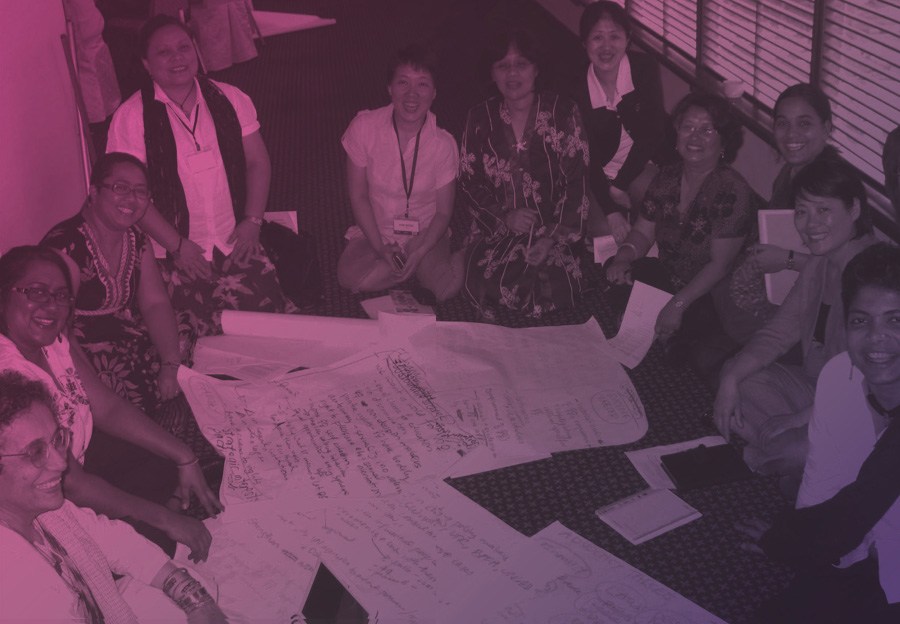
ARROW and partners at the Strategic Planning Meeting, May 2010, Langkawi, Malaysia.
I was initially quite taken aback by how hierarchical [ARROW's] structure appeared. Over time, however, I observed that ARROW was extremely skilled at drawing participation. From the outset, ARROW organised activities and experiences outside the meeting hours that brought all women ‘to the table’ through common laughter, leisure, liberation, learning and, yes, wonderful food. Activities and venues were carefully chosen to maximise opportunity to learn about each other's cultural, social, economic and political realities...Participation was valued and Rashidah and Rita, from the outset, were skilled not only in listening but also in showing that a participant had been heard. Acknowledgement of contributions during meetings was clear and persistent. All contributions were treated as equally respectable. Validation was a hallmark of participation.
—Di Surgey, former Programme Advisory Committee and Board member
Both Rita and I felt strongly that the organisation needed a sound management system, and so from the very outset, we were keen to put into place systems, structures and processes that would create a healthy, productive gender-sensitive workplace. One of the first policies we worked on was the Staff Work Conditions and Entitlements, which outlined leave, maternity leave, flexi hours, etc. We wanted to have an organisation where rights were clear and staff well taken care of. Also appointment letters and job descriptions were well done so job responsibilities were clear. The appraisal process of the probation period and the annual appraisal really helped clarify to the staff member what the organisation required of her.
— Rashidah Abdullah, Founder-Director and Board member
Power and participation are interlinked concepts in any organisational setting. Power in the context of a group or an organisation refers to being in possession of the controlling influence in the group and of its outcomes.
Participation, on the other hand, refers to the act of sharing in the activities of the group. Power always exists as a dynamic in any group or organisation and it is a matter of whether it is acknowledged or not. Acknowledging and mediating power in a conscious way can lead to a higher level of participation in an organisation.
ARROW's founders drew from their previous experiences in NGO work when they formed the core beliefs that:
- ARROW would be much stronger and more effective if it was able to gain insights and ideas of very committed feminist activists with expertise in information, research and advocacy in the development of its women's health and rights programme.
- Asia and Pacific activists, including ARROW's founders, wanted and needed to exchange experiences and resources and continue to learn/improve their capacities both for the development of their own organisations as well as the women's movement.
- ARROW needed to be structured accordingly to encourage participation of activists within the organisation as well as outside it.
- Clear roles, responsibilities, accountability and participatory decision-making processes were needed in ARROW structures and practices both to lessen the chance of unnecessary role conflict and to mediate power. The founders of ARROW believed that participation was an essential value by which contributions could flow into the organisation, and ARROW could benefit from people's creativity and commitment. They also recognised that participation was also a central piece in creating a democratic organisation in which the rights of people to fairness and justice could be better realised.
However, they also understood from experience that power needed to actually be acknowledged and distributed in a conscious way, such that decisionmaking could take place in a way that there was minimum conflict, and maximum participation. They made the conscious decision to order ARROW's structure in what could be defined as a traditional, hierarchical structure in which the legitimate power of decision-making would be assigned, defined and clarified throughout structures and processes like Terms of References (TORs) and Job Descriptions.
They believed that a clear, transparent and accountable hierarchy was the best way to ensure that the responsibility for decision-making was clearly distributed within the structure.
In ARROW, therefore, the BOD holds the greatest amount of legitimate power, but it also delegates a very large degree of decision-making power to the Executive Director (ED) who in turns delegates some degree of decision-making power to Managers who in turn delegate some degree of decision-making power to staff. The ideal is that the work that happens within each of the structural elements of the hierarchy is in congruence with strategic and operational decisions made “up the line.”
In ARROW's case, the work also responds to inputs made by a ‘check and balance’ element in its structure—a Programme Advisory Committee (PAC). This element is not part of the vertical structure of decision-making power. It does, however, temper the risk of programme-related decisions being made in a vacuum or left to the individual ED, programme managers or staff. Rather than holding traditional legitimate decision-making power, the PAC brings relevance and currency, both components in the power to influence within ARROW.
ARROW puts a great deal of effort into making sure that everyone from its BOD to the ED, manager, staff members and PAC are all very clear about their roles, their scope of responsibility and to whom they are accountable. The organisation has invested in committing to writing much of these agreed relationships in TORs so as to reduce ambiguity, and increase the possibility of a high degree of accountability.
ARROW also believes that the clearer everyone is on their roles in the organisation, the more effectively they are able to participate.
With this background, this chapter shares processes, tools and stories related to the structural pillars of ARROW's organisation that mediate power and facilitate participation: the BOD, ED, Management Team (MT), staff and PAC. It shows how the principle of participation figures in all of these structures and relationships and how clear definition of roles, responsibilities and accountability are expressed. The four topics included in this chapter are:
- Ethical framework for organisational practices;
- Board governance;
- ED, Management Team and staff accountability; and,
- Valuing staff
Each topic provides some ARROW context, history and concepts followed by resources in the form of processes or practices and tools that we have used in ARROW to ensure both participation and the mediation of power within the organisational structure. Some stories accompany the resources to provide personal insight onto the use of these tools or processes.
TOPIC 1: Ethical framework for organisational practice
It is possible to develop organisational policies that benefit, not constrain, the organisation. Policies can be written in a way that lives up to our ethical ideals, while at the same time evolving tools and processes that enable greater effectiveness and efficiency within the organisation. It takes greater time and effort, gives more voice and space for argument from members, but in the end, results in a higher quality of both process and results. There is also a greater ownership of the organisation's systems and regulations, leading to consistent practice, as people feel the direct benefit of doing so, and a more enjoy able journey for activists who not only ‘do’ solidarity work, but are in solidarity themselves.
— Saira Shameem, former Executive Director of ARROW
Introduction
Why ARROW decides to do things in certain ways extending from the structures we create, meeting locations and meeting processes we choose, and policies and practices we use to orient new staff and Board members varies according to beliefs and principles valued and comes down to one thing—our ethical framework. ARROW is pleased that its ethics are up front now so that these can be followed consistently in all aspects of our organisational life.
At the centre of ARROWs ethics is our organisational core values. The ethical framework of ARROW is made explicit by the policies that we have developed. These policies, spearheaded and approved by the BOD, are foundational, and provide the organisation and all the people associated with it an inner compass that guides all of our work and actions.
Under this topic, we share with you two organisational tools which we have found very useful in providing an ethical framework to ARROW—TOOL 1: Code of Ethics and TOOL 2: Conflict of Interest Policy.
Introduction
The Code of Ethics (COE) is a policy document that describes the ethical values believed in and committed to, both individually and collectively, by ARROW's BOD, staff and PAC members. The COE is used to guide all the deliberations, decisions and actions of the organisation. Under each core value, there is an elaboration of how this core value is expressed in all the key business and activities of the organisation.
Why was this tool developed?
The COE was developed because the BOD believed that a strong organisation needed “a feminist compass” that would guide the all aspects of the work of the Organisation. ARROW had always been guided by a strong set of values, but these values were implicit in way the organisation was run. This tool was developed to codify and find common agreement on ethical standards that guides both individual and organisational attitudes, behaviour and actions.
How was the tool developed?
The values stated in the COE were developed through in-depth conversations between and within the Board and staff body over different BOD-Staff retreats and special staff sessions in the period between 2002 and 2003 and encoded in the ARROW Management and Administrative Policies and Procedures (MAPP) Manual. The COE was refined over the years and the current version approved in 2010.
Code of Ethics: How to use the tool
ARROW's Code of Ethics lists eight core values:
- Commitment to quality;
- Fairness;
- Social justice;
- Generosity;
- Honesty;
- Innovation or creativity;
- Participation; and
- Transparency.
One of the reasons that the COE acts as a useful guide is because each of the eight core values are further substantiated as to their specific application in different work contexts. Following is an example of how the value, Participation, has been unpacked to express its full meaning in the organisation's context:
Participation
We commit to:
- Ensuring that ARROW includes participatory processes in all aspects of the work with the BOD, PAC, staff and partners, in particular strategic planning and evaluation.
- Sharing chairing of meetings and the other facilitative work of the organisation so that leadership is not the responsibility of only a few.
- Planning and implementing participatory processes into all aspects of our work, believing that people have a right to participate in decision-making and that quality, effectiveness and ownership will be better.
- Asking for input into draft agendas of all meetings and seminars etc. so that others can contribute to identifying issues and content.
- Sharing facilitation of leadership in meetings so that others will experience this responsibility and also develop their capacities.
- Ensuring we do not dominate in meetings, talk too often, or put people down to the extent that this hinders the participation of others.
- Encouraging the participation of peers, staff, partners and PAC and BOD in the planning, implementation and evaluation of ARROW.
The elaboration of each value in this clear manner is one of the key reasons the policy is a useful guide in different organisational contexts. Even if a particular situation is not described in the details of each core value, there is enough information within each value to make informed decisions
The full statement of the Code of Ethics is available in Annexe 1.
How to use the tool
Since the COE has been put in place, the policy document has been used in the following ways:
- An ethical guide for daily interpersonal relations and conduct in the office, between staff and BOD, within the BOD and in relationships with partners, donors, meeting participants and all people encountered by the staff and BOD in the work of ARROW.
- As the basis for the principles and conduct behind policy and procedure development
- In personnel appraisals.
- In defining competencies and capacity building training for staff and BOD.
- As a guide for any kind of principled or ethical decision-making.
- As a guide to decision-making for conflict resolution, grievances and misconduct assertions
- As an ethical guide in strategic planning processes as well as activity planning.
Challenges experienced in using the tool
The tool needs to be referred to more consciously in the decision-making processes of the BOD. While the BOD refers to key principles such as fairness and honesty, it is not often linked to what is in ARROW's COE.
Tips: Lessons from using the tool
The COE needs to be given to new staff and Board members with opportunity given to read and discuss it as part of an orientation or induction programme. Without such a programme, the COE may not be known nor understood.
TOOL 2: Conflict of Interest Policy
Introduction
The Conflict of Interest (COI) Policy is a policy document that delineates the conditions and situations where conflicts of interest may arise in the organisation. These include contracting, transactions and arrangements, financial or otherwise, which could be construed as being in the interest of a Board member, ED or a staff who has decision-making power over that matter. It also provides details of the procedures and mechanisms to deal with violations to the policy.
Why was the tool developed?
The COI Policy was developed in order to ensure that the deliberations and decisions of the BOD and staff keep in mind and protect the interest of ARROW and its beneficiaries at all times.
How was the tool developed?
The COI was developed as a result of dialogue around ensuring accountability and transparency in contracting Board members as consultants to the organisation. ARROW's Bylaws state that although there are no sitting fees for members of the Board, payments to them for professional services are acceptable.
ARROW thus wished to clarify and make transparent its processes in regards to commissioning work from its Board members and other volunteers. The COI policy became an important tool to ensure that this was carried out in a completely ethical and transparent manner. We also were aware that a COI is a standard, necessary policy for any organisation.
Challenges experienced in using the tool
- The challenge in such a process is the time it takes to build the amount of trust enough for members of the Board or staff to question whether something or someone should be acknowledged on the COI registry, without fear of backlash or resentment. If taken seriously, and time is invested, discussing COI matters in a candid manner becomes a process of building trust, raising the ethical standards of the Board and/or staff body.
- The policy, like all ARROW policies, needs to be an important part of new staff and Board orientation programmes. There have been some misunderstandings due to lack of staff orientation.
Tips: Lessons from using the tool
- ARROW began using this policy as soon as it was approved. Within a year, it had become a part of the organisational practice.
- Include COI in all orientations as well as policy and procedural handbooks.
- Staff members participated in the process of development this policy and they were very familiar with the tool. Implementation, thus, was easy.
Introduction
As with most registered organisations, ARROW has a Board that governs the organisation. Governance refers to the structures and systems and core understanding that guide how an organisation is run. The Board decides on these structures, systems and core understanding through its careful deliberations, and provides the framework that ensures that the right decisions are made in relation to policies and the organisation's direction. Given that ARROW is an organisation founded by feminists guided by core values of participation and transparency, ARROW's governance process aims to be:
- Consultative, in that everyone who has an interest in a decision, and has an opinion is heard;
- Decisive, in that once the decision has been made, the decision is understood, documented and implemented throughout the organisation; and,
- Straightforward, in that it is clear who is responsible for what, and how a particular policy or position relates to the organisation's mission as a whole.
The ARROW Board is capable and clear in ensuring accountable and transparent governance processes. The Board anchors the organisation, and is seen as the ultimate decision-making body in ARROW. Final decisions on all important issues are made by the Board. Under this topic, we share several key resources that ensure that the ARROW Board is able to carry out its function effectively and in line with the organisation's core values. These include:
- TOOL 3: Board Terms of Reference;
- TOOL 4: Criteria for Board selection;
- PROCESS 1: Board Meeting Process; and,
- TOOL 5: the Board Appraisal Tool
TOOL 3: Board Terms of Reference
Introduction
The Terms of Reference for the Board of Directors outlines its role and functions and is enshrined in ARROW's Bylaws.
Why was the tool developed?
The Board TOR was developed to provide clarity of function, roles, responsibility and work of the BOD such that every Board member has a full understanding of what is required of her when she agrees to take up the role. It is essential that these responsibilities are clear, specific and written in a document. Without this, the lack of clarity between the roles of the Board and ED can lead to ineffective Board governance.
How was it developed?
The two Founder-Directors of ARROW discussed the need for a TOR, and then developed a draft. This draft was further nuanced and redefined when the Board was expanded in 1999.
Key components of the BOD Terms of Reference
The BOD Terms of Reference contains alisting of the roles and functions of the BOD. It also includes the responsibilities of the Board including:
- Financial oversight: Including approval of annual operational budgets and audited accounts, five-year budgets as part of the Strategic Plan, approval of all annual financial statements and financial guidelines, approval of the setting up of funds and investment portfolios, purchase of property, and salary reviews and approval of changes in salary structure; monitoring of income and expenditure and cash flow quarterly according to the approved budget.
- Personnel matters: Including the approval of changes to the staff positions, in terms of numbers and structures; appointment, supervision and annual appraisal of the ED; overseeing grievance procedures if related to the ED, approval of any re-employment after retirement, and approval of termination of any staff, besides fixed-term contracts.
- Strategic planning and work programme oversight: including the review and approval of the 5-year Strategic Plan and Work Programme and Budget, review and approval of Annual Plans, review and approval of changes to ARROW vision, mission and long-term objectives, review and approval of Annual Reports and reports to funders, approval of the TORs of External Evaluations, review and approval of major funding proposals for core funding and projects.
- BOD and PAC policy development and approval: including the development and approval of BOD and PAC Terms of Reference, decide on appointment of new BOD and PAC members, and second term extensions of both BOD and PAC members.
- Complying with the requirements of the Companies Act: including the review and amendment of the Memorandum of Association and the Articles of Association, signing of any BOD Memorandum to the Registrar of Societies, appointment of auditors, signing the Annual Submission of Accounts to the Registrar of Companies, sign Notice of BOD and Annual General Meetings (AGM) and the minutes of BOD and AGM Meetings.
The full Terms of Reference of the BOD is listed as Annexe 3.
How to use the tool
The Board TOR is used in the following ways:
- As an orientation to new Board members on their roles and responsibilities as a Director of ARROW
- To clarify roles and responsibilities of the Board in relation to decision-making on matters that arise in the organisation
- As an orientation to new staff members, including the ED and Managers, on the lines of accountabilities as delineated in the roles and responsibilities of the Directors of ARROW
Challenges experienced in using the tool
- Being aware and disciplined enough not to raise matters for which the ED and not the Board is responsible and accept that people have their own style.
- Knowing what are strategic issues, both programme and organisational, for the Board to pay attention to.
Tips: Lessons from using the tool
- The Board TOR needs to be given to each new Board and staff member and time allocated for discussion on this in orientation programmes.
- The Board meeting agenda can be structured using the areas of responsibilities in the TOR. This reinforces clarity on Board responsibilities and ensures governance of all areas is being practiced in Board decision-making.
- The TOR is the main document to be referred to when doing the annual Board appraisal.
TOOL 4: Criteria for BOD selection
Introduction
The Criteria for BOD Selection provides a clear guide for the BOD in their consideration of nominations for new Board members. The process by which the Board selection is made has been documented in the MAPP to provide clear guidance to the Board, ED and Management Team in matters of Board selection and recruitment.
Why was the tool developed?
Given the central role that the Board plays in the overall function of the organisation, the choice of Board members has always been of utmost importance to the organisation. Having clear Criteria for Board Selection reduces the possibility of choice based on subjective or personal preferences, and focuses the deliberation of nominees on the qualities and capacities necessary to achieve the goals of the organisation.
How was the tool developed?
The criteria for BOD selection was developed by the Board of that time in preparation for the BOD expansion from two to five members. A draft was developed by one of the Board members, discussed and then approved.
How to use the tool
- The Criteria for Board Selection can be formulated into a matrix format which is used to assess each nominee to the Board. While the criteria will differ from organisation to organisation, what is critical is that there is agreement prior to the nomination of Board members what common criteria will be used to assess nominations, and what method of decision-making will be employed to come to thorough, fair and participative agreements
- Likewise, the procedure for the Selection of Board members may be tailored to suit the needs of your organisation. What is important is that the roles and responsibilities are clear to anyone coming into the organisation.
Challenges experienced in using the tool
- Prioritising time for the orientation of new members of the Board and organisation has been a challenge. An orientation kit for both Board and staff members would help.
- In last five years, members' time availability for meetings has lessened. This is inevitable when activists very engaged in social movements are recruited as Board members.
Tips: Lessons from using the tool
- Call everyone's attention to the Criteria for Board Selection even while nominations are being discussed within the Board and amongst staff members
- Allow sufficient time for the nomination process to ensure that there is a wide enough pool of nominees from which to make the selection from.
- Nominate women who are not just excellent leaders, visionaries and strategic thinkers in their organisations, but also are known for the superior interpersonal and self-management skills. This is an important combination to the overall criteria as respect for others is just as important as expertise and experience.
- Members who are or have been EDs bring special insights and understanding to their role.
PROCESS 1: Board meeting processes
Introduction
The ARROW BOD meetings are the key governance space for the organisation. The BOD meets at least twice a year and these meetings last between two to three days. While ARROW maintains the structure of a traditional hierarchical organisation, each level of this structure is infused with practices that are non-conventional and express congruence with the core values of the organisation. These set of processes are being shared to provide a glimpse of the way in which the ARROW Board functions.
Key components of Board meeting processes
Following are some of the key elements that the ARROW Board has cultivated to be more participatory, transparent and accountable:
- The Board of ARROW does not have a fixed Chair, and the responsibility of chairing each Board meeting is shared between the members.
- Board meetings begin with a personal sharing by each Board member, the ED and staff representative present. Each person takes about 15–20 minutes to share with others their personal, organisational or movement based highlights.
- There is always a staff representative, who is chosen by other staff members, present during board meetings. Although the staff representative is present as an observer and has no decision-making power, she is present through all the discussions of the Board and can be asked to provide a view.
- The staff representative presents at the Board meeting any issue that the staff members would like to put forward during a dedicated agenda item at the Board meeting. These concerns are discussed in a special staff meeting called for this purpose prior to the Board meetings.
- The Board conducts all its meetings in a completely transparent way. There are very few, in-camera discussions and all matters (except personnel appraisal or disciplinary matters and individual staff salaries) are discussed openly and documented meticulously.
- Considerable time and effort is given to ensure the quality of Board documents. Board members are called upon to present position papers and draft policy documents to support the Board's decisionmaking processes.
- All Board decisions are meticulously documented and the ED is required to share these decisions with staff members during the monthly staff meeting, as well as circulate Board minutes to all. The Board's view is that the more open they are about the discussions they have and the rationale by which decisions were reached, the greater the level of appreciation and transparency of the decisions, and less feelings amongst staff members of not having their views taken into account.
- The Board has instituted a Board Appraisal process where Board members undergo an appraisal process annually. In this appraisal process, the Board members assess themselves through the use of a self-reflective Board Competency Assessment Tool (See Tool 5). This is followed by the second stage of appraisal which involves staff members giving their assessment of the Board's performance using the same Board Appraisal Tool. The information gathered with the appraisal tool is used as a way of generating a discussion within the Board about its performance as a Board and as individual members.
Challenges experienced in following the processes
- Given the informality of the process of rotating the chairing of the meeting, time management can become an issue, and some of our efficiency is compromised.
- Sometimes when the Board agenda becomes packed with issues that need our urgent attention, we are unable to allocate time for the more reflective and evaluative discussions that the Board needs on a regular basis. We are also often unable to review organisational policies and procedures with the regularity that is ideal.
Tips: Lessons from following the processes
- Time spent in personal sharing can enhance the spirit of solidarity amongst Board members.
- Creating room for personal interactions outside the Board meeting space ensures greater cohesiveness and cooperation—both critical components of good decision-making.
- Clear documentation of Board decisions around policies, practices and principles is critical to effective governance of the organisation. It is important to develop a practical template for the minutes of the meeting that can communicate critical decisions and views of the Board accurately and in an accessible way.
- Careful and prioritised agenda setting is essential.
TOOL 5: Board Competency Assessment Tool
Introduction
The Board Competency Assessment Tool is a competency assessment tool that was developed in line with the development of competency models for various staff categories of responsibility. This tool has been used by the ARROW's BOD as a process for reflecting and reviewing the role and performance of the Board in its governance of ARROW and deciding on what needed to be improved.
Why was the tool developed?
In 2006, the BOD reviewed an organisational capacity assessment tool, named the SRHR Organisational Capacity Assessment Tool, which included assessment criteria of the Board. In a discussion initiated during a regular BOD meeting, the Board agreed that it would be useful to use such a tool to strengthen the Board. As all positions in ARROW had an annual appraisal and evaluation processes, the Board saw it as fair and important for quality outputs that the Board appraised itself.
How was the tool developed?
This Board Competency Assessment Tool was culled out of the SRHR Organisational Capacity Assessment Tool that ARROW had developed in one of its projects. The competency indicators used in the tool was selected through a discussion between a Board member and the ARROW staff in charge of the development of ARROW's organisational assessment tool. This tool was then finalised and used by the BOD.
Key components of the tool
The ARROW Board Competency Assessment Tool consists of seven competency areas, and four levels indicating degrees of competency in each of areas. The seven competency areas that are used in this tool are:
- Shared beliefs and values: Referring to the degree to which the Board shared the common set of beliefs and values to which the organisation itself adheres.
- Board composition and commitment: Referring to the degree of diversity of fields of practice and expertise amongst Board members, and the degree of their demonstrated commitment to the organisation's success, mission and vision.
- Governing Board commitment and effectiveness on SRHR research, monitoring and advocacy: Referring to the percentage of members with SRHR and research, monitoring and advocacy experience, and the degree to which the Board takes up policy decisions on SRHR monitoring, research and advocacy.
- Board governance: Referring to the degree to which Board members understand their legal, advisory and management roles, and their fiduciary duties. This competency also refers to the effectiveness of the Board in its own nomination processes, and the degree to which it holds the ED accountable.
- Board involvement and support: Referring to the degree to which the Board provides direction, support, leadership and strategic resources to the ED of the organisation. It also refers to the communications of the Board and the degree to which it is respectful, appreciative and reflective of shared commitment.
- Board and ED appreciation of power issues: Referring to the degree to which the Board recognises power issues, and the degree to which policies and procedures are established to mediate power and address these issues.
A copy of the Board Competency Assessment Tool is listed as Annexe 4.
How to use the tool
In ARROW, this tool has been used by the Board to take time and reflect on the role and performance of the Board in order to address problems and enabling Board members to better fulfil their responsibilities. Although this tool has not been used annually as it was envisioned, in the times that the Board has used it, following is the process that has been followed:
- Time is allocated within the Board agenda for a review of Board competencies.
- Each Board member assesses their own performance in quiet reflection and rates themselves on their individual sheets.
- The Board members then sit together and discuss their ratings and their reasons for choosing them. This opens up space for an honest conversation of how each Board member feels they have performed in the year/s past.
- Staff also meet and rate the Board using the same assessment tool. The staff representative presents to the Board their ratings, and this is used as an opportunity for the staff to provide honest feedback to the Board.
Challenges experienced in using the tool
- Placing the Board appraisal as an item on the agenda regularly as a very important governance item.
- Listening to critical feedback openly from peers and colleagues and not being defensive.
- Following up on recommendations. Board matters are sometimes not given as much priority as programme matters and the quality of Board governance can then be at risk.
Tips: Lessons from using the tool
- Enough time needs to be given for a reflective and open process from which maximum learning and insights can be gained.
- Immediate recommendations made to strengthen the Board can be noted. The next Board meeting needs to revisit these to come up with a definite plan.
TOPIC 3: Executive Director, Management Team and staff accountability
Introduction
Accountability specifies to whom the position/person or the committee needs to report to in terms of their performance according to their TOR and work plan. Accountability processes are directly related to the exercise of responsibilities and authority structures. Processes of accountability include reporting, performance appraisal and evaluation according to indicators. For smooth organisational functioning, clear TORs of committees and Job Descriptions specifying responsibility and authority together with specific work plans are essential.
We believe that this clarity of accountability at each level and accountability processes to ensure high quality of work and help build an effective and strong organisation.
Under this topic, we share key tools that are used in ARROW to ensure accountability at the level of the ED, MT and among staff.
TOOL 6: Executive Director Job Description
Introduction
The ED Job Description is the document that outlines the roles, responsibilities and accountabilities of the ED in her position.
Why was the tool developed?
This tool was developed in the early stages of the organisation's set up in order to clearly delineate ARROW's hierarchy of accountabilities and responsibilities within the organisation.
The Board believed that the clearer the role of the ED was within the structure of the organisation, the more effectively she would be in carrying out her duties and responsibilities, thus ensuring that work at all levels was implemented towards the achievement of the organisation's strategic goals.
How was the tool developed?
Di Surgey wrote the current job description for the ED after delineating the role, its responsibilities and accountabilities as part of a capacity assessment in 1998.
Key components of the ED Job Description
The ED Job Description, as with all staff job descriptions begins with a description of ARROW, the organisation's context, strategies, mission, and core principles, before defining the role of the ED. Following is the description of the role of the ED in this tool:
The Executive Director's role is to provide leadership to the organisation, programme and Management Team in terms of vision, strategic planning and overseeing processes to ensure a high quality programme and a sustainable and effective organisation.1
The tool then lists the key responsibilities of the ED in four key areas: namely, i) organisational development, ii) programme planning and development; iii) human resources; and iv) finance and legal.
After listing all the responsibilities of the position the lines of accountability of the ED is clearly stated: “The Executive Director is responsible to the BOD.”
This tool is thus laid out in a way that provides the incumbent in the position of ED a clear outline of her roles and responsibilities.
The copy of the complete ED Job Description is listed as Annexe 5.
How to use this tool
The tool is used in the following ways:
- As a reference for the ED in carrying out her functions;
- As a reference to the BOD on the areas of responsibility that the ED is held accountable for;
- Together with the ED Competency Model document, the Job description is used in the annual appraisal of the ED's performance on the job; and
- As a reference for other staff members of ARROW of the roles and responsibilities of the ED in relation to other positions.
Challenges experienced in using the tool
- There are some grey areas in ED authority as a j ob description is not able to describe all the specific operational aspects of decision-making. There is thus need for clarification at times with the Board.
Tips: Lessons from using the tool
- The job description needs to be very clear. Sufficient time is needed to develop an excellent job description.
- Review of the job description by several Board members is useful.
- Refer to the job description as often as needed when clarifying roles and responsibilities so that familiarity is established and use becomes more frequent.
- The job description needs to be given to new Board members as part of their orientation package.
PROCESS 2: The accountability of the Executive Director to the Board
Introduction
The accountability of the ED to the BOD refers to the ED's responsibility to report back to the BOD on all her areas of responsibility as clearly outlined in her job description. The ED's job description is critical to this relationship as it clearly delineates what the ED is being entrusted with responsibility for. This process describes all the ways in which the ED remains accountable to the BOD. This is being shared as a resource because it is a critical component of the way the hierarchy of authority and responsibility for work is distributed and accounted for at every level of the structure.
Following are the specific ways in which the relationship of accountability between the Board and ED is established and maintained:
- The ED presents the Annual Work Plan and Budget to the Board for approval during the last Board meeting of the year. This is developed based upon agreements of goals and outcomes as outlined in the five-yearly Strategic Plan.
- Advice and support is sought by the ED for specific segments of the Work Plan and Budget, and the Board discusses and provides their recommendations and inputs on these sections before approving the plan and budget.
- The ED provides regular progress reports to the Board both during the official board meeting, as well as via email in between Board meetings, identifying any strategic issues either needing the Board to be aware of or specific Board input. In particular, she alerts the Board on risk to all aspects of organisational, programme and financial health of the organisation, as part and parcel of her responsibility as an ED and as a critical component of risk management. When needed, the ED is encouraged to freely consult any member of the Board for advice on how to handle different organisation and programmatic issues as they emerge.
- The ED goes through an annual appraisal process which is conducted by two members of the BOD. The BOD uses the ED Competency model in tandem with the Performance Appraisal Form in an in-depth evaluation process. (See TOOL 7: ED Competency Model and TOOL 8: Performance Appraisal Form below).
- The ED is responsible for conducting an annual programme evaluation and planning process. The Board participates in this exercise and provides recommendations and inputs into the process. The Board also reviews, comments and then finally approves the annual report of ARROW including the EDs introduction to this for accuracy and evaluative insight.
- The Board works closely with the ED and participates in the design, development and evaluation of the Strategic Planning process.
- Two documents that are central to the accountability relationship between the ED and the Board are the Board's TOR and the ED's job description. They provide the core agreements and understanding of roles and responsibilities, and guides discussions when there are points lacking clarity or some grey areas not specifically referred to in the documents.
Challenges experienced in using the tool
- When there are unplanned activities and opportunities that are outside of the approved Strategic Plan emerge, the ED's authority to make decisions on these are unclear. There have been a couple of instances where the BOD and ED needed to further discuss and clarify decisions made by the ED on unplanned activities.
Tips: Lessons from using the tool
- Investing time and effort to develop documents that clearly outline roles, responsibilities and relationships goes a long way towards ensuring that every level of the organisation's structure has greater clarity on responsibilities and lines of authority and accountability.
- Recruiting Board members who themselves have experience in both managing and governing women's organisations enriches the discussions of the accountability of the ED to the Board.
- Be willing to be honest in raising concerns for the benefit of the governance of the organisation and exercise full governance authority rather than act as a rubber stamp.
Introduction
The ED Competency Model is an organisational document prepared by consultants that provides a common language for understanding the ED's job competencies, as well as providing the framework for developing a competency-based approach to human resource development for all staff positions in the organisation. The ED Competency Model was the first to be developed.
Why was the tool developed?
This tool was developed in 2004 when the Board and staff members felt that the organisation was ready for a clearer definition and understanding of job competencies required for each member of the staff body. The competency-based approach to human resource management that this model gave rise to is seen as in keeping with the organisation's core values of fairness, commitment to quality and transparency of process.
How was it developed?
The ED's Competency Model was developed through an extensive human resource research exercise spanning a month and involving both staff, Board members and key informants. The initial discussions were carried out in a workshop held by the organisational consultants for both Board and staff members during one of ARROW's Board-Staff year-end evaluation and planning retreats. This provided the core understanding of what the organisation was seeking to establish through this process.
How to use this tool
The Competency Model has been used by ARROW in the following ways:
- As a recruitment tool: ARROW has successfully been able to recruit two EDs using the Competency Model as a recruitment tool. The very clear benchmarks for competencies were converted into areas for assessment of candidates, and through a rating and scoring method that was developed, Board members were able to stay focused on the requisite competencies of the candidate and fairly assessed all candidates based on standard indicators.
- As an appraisal tool: The ED Competency Model serves as the key tool during the annual performance reviews of the ED. The articulated definitions of competencies and descriptions of behaviour traits, though lengthy in nature, provide a common frame during the evaluation process, and the model is used in tandem with Tool 7: ED Performance Appraisal Form
- As a supervision tool: The ED Competency Model can be used to supervise the ED to strengthen certain competencies.
Challenges experienced in using the tool
- The model is very comprehensive, but frames some of the key behaviours under a particular area of competency in language that may not be entirely in keeping with the ethos of the organisation. It is vital therefore, to use the model as a guide and interpret the principles of the model in line with the needs of the organisation.
Tips: Lessons from using the tool
- This is a long tool with many competencies. In order to use it effectively, one needs to take time and become familiar with the tool.
- For ED recruitment, it is very useful to have a guide on which competencies are the most important in the organisation's view. In other words to give a weightage to the different competencies. Since candidates will not have an excellent level of all competencies required when they first join an organisation, it is important to decide which ones are critical to the organisation at the time.
- Regularly refer to the Competency Model when carrying out the appraisal of the ED.
TOOL 8: ED performance appraisal
Introduction
The ED's Performance Appraisal Form is the tool that is used by the BOD to conduct the annual assessments of the Executive Director. This form is tailored specifically for the ED's areas of core responsibility and core competencies. This tool is being presented as an example of a performance appraisal form for leaders and managers. There are two other Appraisal Forms developed for each of the levels of staff—for Managers and for Programme Officers.
Why was the tool developed?
Appraisal of the EDs performance annually by the Board is a critical component of Board governance. The process holds the ED accountable to the Board, rewards the ED for excellent performance and results in a plan to strengthen ED competencies.
How was the tool developed?
This is the second ED performance appraisal tool which was developed in 2007 after the ED competency model was developed. The appraisal criteria were developed in a participatory way with both Board and ED and managers giving input of the criteria to be included and the weightage of these. The tool was then finalised by the same consultancy that produced the ED Competency Model, and has been used as a model to develop all the other staff appraisal forms in the organisation.
ED's Performance Appraisal Form—How to use it
The ED Performance Appraisal Form, like other staff appraisal forms in ARROW, are crafted specifically to evaluate the staff member based on key performance indicators and job competencies. The appraisal form is divided into three key components:
- Key Performance Indicators/Major Accomplishments
- Core Competencies
- Attitudes and Values
A rating system allocates 60 percent to Accomplishment and 20 percent each to Core Competencies and Attitudes and Values. The Appraisal of the ED is conducted by two Board members and usually is conducted over half a day.
Following are the steps by which the ED Performance Appraisal Form is used:
- The Board members and ED confer and agree on the Key Performance Indicators (KPI) and Major Accomplishments that will be included in that year's appraisal
- Using the ED Competency Model, each Board member conducting the appraisal fills in her own assessment in separate forms.
- The ED uses the same form to do a self-assessment prior to meeting up with the Board members, based on the ED Competency Model.
- When the Board Members and ED come together, they go over each area of the KPI and Major Accomplishments and discuss the ratings that each gave, and the reasons for doing so. This opens up the space to have a deeper dialogue about the different areas, as well as review some of the significant examples of accomplishments over the past year.
- The Board members and the ED use this opportunity to raise concerns and challenges faced over the year. The time of the evaluation is also used to celebrate key successes and accomplishments of the ED individually, and of the organisation as a whole.
- Through a process of negotiation with the ED over each appraisal item in the form, the Board Members come to a common agreement on their common rating, and the comments that they wish to have formally noted in the Appraisal Form.
- The Board members and ED also used this as an opportunity to chart out the ED's Development Plan and agree on the kind of support and/or professional development opportunities the ED will seek over the coming year.
- A completed Appraisal Form is submitted by one of the Board Members to the organisation's administrative unit, for filing and action.
- One of the Board members will make a verbal report of the ED Performance Appraisal process and decisions arrived at during the next Board meeting.
A copy of the complete Executive Director Appraisal Form is listed as Annexe 6.
Challenges experienced in using the tool
- Following the process and timelines conscientiously can be difficult due to competing demands. This is an internal organisational process and sometimes external events take precedence.
- Ensuring that the performance appraisal is based on solid evidence can be a challenge for the Board which does not work with the ED on a day-to-day basis. Preparation and reflection of the Board before hand is thus essential. The ED also needs to present a summary of her achievements from her perspective to the Board representatives before the appraisal.
Tips: Lessons from using the tool
- Do appraisals on time as performance is time bound. This both shows the commitment to the process and ensures performance is time bound.
- The whole process needs to thoroughly documented, signing and filing the appraisal form at the end. This process is just as important as any programme matter.
- Give adequate time so that the process is comprehensive and relaxed.
- Agree upon the KPIs and accomplishments that will be assessed prior to the start of the appraisal session.
- Provide concrete examples of situations or events when making an assessment of the ED's competence.
PROCESS 3: Management Team's decision-making process
Introduction
The Management Team (MT) consists of three managers and the ED, who leads the MT. The Managers are tasked to support the ED in the overall management and development of the organisation.
Why did ARROW develop a Management Team?
The Management Team was developed to provide the ED with support to carry out the management and development of the organisation. ARROW's staff group was expanding and creating an additional layer to the structure of the organisation, meant adequate support and supervision to team members. This has also enabled the ED to take input from the Managers for more informed, consultative decision-making processes.
Key responsibilities of the Management Team
The relationships within the MT are established in the job descriptions of the ED as well as each of the Managers. The role of the MT is to support the ED in carrying out the management and development of the organisation.
Together, the MT carries out the following responsibilities:
- Oversees ARROW's overall implementation of the strategic plan, in line with the overall vision and mission of the organisation and to ensure that plans for the year are accomplished to the best of the organisation's ability, which includes monitoring programmes, to troubleshoot where necessary, and to ensure that the staff and the organisation's needs are looked after;
- Reviews the organisation's overall financial management and resource mobilisation strategy;
- Led by the ED, works on personnel recruitment and development of induction (orientation), training and personnel appraisal systems and practices for programme staff, and other senior staff when necessary;
- Led by the ED, engages in strategic planning, particularly programme planning, monitoring and evaluation; and
- Works with the ED and other appropriate staff members on the development of project funding proposals, the annual report, and project reports to donors.
Key components of the Management Team's decisionmaking process
- The main forum for consultation and decisionmaking of the MT is its monthly meetings. Initially, both the chairing and minute taking at these meetings were rotated. However, for efficiency, the chairing is now done by the ED and the minutes are taken by the Executive Assistant.
- The agenda of the MT meeting is prepared in draft by the ED and circulated ahead of time. These agenda items are prioritised in order to ensure that all critical decisions will be made at the meeting.
- Preparation for MT meetings ensures that there is sufficient management information for decisions to be made effectively. All necessary documents and financial reports are prepared as far as possible, ahead of the meeting and circulated so that the ED and Managers have time to prepare for the meeting.
- During the MT meetings, the first agenda item is a review of all decisions and actions taken from the last meeting. This leads to the issue being closed, or if necessary further discussed in order to address what remains outstanding.
- This is followed by a discussion of each agenda item with the background of the issue under discussion highlighted. After the agenda item is presented, there is a round of inputs from everyone giving their views on the issue being. The matter is discussed until the MT comes to a final agreement. Decisions are made as far as possible on the basis of consensus. Where there is a disagreement on an issue, or they are unable to reach a decision, the MT through the ED will seek out additional inputs and advice from the Board.
- The ED has the authority to make the final decisions on issues, keeping in mind, the guidelines of the organisation, the strategic plan and the interests of the staff, Board and the organisation as a whole.
- The designated staff representative sits through the MT meetings to be aware of the discussions and decisions of the MT. The staff representative may also be asked for opinion by the MT on certain matters affecting staff, or she may also bring up staff matters for MT to discuss. The MT also ensures that meticulous minutes are taken and that the updates of MT decisions are shared during the staff meetings.
- Besides the formal MT monthly meetings, quick consultations happen throughout the month on decisions that need a quick turnaround. These happen either face-to-face, via email, telephone or Skype conversations.
Challenges faced in using the process
- During extremely busy periods, when MT members are organising or attending meetings and therefore travelling extensively, finding time for all members to meet can be challenging. The first opportunity is taken to hold the meeting, and consultations are done via email or phone calls if a decision needs to be made urgently.
Tips: Lessons from using the process
- The MT is a sufficiently small decision-making unit to develop processes of decision-making that are more consensual. Being deliberate and conscious about the meeting processes used to make decisions strengthens the leadership capacity of all involved.
- Being prepared for meetings goes a long way in being able to make informed decisions for the good of the organisation.
ARROW staff meetings always hold a special place for staff for many reasons: It is a time of coming together for most of the staff (unless they are on an emergency mission, or taking emergency leave), to discuss what we all have been doing in the past month and what we plan to do in the future, and essentially keep ourselves abreast of organisational and programmatic matters. This time is also considered special because staff has an opportunity to put forward their views and perspectives going beyond their work area or work objective, when issues are discussed. Staff meetings have also served as the initial launch pads for issues that concern staff including staff benefits such as health allowance, revision of salary scales and so forth.
— Sai Jyothirmai Racherla, former ARROW Programme Officer
Introduction
Staff meetings are regular monthly meeting where staff members share information, discuss programmatic and other issues, and put forward concerns. These meeting are highly participatory and central to the organisation's programme planning, implementation and monitoring structure.
Why was the tool developed?
ARROW has held staff meetings even when there were just two Directors and two staff members as the total staff body. We did so because we believe that the organisation is strengthened when all staff members have full knowledge and are able to critically engage and give inputs into all aspects of the organisation. Over time, the meetings have become more formal in their processes. However, we believe that what may have been lost in informality has been gained by clearer and more accountable decision-making and transparency of information flows. We have found that well-planned and well-documented meetings are critical to effective planning, monitoring and evaluations.
Key components of the staff meeting process
Following are the key procedures involved the set up and carrying out of ARROW staff meetings:
- Meetings are scheduled earlier so that people can prepare and plan their time.
- A draft agenda is prepared by the ED with input from the MT, and circulated along with the minutes of the previous staff meeting to all staff members for their comments and inputs.
- The regular format of the meeting is as follows:
- The agenda for the meeting is confirmed;
- Conflict of interest is registered by staff members;
- The minutes of the previous staff meeting are confirmed;
- Matters arising are discussed;
- MT reports updates and decisions from their previous meeting;
- BOD and PAC updates if any are shared,;
- Reports from each of the staff teams working on programmes and projects
- Administration and Finance updates
- Reports of representations at meetings outside the office in the previous month
- Annual work plan's monthly and quarterly outputs are monitored together and planning of activities for the next few months are discussed,
- Any other matters arising.
- If there are documents to discuss these are sent out earlier for better preparation.
- The ED chairs the meeting and the minute taker is rotated in an alphabetical order.
- Draft minutes are aimed to be circulated at the latest three days after the meeting for efficiency. If capacity building in minute taking is an objective, the staff will obtain their supervisor's input.
- Once all staff have commented (within three days), the minutes are finalised quickly and sent out again to all staff.
- The Executive Assistant to the ED is assigned with the task of reminding staff of meetings and minute schedules, preparing the routine agenda, sending out papers and filing documents in the staff meetings file.
- Staff meetings have been evaluated by the MT and staff from time to time. This practice, however, has not yet been institutionalised into the half year and annual evaluations.
Challenges experienced in using the process
- Given the fairly intensive travel schedule of staff members for different project related meetings and events, scheduling monthly staff meeting have sometimes been a problem. When we have postponed a staff meeting, our next meeting is extremely lengthy as we have to accommodate pending issues from previous months.
- Staff rarely speak up on issues and discussions. When the issue is new or fairly complex, some staff might not feel confident enough to speak up.
Tips: Lessons from using the process
- Introduce a quarterly programme coordination meeting, which are longer than staff meetings and allow for a fuller discussion of programme implementation and coordination within the office.
- Orient new staff on staff meeting processes so that they are able to contribute to discussion meaningfully.
- Encourage staff to comment on issues that are beyond their areas of work by creating moments in the meeting process, where inputs from all staff are encouraged.
- Deal with grievances outside the staff meeting space. We find that this can distract the productivity of the meeting. Use existing procedures in a separate discussion with concerned staff member/s and their programme manager.
- Where possible, rotate the role of the meeting chair amongst staff so that all have an opportunity to develop their capacity in chairing meetings and leading discussions.
TOPIC 4: Programme Advisory Committee
Introduction
The Programme Advisory Committee (PAC) is an advisory body of individuals that are experts and activists in the field of SRHR who provide strategic direction to ARROW's programme. The PAC was formed in early 1994 barely a year after ARROW was founded, and began to meet annually from that year. The PAC is a body separate from the BOD that provides critical advice, evaluation and direction for ARROW's programme relevance, quality and effectiveness. The PAC played a critical role with inputs into of ARROW's programme planning in the early years and continues to play an important role in sharpening and strengthening the strategic nature of ARROW's programming.
Through the PAC, ARROW has been able to ensure the kind of participation of feminist and SRHR activists in ARROW that the founders envisioned. The PAC is also an important way in which power is distributed, as the Board does not influence the PAC, nor does it play a role in the work of the PAC. The PAC provides input into the kind of strategies that would be most suitable given the present socio-political conditions, introduces and discusses emerging issues, and ensures that ARROW's work is on track with regards the commitments set in the Strategic Plan. The PAC creates a ‘check and balance’ mechanism to ensure that the programmatic decisions of the organisation are not made in a vacuum, but with grounding in realities at both national and regional levels.
Under this topic, we share several key resources that help ensure we are able to benefit from having our PAC:
- TOOL 10: Programme Advisory Committee Terms of Reference;
- TOOL 11: Criteria for PAC Selection; and,
- PROCESS 4: Programme Advisory Committee Consultation Process.
TOOL 10: PAC Terms of Reference
Introduction
This tool describes the roles and responsibilities required of a PAC member.
Why was the tool developed?
The tool was developed to provide clarity of function to all those joining the PAC as new members, and to the staff members to better understand how they could tap into the PAC members to support ARROW's programme implementation.
How was the tool developed?
This tool was developed by the Founder-Directors who were also the BOD at the time. Developed in 1993 when the organisation was just being founded, it was based on thinking of the needs of the organisation and the new programme that had been outlined in the first strategic plan of ARROW.
Programme Advisory Committee Terms of Reference
The Terms of Reference (TOR) of the PAC members contained in ARROW's MAPP was revised in 2002. Following are the key roles and responsibilities of the PAC members as defined in the TOR:
- Review and assess the general direction of ARROW's programme and work plan during an annual meeting to ensure that it is effectively addressing the mission, objectives and roles of the organisation as well as meeting the programme objectives;
- Contribute feedback, reviews, evaluation and other inputs on information, publications, research, advocacy and capacity building related to ARROW's core areas of work in and between meetings; and
- Assist in identifying people and organisations who can become involved in advancing, implementing and envisioning ARROW's programme objectives.
A member of ARROW's Programme Advisory Committee will serve for a fixed term of three years and may be nominated again for not more than one more term.
All members of the PAC shall comply with ARROW's Code of Ethics and all other policies. In the event that a member is found to be in breach of organisational policies, it may result in the Board recommending the exclusion of the said member from the Programme Advisory Committee.
How to use the tool
This tool can be used, and has been used in the following ways:
- As part of an orientation programme for new PAC members;
- As a reference for clarifying roles and responsibilities by PAC members and by staff members; and,
- As part of an assessment exercise.
Challenges experienced in using the tool
- The inputs of the PAC are an essential component of ARROW's programme implementation. As such most PAC meetings have a very full agenda, and a lot of documents shared for PAC members to review. It has been a challenge for some PAC members to get through the volume of documents presented at the meeting.
- There is also the fact that documents are prepared in English and this is not the native language of several PAC members, making it harder to comprehend the full meaning of the documents.
Tips: Lessons from using the tool
- PAC members need to be fully oriented on their role to be able to function effectively.
- Make provisions to support the language needs of PAC members with limited English skills. Providing a brief summary at the start of every document that the PAC member is required to read could be helpful.
TOOL 11: PAC selection criteria
The Board maintained a commitment to the practice of inviting a potential PAC member as an observer at an annual meeting, giving both parties the opportunity to test ‘the fit’ with the organisation. Members were chosen carefully and only after evidencing outstanding contributions to the women's health cause. By the time an individual became a formal member of the PAC, there was a lot of lateral respect in the room. Thus, strategic and careful recruitment, an inclusive culture and fostering the recognition of mutuality of interest, experience and delight were, in my view, the keystones to ARROW's approach to participation.
—Di Surgey, former PAC and BOD member
Introduction
This tool consists of both the criteria for the selection of Programme Advisory Committee members as well as the process by which this selection takes place.
Why was the tool developed?
The PAC provides critical advice and direction for ARROW's programme relevance, quality and effectiveness. The criteria and the process of selection were both developed in order to be able to seek out the best possible PAC members, to strengthen the implementation of ARROW's Work Programme and Budget.
How was the tool developed?
This tool was developed together with the PAC TOR. Looking at the TOR and what was listed as the needs of the organisation, criteria were developed to seek out people best able to carry out the responsibilities listed in the TOR. The draft was prepared and the discussed with the staff members, before being finalised by the BOD.
Selection criteria for Programme Advisory Committee members
ARROW's PAC members are chosen based upon a correlation between their affiliation to the democratic struggles in the region, especially with regards the women's and SRHR movements, and the pragmatic needs of ARROW in terms of expert advice.
PAC members will be appointed by the Board after consultation with ARROW staff on programme needs. Both staff and Board members will recommend candidates based on the following criteria:
- Proven expertise in at least two of ARROW's programme strategies;
- Commitment to ARROW's mission and long-term programme objectives;
- Active in the women's movement nationally, and if possible, also regionally and internationally;
- A person who is widely respected among ARROW stakeholders and the women's movement for their personal qualities and skills; and,
- Working in or coming from one of ARROW's current priority countries.
These women (and men) are invited to PAC in their own right, and not as representatives of their organisation, not do they represent any specific interest groups nor constituencies. However, effort is made to ensure that there is a balance of geographical location, focusing on the countries where ARROW's work is concentrated.
The PAC presently consists of 8 members. Two of these places are reserved for young people (defined as being under the age of 30, though the Board has requested that at least one person be below the age of 25 years). Membership can be expanded up to 10 people, as ARROW considers 8–10 people a good number of PAC members for input, synergy and group bonding.
How to use the tool
Following are the procedures that guide the process of selecting PAC members:
- Potential members are identified by staff and discussed based on the criteria, the organisation's current work and strategic needs of the organisation.
- Up to two guests are budgeted to be invited to PAC meetings as a way to both get to know potential new PAC members and also to provide expert input into the meeting on specific items or overall.
- Information from people followed up (i.e., their CV etc.) is compiled into a criteria format by staff and presented to the Board for consideration.
- The Board shortlists candidates, based on the criteria, and decides on new members preferably during in a meeting which allows for more discussion. An offer of appointment is made by the ED on behalf of the Board.
- When the 3-year term is coming to an end (i.e. six months before), the Board considers staff views and their own views on the member's performance and may offer another 3-year term if in the interests of the organisation.
Challenges experienced in using the tool
- This tool and the process of using it have been most effective in finding the right people as members of PAC. Given that many of the people with the right skills sets are also leaders of their own organisation, in some instances, some PAC members have not been able to keep up with requests for inputs that come in between the meetings.
Tips: Lessons from using the tool
- Inviting a potential PAC member to a meeting to give some technical input has been a good way to get a sense of the match between the person and the organisation and the PAC as a group.
- Advisors need to be given a clear sense of what their responsibilities will entail in terms of a time commitment, so that they can make an informed decision about joining the organisation as an advisor.
PROCESS 4: PAC Consultation Process
I was really struck by the PAC and how it functioned. There was such a high level of competence amongst the staff, and they provided energy, creativity and a kind of empowerment. In ARROW, they're very literate, knowledgeable and empowered, and it felt good to interact with young people. It gives you hope. I was on the PAC for two terms, and I must say that I was really amazed by its structure. I'd open the folder and see thick stacks of documents! It was very business-y, and sometimes meetings went were often very long. The process that they employed was quite flexible and loose. They would ask different members of the PAC to chair the meeting, and I think this was a great idea. What you lost in efficiency, you gained in participation and ownership. I also really appreciated the close friendships we had with other PAC members. It was a very different kind of venue and very personally enriching for me.
—Junice Demeterio-Melgar, Executive Director, Likhaan, former PAC and Board member
Introduction
The Programme Advisory Committee is consulted once a year in an annual meeting, and throughout the year through email and Skype. The process of consultation is one that is carefully thought through to maximise the interactions of the PAC members with both staff members and other PAC members. As such, a high degree of participation and engagement in encouraged.
Key components of the PAC consultation process
Below are the consultation processes that ARROW has in place to ensure that the Programme Advisory Committee is able to contribute to ARROW's programmatic growth:
- The main ARROW forum for consultation to the PAC is the annual meeting, held prior to the Board meeting in April or May. At this meeting, critical agenda items include the following:
- Sharing by PAC members of the SRHR status and context in their country, which provides the programme team with first-hand insights from activists working in that context. This also would affirm the team's reading of issues in the region, and may also point to emerging trends.
- A review of the ARROW programme team's work for the past year and plans for the remainder of the year. PAC members help assess annual progress towards the achievement of the objectives of the strategic plan, identify the gaps, and propose ways in which the team can further improve its work.
- Seeking input from the PAC on other critical programmatic matters. The programme team also poses a few ‘burning questions,’ matters that they most need strategic advice on, usually when they are thinking of starting or expanding a programme. The meeting is also a venue for the programme team to present and seek input from PAC on strategy papers and plans, and position papers on certain issues. Input on the AFC bulletin themes are also sought from PAC.
- All programme staff members facilitate sessions and make presentations at the meeting. Board members also participate as observers in the PAC meeting, to enable them to be appraised of what is happening programmatically, as well as to get to know the PAC and staff team better. Ideally, at least two Board members observe, and they report to the Board meeting.
- Aside from this, advice is sought from PAC throughout the year via email. These may include seeking input related to AFC concept notes, strategy and position papers, as well as funding proposals.
- It should be noted that in the end, input from PAC is advisory, and it is left to the Programme Team to decide what can be taken forward, in consideration of various other factors, such as funding and human resource availability, and whether the advice fits into the strategic plan.
- In cases where the PAC advises that papers or policies to be developed in relation to programme, the Board's input and approval is also needed.
- The staff maintains a regular section during the monthly management and staff meetings, for discussions on both the Board and PAC. During this time slot, updates relevant to these two bodies are given, including the decisions made at the annual PAC meeting, as well as on PAC membership issues.
Challenges experienced in using the tool
- Given that ARROW invites experts in the regions who are extremely busy and wear multiple hats, and that membership to the PAC is voluntary, getting timely and substantive inputs from members can sometimes be a challenge.
Tips: Lessons from using the tool
- The input of any advisory team will be as good as the meeting that is planned for it. Therefore it is critical that time is given to plan an excellent agenda, and sufficient time for dialogue and reflection on all of the key items. Likewise, documents that need to be reviewed should be sent ahead of time so that advisors have time to prepare adequately for the meeting.
- Encourage advisory members to take a lead on the discussion of different items on the agenda. This will involve them more effectively, and create a greater sense of ownership for the process and the programme.
- Rotate the responsibility for planning advisor meetings to different staff teams. This increases the sense of ownership by the staff for the process. It is also an effective capacity development opportunity for staff members, and particularly for those who are new to the organisation.
Introduction
In 2013 ARROW has 17 women employees. The organisation relies on these women to drive the outputs of ARROW through their work and also to keep the heart in the organisation through their commitment to advocacy in line with the organisation's mission. Without our paid employees, ARROW would not exist.
As a regional organisation it is extremely unlikely that the Board could sustain an organisation on unpaid labour or their own voluntary contributions. We value staff because they are the engine of the organisation. We rely on them to make us strong.
Maintaining staff and enjoying low turnover rates is critical to the organisation. Continuity brings stability but it also brings to the organisation the opportunity to enjoy the benefits of skills development. Managing our industrial relations and taking care to offer decent work conditions are ways that we can show that we value staff and respect their importance in ARROW's work. For these reasons, ARROW has strived to offer conditions that are attractive to current and to potential employees.
Further, ARROW's values of participation, fairness and transparency also suggest that work conditions, and the way they are negotiated, display value and respect for staff members. As an employer ARROW must, of course, meet minimum standards as reflected in local labour laws in its host country. It is the responsibility of the Board to ensure that these are met in policy, and of the ED to ensure that they are met in practice.
In keeping with its rights-based approach, ARROW treats all work conditions and benefits as a right, not a privilege. If they exist in our Management and Administrative Policies and Procedures document, they exist as a right for staff. ARROW sees fundamental importance in staff understanding that they do not need to ask for their rights to be met.
Under this topic, we share one process and two tools that are key to our overall commitment to valuing staff in tangible ways, namely:
- PROCESS 5: Review of ARROW's Salary Scale,
- TOOL 12: Staff Work Conditions and Entitlements, and
- TOOL 13: ARROW's Well-being Policy.
PROCESS 5: Review of ARROW's salary scale
Introduction
The Review of ARROW's salary scale refers to a process by which the organisation's Board-approved official salary scale goes through a process of regular assessment to ensure that salaries for each staff position remains competitive. The Board has stated that a salary review does not necessarily mean that salaries will increase and they may even be reduced.
Why was the process developed?
ARROW developed this process of salary scale review in keeping with our principle of wanting to provide, good, if not very good, salaries to be able to attract the best possible staff and to remunerate them fairly and well for their work. By staying competitive in terms of salaries offered, and combining this with an attractive benefit package and opportunities for staff to continuously learn and grow, ARROW's leadership was confident that ARROW could maintain a body of highly qualified, well-appreciated and satisfied staff.
In 2006, the Board recommended the practice that staff salary scale be reviewed before the finalisation of the next cycle of the Strategic Plan, so that a new salary structure, if approved by the Board, could be included in the budget of the new strategic plan for fund raising. Prior to that, salaries were reviewed, but not following the organisational cycle in the way that it does now.
Key components of the salary scale review process
- The regular review of the salary scale is an approved automatic process to occur prior to the finalisation of the strategic plan. As such every five years, before the next Strategic Plan is finalised, the ED presents for Board consideration the plans for the salary scale review, including the names of some possible consultancy firms that are being considered. Once the Board has discussed and approved the plan, the ED is entrusted with identifying the right consultant or consultancy firm to undertake the exercise.
- A working group is set up by the Board to oversee the review process. This working group would include the staff representative, representatives from the Management Team and at least one Board member. This team oversees the review process, and together with the ED, clarifies and provides information needed to the consultant.
- Typically, this exercise involves contacting between five to eight national or nationally-based regional development NGOs of similar size as ARROW with a formal request for them to share their salary scale and positions for purposes of review. They are guaranteed confidentiality and also promised a copy of ARROW's salary scale review once it has been completed.
- Salaries are compared against job descriptions that are similar in scope and scale of responsibilities, as different organisations have different titles for various posts.
- Financial and non-financial benefits such as annual leave, annual increment levels, medical insurance, relocation costs for international staff, and other items are taken into consideration.
- There is the inclusion of an ethical analysis of the actual difference in salary scales between different positions, as well as the difference in annual increments between various levels of posts, in one salary review.
- Salary reviews also can re-examine the amount of annual increment per scale, and have this analysed against comparative organisations, as well as the inflation rate at the national level. At certain times where there have been significant price hikes, there could be adjustments made in terms of the increment amount. However, if this is done, a finite period should be clearly stated at the outset, as such things are hard to remove once introduced. This is termed as COLA in Malaysia—Cost of Living Allowance. Eventually, instead of tying it to increments or a proportion of salary, it was instead given as a lump sum amount and removed once the economic situation improved.
- Salary reviews also offer the possibility of reexamining the process of determining entry-level salaries for new recruits (i.e., how do you decide where a new staff member starts on an existing salary scale), the considerations that go into it and the basis for adding years. It also allows for a way of standardising this process across the organisation as many different people may be involved in the recruiting of new staff. These criteria were established in consultation with staff as well as Board and Management.
- The consultant uses all data gathered to make a comparison and analysis of ARROW's salary scale with those of these selected organisations as well as with the “market” rates.
- The consultant also interviews all the staff members to find out their views of their salary and the salary scale. The consultant also meets with the Management Team to solicit their views as well.
- The consultant/s write up a report based on the data gathered and make a set of recommendations to the review working group. This is also accompanied by a formal presentation of the data at a BOD meeting, or a special meeting called for the consultant to meet with the members of the working group and the Board.
- These recommendations are also presented to the staff body, and they are also free to comment on the proposed new salary scale and salary adjustments, if any.
- The BOD considers the recommendations of the consultant and the views of the staff and the MT and come up with a final agreement on a new salary scale, as well as any salary adjustments that may occur as a result. ARROW aims to remunerate on the basis of skill, aptitude and relevant experience, and considers the compensation and benefits offered by other regional organisational settings to ensure we remain competitive.
- Once the decision is made, each staff member is given a letter stating any salary scale change and a copy is filed in her personal file.
Challenges experienced
- The expectations of staff need to be managed from the beginning, as there is always the hope that the review will end in an increase in salaries.
- At times, a salary review can mean that a decrease is recommended, and the Board and the MT need to be prepared on how they will handle this. Normally, this is not implemented as a salary cut, but as amendments to TORs to increase levels of responsibilities borne.
- The issue of confidentiality needs to be addressed in terms of what information is made available to whom, as in the case of the organisation doing the review, individual salary information is affected.
Tips: Lessons from using this process
- Give sufficient time in the process to make decisions on the salary scale review based on principles
- As a public-funded organisation, the issue of privacy of individual salaries will invariably come up, and just like public servants, our scales can be queried. There needs to be organisational clarity of the parts of the information which can be publicly shared (scales) and those that remain private (position or level within the scale).
TOOL 12: Staff work conditions and entitlements
Introduction
This tool describes all the work conditions and entitlements ensured to all staff of ARROW, and an explanation of the staff members' entitlements and rights. It was prepared as one of the first policy documents of ARROW in early 1994, and was reviewed, updated and approved by the BOD in January 2002.
Why was the tool developed?
This document was developed to ensure that the staff was well aware of all their rights, and would not be subject to abuse, discrimination or inequality from their supervisors, ED, BOD and their colleagues. The Board also wanted the management practices of ARROW to conform to the legal requirements of Malaysia, as well as the recommendations of the ILO and be in keeping with the core values of fairness, participation and transparency that ARROW strongly espouses.
How was the tool developed?
This tool was developed by the Founder-Directors using other development NGO policies as reference. The draft document was shared for review with other management specialists in the field for their inputs and advice. It was also discussed with staff before being finalised. It was reviewed and updated again in 2002.
How to use the tool
This tool is an essential reference guide to the management and administration of all staff matters. As such, the ED, Managers and all administration staff needs to be fully familiarised with this document. The tool may be used in the following ways:
- To guide all administrative matters in relation to staff employment and benefits;
- To guide management in decision-making on all staff matters pertaining to their employment contract and benefits;
- To orient new staff on their rights as members of the staff body of ARROW; and,
- To guide staff members when they have questions regarding their entitlements, benefits and rights as a member of the ARROW staff body.
Challenges experienced in using the tool
- The workload makes it hard for staff to complete the annual leave provided. It is not just about having a right to annual leave, but the Management enabling it to be taken by reducing workload, which is important.
- There is a tendency for staff to advocate for their rights and confuse the issue of ARROW being an organisation dedicated to championing women's rights to mean championing their rights. It is important to regularly have conversations that distinguish between the rights of marginalised women who are championed, and rights of staff that are to an extent guaranteed by law, and also ensured by ARROW to an extent far greater than many organisations of equal standing.
Tips: Lessons from using the tool
- Explaining the staff work conditions and benefits should be an integral part of the orientation process to every new staff member. Ensure that changes in policies are also documented and shared with staff members.
TOOL 13: ARROW's Well-being Policy
Introduction
The Well-being Policy is a policy statement that has been added into the Management and Administrative Policies and Procedures manual regarding a budgetary allocation made to promote well-being of staff.
Why was the tool developed?
In its early years the ARROW Board took a view that being well and healthy for women is more than an absence of illness or disease. This view was congruent with the view of the international women's health movement. It wanted to encourage staff to take care of their well-being and to take a preventative approach to their health care. The policy statement was included to institutionalise this principle in the organisation.
How was the tool developed?
The Well-Being Policy statement was developed through a process of dialogue within the Board, and with the ED. The ED took the matter up with the staff body during the staff meetings and their inputs were channelled back to the Board for their consideration.
Well-being Policy1—What is it?
In acknowledgement of ARROW's perspective on well-being, the ARROW Board allocated a small budget item that would allow each and every staff member to access some form of self-care. There was no restriction on how the small amount could be used as long as it contributed to well-being in the opinion of the recipient. During that initial discussion, the Board made suggestions that the cash amount could be used to cover the cost of a yoga class, a massage or some vitamin supplement but the choice was up to the individual. The benefit (500 Malaysian Ringgit per year per employee) remains in place till this time as a legacy of the holistic views espoused by the women's health movement.
Following is the Well-being Policy Statement:
Staff are entitled to a Well-being Allowance of a flat rate of RM500.00 per staff per year which will he given to the staff in payments of RM250.00 every six months. This may be used on any expenses related to health, medical, dental, alternative treatments, vitamins, exercise and others, which the staff member considers are necessary for her health and well-being, both preventative and for actual treatment.
Challenges experienced in using the tool
- The organisation has not been able to ascertain whether the staff indeed use the additional funds towards their well-being, as this is not monitored. Even so, Management does occasionally receive informal feedback that staff members have used the allowance for supplements and herbs, and we know that this allocation is worth the while.
Tips: Lessons from using the tool
- When staff members feel involved in the creation of circumstances that promote their well-being at work and at home, it is empowering.
- Policies such as the Well-being Policy is an entry point to staff discussions on issues of women's sexual and reproductive health issues broadly, but self-care more specifically.