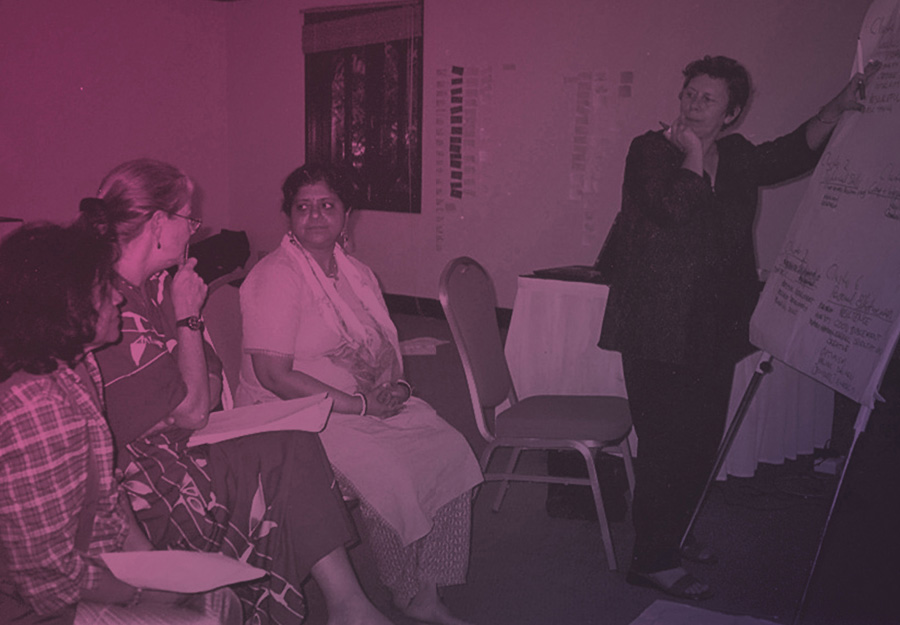
Board members in action at an ARROW meeting to discuss the Executive Directors' core competencies in Langkawi, Malaysia, 2003.
As ARROW moves ahead, I think it is important to learn from the past. In the past, ARROW valued partnerships and people greatly, engaged in deep listening, and were open to learning from their partners. ARROW has a phenomenal history, and looking hack to it is like looking in a rear view mirror—constantly watching through it helps you move forward.
—Indu Capoor, Former PAC and Board member and Founder-Director of CHETNA, India, an ARROW organisational partner
This chapter provides a short history of ARROW's founding and growth as an organisation, and the context that it was responding to when it was founded. We also mention some of the key contributions that ARROW has made since its inception. We feature in this chapter a number of stories from women who have been with the organisation since its founding. Their stories offer a glimpse from a personal perspective of what it was like being a part of ARROW's genesis and growth in the early years.
At the end of this chapter, we list some of our highlights in organisational development terms, focusing on significant moments in terms of our governance, staff body, structure, processes and partners. This set of milestones describes the journey we have taken in setting up ARROW.
We decided to keep the name as Asian-Pacific Resource and Research Centre for Women (ARROW) even though from the first year our focus was women's health because we liked the symbolism, and the idea of strategically reaching targets. We always knew that we wanted to be strategic, and to have impact and be associated with movement and the process of social change. So even though our name did not refer to women's health issues specifically, we thought the name had the kind of dynamism that we were aiming for as an organisation.
— Rashidah Abdullah, Founder-Director of ARROW
ARROW was founded in 1993 in Kuala Lumpur, Malaysia by Rashidah Abdullah and Rita Raj, both women's activists and friends who had worked on women's reproductive health and development in different contexts for the previous two decades. Prior to founding ARROW, Rashidah and Rita had been close colleagues for five years working on the Gender and Development (GAD) Programme of the Asia-Pacific Development Centre (APDC). During that period, Rashidah and Rita were co -writers of the seminal publication, Asia and Pacific Women's Resource and Action Series: Health, a resource handbook series developed by feminists in the region as a regional women's movement project.
Through the course of collecting materials for this publication, they came into contact with many women's health activists, organisations and groups in the Asia-Pacific region, and soon recognised the informational, resource and capacity building needs of other women's activists. Both women also had experience of working in local and national-level family planning programmes and women's rights organisations in Malaysia. Through this ground level experience and through their interactions with NGO leaders, key government officials, the media and international development organisations, they sensed a strong need for regionally relevant information sources to provide the latest research, analyses, perspectives and action. They decided that together they would establish an organisation that would address the gap at the Asia-Pacific regional level for better interchange of systematic information, evidence-based research and practical resources necessary for policy advocacy on women's health and rights.
ARROW began with a regional women's reproductive health and rights resource centre project, while still operating within the APDC GAD programmes, then based in Kuala Lumpur, Malaysia. Soon after, in January 1993, ARROW was set up as an autonomous, nonprofit NGO with funding support. The organisation's own resource base was also established, including office space, equipment and staff. When the first funding proposal was developed, ARROW had only two full-time staff, the documentation officer and documentation clerk, and the two co-Directors on a part-time basis.
From its very founding, ARROW was rooted in the women's movement and had a strong vision of strengthening women's movement building. In its first proposal for funding, the Founder-Directors identified the following objectives : i) improving the capacity of women's NGOs in the Asia-Pacific to influence, health, population and family planning organisations at national, regional and international levels; ii) providing practical information and resource materials to strengthen initiatives to reorient health, population and reproductive health policies and programmes with women's perspectives and gender analysis towards an improvement in women's health and rights; and, iii) facilitating the generation and utilisation of new information and analyses on policies, programmes and organisations related to women's health through collaborative research. Achieving these objectives included monitoring of the actual implementation of related UN conferences.
It was ARROW's involvement in the 1994 International Conference on Population and Development (ICPD) in Cairo and in the United Nations World Conference on Women (UNWCW) in Beijing in 1995 that consolidated its focus on SRHR advocacy (See Story 1). Soon after both these international events, ARROW became involved in the monitoring of the ICPD Programme for Action (POA) and the Beijing Platform for Action (BPFA) and producing materials that provide research data in support of evidence-based advocacy programmes of partners in the region. From its first research project to assess the extent of government action and commitment towards the implementation of the ICPD POA in the areas of women's reproductive health and rights was initiated in December 1995, ARROW has grown from strength to strength in its leadership of ICPD monitoring work, now leading a global South-South post-ICPD research and advocacy initiative.
ARROW's objectives have evolved over the years, and our activities have expanded in breadth and increased in their depth of complexity. We now work in 15 countries in the region and continually strengthened our partnership in these countries and beyond. Our current work spans information and communications, knowledge exchange and transfer, evidence generation for advocacy, consistent monitoring of progress towards relevant international commitments made vis-à-vis women's health, capacity building, partnership building for advocacy, engagement at international and regional forums, and enhancing the organisational strength of both ARROW and partners.
The women's SRHR movement in the Asia-Pacific
ARROW was formed as the international women's health movement gained momentum in the early 1990s. Women's health rights activists were frustrated with population policies focusing on population control rather than women's reproductive health and rights. Women from the South brought to the discussion the importance of locating women's health rights in the larger context of economic, social and gender inequality and oppression. In the Asia and Pacific region, women's health activists were pushing for a broader definition of national health programmes and for women's perspectives and needs to be taken into account.
All over the Asia-Pacific, women's health and rights groups were already working on women's health issues, and trying to influence the health agenda of their countries. In some countries, such as Australia, Bangladesh, India, Japan and the Philippines, the advocacy for women's right to quality health services and the right to decide about reproductive issues, such as childbearing, choice of contraceptive technology and sexual protection, childbirth practices and sexuality, was already a strong force. In others, activism around these issues was just beginning.
In 1990, the 6 th IWHM held its meeting in Manila, Philippines, with the theme “In Search of Balanced Perspectives and Global Solidarity for Women's Health and Reproductive Rights.” It was an important moment for women's health rights activists in the Asia-Pacific to meet and to share their analyses and understanding of women's reproductive health and rights. ARROW's Founder-Director, Rashidah Abdullah, attended the IWHM and met up with inspiring women's health activists who would become ARROW's long-term partners and friends.
The ICPD in Cairo, Egypt held four years later in 1994 was a historic moment for the international women's health movement, a moment when feminist activists were able to win a change in a paradigm shift in thinking around population issues to a focus on women's reproductive health and rights. Organisations like CRR, Development Alternatives with Women for a New Era (DAWN), International Women's Health Coalition (IWHC), and Latin American and Caribbean Women's Health Network (LACHWN), amongst others, were part of the strong feminist lobby that pushed for the dramatic wins in the ICPD POA. A small ARROW delegation went to the ICPD, and participated and co-facilitated a number of workshops there. The achievements made in Cairo by feminist and women's health activists were affirmed and confirmed during the United Nations Fourth World Conference on Women (FWCW), held in Beijing, China in 1995, and this was a really boost for activism on SRHR.
ARROW saw a niche for regional information dissemination and documentation, and research and monitoring for policy advocacy. Both the ICPD and the FWCW put women's reproductive health and women's human rights on the global agenda. Government and international development agencies could not ignore the demands for these issues to be centrally a part of national agendas, and all over the world, national machinery were being developed to put in place policies and programmes to implement the commitments made in both the Cairo and Beijing conferences. ARROW rode the huge wave of passion and commitment present for these issues, and joined forces with others who recognised this as an opportune moment for sea change for women's SRHR.
Key contributions of ARROW to date
For those people to whom ARROW is new, we provide a brief introduction. Today, ARROW occupies a strategic niche in the Asia-Pacific region and globally as a South-based women-led organisation that has a women's health and rights focus; a gender, rights-based and Global South framework; and that utilises interlinked strategies of evidence generation for advocacy, strategic information and communications, which promotes knowledge exchange and transfer, and advocacy, capacity building and movement building through partnerships in order to achieve SRHR for all.
Following are what we believe are our key contributions to promoting and defending women's SRHR to date:
- ARROW is the only regional organisation globally that has consistently conducted five-yearly research and monitoring of the ICPD POA. It has also monitored the Millennium Development Goals (MDGs) 5a and 5b on women's reproductive health. In the lead up to 2014–2015, we realised it is critical to bring together voices of a larger constituency, whose lives will be impacted by the proposed new development framework being negotiated. We thus worked together with other regional and global organisations to develop regional reports and a global South report, to influence and enable the ownership of the SRHR agenda in such a way that any action plans around SRHR beyond 2014 will take into account the voices from the Southern women and young people, and their lived realities. ARROW leverages monitoring as a political tool to hold governments, donors and international agencies accountable to national and international commitments, and has produced high-quality reports that have been used as evidence for policy advocacy both regionally and globally.
- ARROW, together with its partners, has developed and refined alternative gender-sensitive and rights-based indicators and frameworks of monitoring international commitments related to SRHR. Our 2013 publication, An Advocate's Guide: Strategic Indicators for Universal Access to Sexual and Reproductive Health and Rights, provides a core set of indicators that are internationally cross-comparable that aims to help advocates better understand the process of concrete evidence generation on universal access to SRHR. We have also previously produced a substantive database of gender-sensitive, pro-human rights alternative indicators known as the SRHR Database of Indicators and made it accessible online. This framework of 79 cross-country ICPD-SRHR indicators provides comparisons of the status of sexual and reproductive health and rights in 12 Asian countries. In 2011, this database was up scaled to 47 countries from the Global South covering Africa, Eastern Europe, Latin America and the Caribbean, the Middle East and North Africa and the Pacific. This database was made freely available to SRHR activists both regionally and globally until 2012 to conduct their own research and produce the data necessary to do evidence-based policy advocacy and awareness raising in the own local, national and regional contexts. This will be made available again once updated.
- ARROW for Change (AFC) bulletin, ARROW's flagship publication, has been providing some of the most cutting-edge and innovative analyses on the issues of sexual and reproductive health and rights in Asia and Pacific region and beyond since its inception in 1994. The bulletin is distributed to at least 5,000 print subscribers and 2,000 electronic subscribers, and reaches policy makers, decisionmakers, researchers, student, activist organisations and SRHR advocates working 124 countries globally. AFC has been cited or featured in numerous other organisations' publications and websites and used in a variety of ways, including as teaching material for university students as course material in training workshops and as reference materials for policy and programme changes. Since 2008, AFC has also been translated into 11 different Asian and Pacific languages, and been well-received by our partners in different national contexts who are able to use these materials in their training and advocacy work.
- ARROW, together with its partners, has established a long-term partnership programme known as the Women's Health Rights Action Partnership-South Asia (WHRAP-South Asia) initially in five countries and (currently it is now working in seven countries). Together, they have been working for the last decade to improve the access to health services for some of South Asia's most marginalised community women. The programme has resulted in significant changes in the attitude of service providers, increased responsiveness of health providers and health systems, and the establishment of networks to empower grassroots women to demand for improved health services and accountability by government health officials. This innovative partnership has been recognised by the South Asian Association for Regional Cooperation (SAARC) and has invited the WHRAP-South Asia Taskforce to be in consultative status on issues of maternal health.
- In 2009, WHRAP was also rolled out in China with three partners from Shanghai, Beijing and Heilongjiang with a focus on building strategic alliances and strengthening the capacity of Chinese organisations for enhanced advocacy on Chinese migrant women's SRHR. Further to this, in 2010, WHRAP expanded to include seven countries in South East Asia (Burma, Cambodia, China (Mekong Region), Lao PDR, Indonesia, the Philippines and Vietnam). Partners in WHRAP-South East Asia are focusing their advocacy on Young People's SRHR, Education and HIV with a focus on calling for Comprehensive Sexuality Education and Youth-friendly Services. Results over the years include significant changes in the attitude of service providers, increased responsiveness of health providers and health systems towards the needs of marginalised women and young people in programme implementation areas, and the establishment of networks to empower grassroots women and young people to demand for improved health services and accountability by government health officials. At the sub-regional levels, WHRAP has emerged as strong platforms to advocate for marginalised women and young people's SRHR.
Highlights of ARROW's organisational development
1990
Rashidah Abdullah attends the International Women's Health Meeting in Manila, Philippines to publicise the publication that she and Rita Raj jointly authored, Asia Pacific Women's Resource and Research Series: Health, while still at the Gender and Development Programme of the Asia Pacific Development Centre.
1992
Rita and Rashidah applied to formally register ARROW as a non-profit organisation.
ARROW, represented by Rita, participates as country coordinator for an ethnographical research for the International Reproductive Rights Research Action Group (IRRRAG). The findings were disseminated in preparation for the ICPD, the Women's Voices meeting in Brazil and at the World Conference on Women, Beijing in 1995.
ARROW becomes a part of the International Women's Health Documentation Centre Network (IWHDCN), an international network to digitise documentation centres consisting of the Boston Women's Health Book Collective (USA), CIDHAL (Mexico), Isis Internacional (Chile), and Sos Corpo (Brazil), and funded by Ford Foundation.
1993
ARROW is officially registered. Rita and Rashidah joined as part-time Co-Directors and Directors of the Board. A funding proposal, Changing Health Policies and Programmes: Regional Information Support on Women's Health, which included monitoring of ICPD implementation, was sent to Sida.
ARROW participates in the Asia-Pacific Regional NGO Forum in Manila, Philippines in preparation of the Beijing Fourth World Conference on Women and co-organised a workshop on women's health with the World Alliance on Breastfeeding Action (WABA). There, Rashidah and Rita met many inspiring activists at this event who would later become ARROW PAC members and partners.
1994
The first PAC meeting is held in Kuala Lumpur, with Adrina Taslim, Ana Maria-Nemenzo, Di Surgey, Nasreen Huq, Shanthi Dairiam, Sundari Ravindran and Vanessa Griffen as members.
ARROW participates in the ICPD NGO Forum in Cairo and co-organised a workshop on ICPD monitoring and indicators with the CRR and CHANGE.
1995
The planning meeting for ARROW's first Resource Kit is held in Malacca, Malaysia. Participants include: Ambiga Devy (Malaysia), Hilda Saeed (Pakistan), Indu Capoor (India), Irihapeti Merenia Ramsden (New Zealand), Lee Nham Tuyet (Vietnam), Marilen J. Danguilan (Philippines), Nasreen Huq (Bangladesh), Ninuk Widyantoro (Indonesia), Ninuk Sumaryani (Indonesia), Sue O'Sullivan (Australia) and Sumie Uno (Japan).
The ARROW for Change bulletin is first produced. Its first issue, entitled Challenges after Cairo, focused on what needs to be done post-ICPD, and the task of monitoring recommendations from the ICPD POA.
ARROW participates at the FWCW and was on three panels: the ICPD, Research, IRRRAG research, and Strategic Information panels in Huairou, China.
1995–96
Rita resigns as co-director and stays on the Board for another year. She was replaced by Zainah Anwar as Board member at the end of 1996.
1997
ARROW holds its first Women's NGO Consultation in Bangladesh, hosted by Naripokkho and funded by Ford Foundation. A PAC meeting followed immediately after.
The Women's Access to Gender-sensitive Health Programmes Research Project planning meeting is held. LACWHN and Women's Health Policy Project (South Africa) members and Sundari Ravindran were resource persons.
ARROW's Southeast Asia Beijing Monitoring Project was initiated with ARROW (Malaysia), Cambodian Midwives Association (Cambodia), CHAMPA (Lao PDR), Research Centre for Gender, Family and Environment in Development (Vietnam), Serika Perempuan Anti Kekerasan (Indonesia), WomanHealth Philippines, Inc. (Philippines), and Women's Health Advocacy Network (Thailand) as partners.
1998
A personnel capacity assessment was done by Di Surgey, PAC member, as a consultant. Recommendations and action included new managerial positions and structure and Job Descriptions of all staff members were made more comprehensive.
1999
ARROW's first external evaluation is conducted by a Sida-commissioned researcher whose review of ARROW was included in a book, Women Weaving Webs, containing organisational reviews of three other regional and international women's health organisations.
ARROW's Board expands from two to four members. PAC members Di Surgey and Indu Capoor joined Zainah Anwar and Rashidah Abdullah.
ARROW receives funding from KULU/Danida for a regional information and advocacy capacity building project in four countries, namely, India, Pakistan, Vietnam and Philippines.
Following a personnel capacity assessment exercise, a new management post is created. An additional layer is created in the organisational structure through the formation of a Management Team consisting of two managers and the Executive Director.
The Netherlands Organisation for International Development Cooperation (NOVIB, later Oxfam Novib) becomes a new core funder. Prior to this funding, NOVIB funded the Regional Consultation Meeting, held in Dhaka, Bangladesh, November 1997.
2000
ARROW is awarded Special NGO Consultative status with the United Nations Economic and Social Commission.
2001
ARROW holds its first regional strategic planning meeting in Port Dickson, Malaysia. The meeting includes all ARROW's partners from 1 countries, namely, Cambodia, China, Fiji, India, Malaysia, Nepal, Pakistan, the Philippines, Thailand and Vietnam.
ARROW's second External Evaluation is completed with Caridad Tharan and Josefa Francisco as its evaluators.
The Board of Directors is further expanded to five people, with Rashidah Shuib joining as its fifth member.
2002
Zainah Anwar leaves the Board after two terms and is replaced by Marina Mahathir.
A PAC meeting with new members, including Chee Heng Leng (Malaysia), Junice Demeterio-Melgar (Philippines), Raijeli Nicole (Fiji), and Socorro Reyes (Philippines), is held in Chiang Mai, Thailand.
2003
ARROW's first Annual Board-Staff Planning and Evaluation Retreat is held. This was one of the recommendations from the External Evaluation in 2001.
ARROW rolls out the 3-year WHRAP project with six national partners in four South Asian countries, namely, Bangladesh, India, Nepal and Pakistan. This initiative is supported by Danida through the Danish Family Planning Association.
2004
ARROW commissions an organisational consultancy, Pelita Leadership Sdn. Bhd., to conduct research and develop a competency model for its Executive Director position.
2005
Rashidah Abdullah resigns as Executive Director and remains on the Board of Directors. Saira Shameem joins ARROW as its second Executive Director from January 2005. The successful transition was commended and we were asked to share our experience by Malaysian women's NGOs.
Di Surgey and Indu Capoor complete their two terms as BOD members. Marina Mahathir completes one term as BOD member. They are replaced by Susanna George, M. Prakasamma and Junice Demeterio-Melgar.
2006
ARROW's second Strategic Planning meeting with our partners in the region is held on Perhentian Island, Malaysia. ARROW's new critical areas of concern are pregnancy and childbirth-related deaths and disabilities; equity issues in the face of globalisation, privatisation and health sector reforms; and the impact of religious and political conservatisms and fundamentalisms on SRHR.
WHRAP-South Asia Phase II started, and the Steering Committee was established, signalling increased ownership of and joint accountability to the partnership. The South Asian Regional Task Force on SRHR, a unique collaboration between NGOs and parliamentarians, was also born.
Rashidah Shuib completes two terms as BOD member. She is replaced by Ninuk Widyantoro.
ARROW conducts its second self-initiated External Evaluation with Ranjani Murthy and Vimla Ramachandran as its evaluators.
2007
ARROW implements its 2007–2011 Strategic Plan.
The ARROW appraisal system was revamped with input from staff, and the competency models for managers, officers and assistant officers were added.
ARROW developed the framework and indicators for the ICPD+15 monitoring and research project, involving 12 countries in Asia-Pacific.
ARROW embarked on an initiative to provide country-level technical support to the Gender Mainstreaming Action Group of Cambodia's Ministry of Health to gender sensitise its health system.
ARROW plays a critical role at the 4th APCRSH in India, conducting a highly-attended satellite session on religious fundamentalisms and its impact on SRHR, as well as sessions and presentations on WHRAP-South Asia and an exhibition booth.
2008
To celebrate ARROW's 15th anniversary, we moved to a new office which offers a more comfortable working space, and celebrated with allies and friends.
In line with ARROW's vision of partnerships across the Asia-Pacific region, ARROW commences a research and advocacy project in China with support from Oxfam Novib, referred to as WHRAP-China. Meanwhile, the WHRAP-South Asia's mid-term evaluation showed the strategy continued to have results; the partnership also published a status report on maternal health and young people's SRHR in South Asia, and successfully engaged the SAARC.
ARROW's Information and Communications Strategy is developed, presenting present and future trajectories for ARROW's work in this area. We hired a full-time website officer, signalling the new importance of an effective online presence for information and advocacy. Several translations of the AFC bulletin issues were also done strategically due to demand, increasing reach and impact.
ARROW launches its regional monitoring, evidencegeneration and advocacy project with all ARROW partners in the region for ICPD+15.
ARROW developed individual key performance indicators to help assess the way we do our work.
2009
ARROW produces a 12-country regional report on ICPD+15, which opened doors for interventions in various regional and global spaces, including at the UN Asia-Pacific High-Level Intergovernmental Forum on ICPD+15 and the Global NGO Forum on ICPD@15 (where we were the vice-chair of the International Steering Committee). Meanwhile, national partners hold policy dialogues and dissemination seminars in nine countries to build support for and advocate for change in specific SRHR issues.
WHRAP-South Asia holds its external evaluation for Phase II of the project.
For the first time, ARROW produces a DVD of all of ARROW publications from inception to date, an innovative product that signals a change in the way we promote and share our knowledge products.
2010
ARROW holds its third Strategic Planning meeting with all its key partners in the region in Penang, Malaysia.
ARROW hosts the global meeting, Repoliticising Sexual and Reproductive Health and Rights in Malaysia, which was attended by 50 feminists and SRHR activists.
WHRAP-South East Asia commences with support from Oxfam Novib with partners in seven countries: Burma, Cambodia, China (Mekong Region), Lao PDR, Indonesia, the Philippines and Vietnam with a focus on Young People's SRHR, Education and HIV.
ARROW publishes an all-time high of 30 publications, all of which were included in the ARROW Publications DVD 1994–2010 edition. We also developed a Southern database on SRHR.
ARROW launched the MDG 3 and 5 Watch campaign.
Utilising evidence from our ICPD+15 report on 12 Asian countries, we successfully made interventions at 29 key global and regional events, including the UNFPA NGO Global Consultation, the 8th International Dialogue on Population and Sustainable Development, the UN Summit of the MDGs, the World Youth Conference, the Global Maternal Health Conference and the ASEAN People's Forum.
2011
WHRAP-South Asia starts its 3rd phase, and expands from four countries (Bangladesh, India, Nepal and Pakistan) to six with the addition of Maldives and Sri Lanka. WHRAP-South Asia partners also attend the first global partners' meeting hosted by DFPA in Copenhagen.
ARROW's Information and Documentation Centre was rebranded to become the ARROW SRHR Knowledge Sharing Centre (ASK-us).
Junice Demeterio-Melgar, M. Prakasamma and Susanna George complete their two terms as Board members. Khawar Mumtaz, Maria Chin Abdullah and Sunila Abeysekara join the Board.
ARROW launches its ICPD+20 monitoring and evidence generation initiative with women's networks across the global South regions. We partnered with the Central and Eastern European Women's Network for Sexual and Reproductive Health and Rights (ASTRA), Egyptian Initiative for Personal Rights (EIPR), LACWHN, and World Young Women's Christian Association (YWCA).
ARROW holds a dialogue with Burmese organisations working on SRHR and HIV and AIDS issues in order to assess suitable partners for WHRAP-South East Asia.
ARROW establishes a page on the social networking site Facebook, to serve as a platform for dynamic interaction with its ‘fans.’
ARROW, in collaboration with the World Diabetes Foundation (WDF), implemented a ground-breaking initiative establishing the links between diabetes and women's SRHR.
ARROW conducts its third self-initiated External Evaluation with Lin Chew and Mary Jane Real as its evaluators.
Ninuk Widyantoro completes her two terms as Board member. Naeemah Khan joins the Board.
2012
Sham resigns as Executive Director. She is replaced by Sivananthi Thanenthiran from January, formerly ARROW's Programme Manager for Information and Communications.
ARROW begins our latest Strategic Plan, which will continue until 2016. Our vision, mission and long-term objectives have been reframed to ensure currency, relevance and clear articulation of our response to the needs of the region.
ARROW undertook a revamping our identity, including rebranding of our logo and of the look of our online and print resources and publications, including the AFC bulletin and the website.
ARROW strengthens its online presence and engagement in social media for information and advocacy. Aside from being on Facebook, we are now also on Twitter.
ARROW shifts our accounting system to Navision, and strengthened our internal financial controls system.
ARROW holds the Asia-Pacific regional CSO meeting for ICPD beyond 2014, bringing together more than 130 key stakeholders from different movements, the UN and NGOs.
ARROW initiates the Global South youth monitoring and advocacy work with ASTRA Youth, Allianza Juvenes, World YWCA and EIPR. We co-chaired the Bali Global Youth Forum, which resulted in a revolutionary Bali Declaration that has been widely disseminated by UNFPA as an official UN document.
The WHRAP-South Asia Theory of Change was mapped out for the first time, and Phase III baseline exercises were conducted in Bangladesh, India, Nepal and Pakistan.
To fully address our critical issues in our Strategic Plan, ARROW begins several initiatives exploring the interlinkages of SRHR with various issues, and engages in cross-movement work to strengthen our advocacy. These include for climate change (supported by Population Action International until 2013), migration (funded by International Development Research Centre until 2013), and food security and poverty (funded by the David and Lucile Packard Foundation until 2014).
2013
The WHRAP-South Asia Continuum of Quality Care position paper was published. The mid-term evaluation was conducted and planning for Phase IV began.
ARROW is involved in all of the ICPD beyond 2014 global meetings and processes, as a key organisation working on women's SRHR. Five regional ICPD+20 reports from the Global South were published.
ARROW holds a cross-movement meeting with advocates and representatives of 16 organisations and networks working on addressing poverty, food sovereignty, the right to food, women's rights and SRHR, which resulted in the Bangkok Cross-Movement Call on Poverty, Food Sovereignty and SRHR.
ARROW and partners made significant interventions at the 6th Asia Pacific Population Conference and its associated NGO forum, as part of the steering committee, resulting in a very good outcome document.
ARROW, with national partners, embarks on an EU-supported initiative to strengthen its partnership across 15 countries in Asia, on the issues of universal access to SRHR and addressing the impact of SRHR. We also begin an initiative exploring the interlinkages of climate change, religious fundamentalisms and SRHR, supported by Norwegian Agency for Development Cooperation (NORAD). Sida renews its commitment to fund our work as our core funder until 2016.