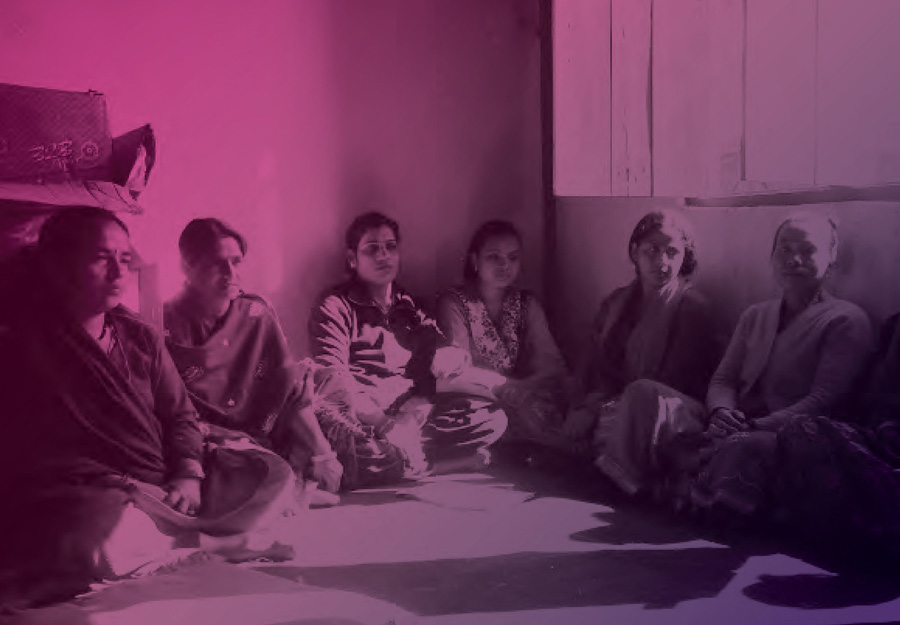
Grassroot women discussing safe abortion in Morang, Nepal.
Introduction
In 2006, the ARROW Board of Directors began a process of developing an organisational Code of Ethics that would guide the organisation and provide a feminist compass to the work that ARROW undertook.
This Code of Ethics is in turn based upon ARROW's mission and long-term objectives1 which are as follows:
ARROW's mission
ARROW is committed to advocating and protecting women's health rights and needs, particularly in the area of women's sexuality and reproductive health. We believe that good health and wellbeing and access to comprehensive and affordable gender-sensitive health services are a fundamental human right.
ARROW's long term objectives:
- Health, reproductive health and population policies and programmes are re-oriented to become more accessible, affordable, and comprehensive, and include a gender and rights approach.
- The women's movement and civil society become stronger and more effective in holding governments accountable to international commitments, influencing policy agendas on women's health and rights, and gaining sustained representation on decision-making structures.
- Women's health outcomes and women's lives improve, especially for poor and marginalised women and girls, particularly in the area of sexual and reproductive health and rights (SRHR), and violence against women.
ARROW defines ethics as a set of principles by which behaviour can be judged to be appropriate or inappropriate. This code describes the ethical values believed in and committed to, both individually and collectively by ARROW's Board, Programme Advisory Committee members and staff.
As a feminist organisation, ARROW believes that the principles on which the COE is based include feminist, human rights and humanitarian principles.
How to use the COE
The COE can be used in the work of ARROW in all its aspects from planning, implementation, evaluation and for both staff and Board work. Some uses are:
- As an ethical guide for daily interpersonal relations and conduct both in the office, staff and Board, within the Board, Programme Advisory Committee and in relationships with partners, donors, meeting participants and all people encountered by the staff and Board in the work of ARROW.2
- As the basis for the principles and conduct behind policy and procedure development.
- In personnel appraisals.
- In defining competencies and competency capacity building training for staff and board.
- As a guide for any kind of principled or ethical decision making.
- For guiding and decision making for conflict resolution, grievances and misconduct assertions.
- As an ethical guide in strategic planning processes, as well as activity planning.
Review of the COE
As with all other ARROW policies, when new, the COE will be reviewed after one year of implementation by the Board and staff to see if and how it was used and how useful it was. Any changes and additions can be made at this stage. As with other ARROW policies, there will be a review every 2 years. It is proposed that the Code is monitored through the development of perception indicators related to the principles within the Code, and feedback sought from different constituent groups — staff, board, PAC and partners.
Scope of Application
The COE applies to all employees, Board Members and PAC Members when they act in representation or on behalf of the organisation.
The Purpose of the Code of Ethics
ARROW's COE serves to:
- Express ARROW's collective commitment to specific principles and standards of conduct.
- Clarify ethical responsibilities
- Help support ARROW's mission and vision.
- Establish principles and standards that define and guide ethical attitudes and behaviour.
- Provide the basis for the processing of ethical issues and complaints including prioritising conflicting principles.
Other potential benefits are that it can:
- Increase ethical sensitivity and judgement.
- Strengthen support for individuals' moral courage.
- Help to hone ARROW's sense of identity.
ARROW's Values3
- Commitment to quality: Striving to produce a high quality in everything we do (both in terms of outputs and processes) as high quality is critical to effectiveness.4
- Fairness: Respecting peoples' equal right to participate and to be treated equally well and to develop as human beings irrespective of their differences of position, education, religious beliefs, personality, body size, class, race and sexual preference etc. [this value is an important component of equity], and to remain secular and non-sectarian.5
- Social justice: Striving to recognise and address the various power hierarchies of class, gender, race, sexuality etc., and being aware of power relations and the ways in which patriarchy and other social and economic systems manifest themselves, and the importance of the origins of the feminist movement in subverting patriarchy.
- Generosity: Sharing information, resources and time wholeheartedly and responsively, rather than hoarding or clinging, believing that ARROW will not be depleted by sharing.6
- Honesty: Being straightforward and to tell the truth, but to ensure appropriateness of venue, delivery and methodology, and to be aware of and listen to all perspectives.
- Innovation or Creativity: Constantly doing new things or trying new processes in order to be more effective.7
- Participatory: Consulting and involving staff, the Board, the Programme Advisory Committee (PAC) and partners in strategic and operational decisions and sharing information in the belief that more informed and active contributions will lead to organisational effectiveness and quality as well as work satisfaction and commitment to ARROW.8
- Transparency: Being open and honest about information and decisions as critical to achieving real participation and fairness.
THE CODE OF ETHICS: Commitment to quality
We commit to:
- Ensuring that we prepare for and implement each task through our best effort.
- Seeking feedback from our peers and relevant stakeholders on how to further improve a task to achieve a high level of quality.
- Seriously giving time and follow up to personnel appraisals, both our own and others.
- Accepting feedback and criticism on our performance without denial and defensiveness.
- Rigorously evaluating our own and the organisation's impact, achievements, lessons learned, and the ways to improve impact and achievement.
- Ensuring all communications, both spoken and written, are very clear, accurate, comprehensive, timely, and polite.
- Ensuring reports and publications are clear, accurate, and timely, designed creatively, tailored to needs and are highly valued and utilised by the target groups.
- Identifying our strengths and weaknesses honestly and developing and implementing a plan to develop our competencies to an excellent level.
- Ensuring that no harm is done to women or others involved in ARROW monitoring and research projects.
- Ensuring ARROWs finances are extremely well managed, monitored and audited and lead to excellent sustainability of the organisation.
Fairness
We commit to:
- Providing and requesting salaries and work conditions which are fair according to market rate assessments and existing salaries of ARROW staff.
- Ensuring personnel appraisals are based on careful assessment of evidence of achievements and competency following procedures.
- Developing, implementing and following grievance procedures when appropriate.
- Being unbiased in perception and decision making related to people we work with so as their class, race, religion, size, personality, sex, sexual preference, colour, do not make a difference to how we regard and treat them.
- Treating all staff, Board, PAC and partners equally and not giving special favours and privileges to those we know better or like more.
- Ensuring that the principle of ‘do no harm’ is incorporated within all of ARROW's research work, and that the organisation subscribes to the highest level of research ethics when conducting research or evidence generation work.
- Ensure that we do not privilege or promote or align with any religious or sectarian interests or positions or organisations.
Social justice
We commit to:
- Striving to recognise and address the various power hierarchies of class, gender, race, sexuality etc.
- Continually striving to be aware of and discussing new issues of gender inequity in the work place and at home.
- Pointing out any discriminating ARROW attitudes, policy and practice based on gender roles/differences, class, race or sexuality and trying to rectify this.
- Providing and accessing appropriate maternity leave and breast feeding breaks according to ILO guidelines and family leave and encouraging colleagues to access these.
- Following and encouraging flexi work schedules of beginning and ending the work day in acknowledgement of gender roles and family responsibilities.
- Ensuring that all relevant policies, procedures and the work environment are gender- sensitive and emphasise safety from gender violence and discrimination.
- Respecting equally men who work with ARROW and participate in meetings, ensuring they feel comfortable and are not marginalised.
- Ensure all project proposals are equitable in the distribution of resources between local, national and regional counterparts involved in the project implementation.
Generosity
We commit to:
- Sharing fully all information and resources proactively and when requested especially the most useful and critical.
- Always giving slightly more than less when there is a choice, to ensure people are appropriately reimbursed and compensated.
- Being non-judgemental about peoples' actions, understanding their intentions, motivations, circumstances and the evidence.
- Responding wholeheartedly and prompdy to requests for assistance, especially to partners in need.
- Listening fully to others and giving them the time they need to express themselves.
- Expressing genuine appreciation and gratitude to colleagues, Board, PAC, partners and others.
Honesty
We commit to:
- Providing accurate and complete information of all kinds and wherever appropriate, to management, staff, funders, the public and partners.
- Never distorting, misleading, hiding or misrepresenting information for personal or the organisation's gain.
- Keeping completely confidential, information so requested and not disclosing to outsiders, personal information about ARROW which may not be in the organisation's interest.
- Expressing our views and comments openly and fully yet with sensitivity on concerns and issues for the benefit of the organisation.
- Providing accurate and complete claims, reports, leave, travel requests and financial reports, statements, funder's reports and annual reports.
- Using ARROW property and resources for ARROW work only, following all guidelines on equipment and supplies.
- Declaring a conflict of interest (COI) in personnel recruitment, contracts, supplies, consultancies etc. and following COI policies.
- Speaking out when there is clear evidence of dishonesty at any level.
- Giving work related comments directly yet sensitively to the person rather than behind their back, refraining from personal and judgemental comments.
- Keeping the individual and organisational promises and agreements we made, including agreements such as adhering to a flexi time schedule.
- We commit to ensure that feedback and confidential information given to management and board be handled with utmost delicacy and care while finding a solution.
Innovation or creativity
We commit to:
- Dreaming big, bold ideas that have the chance of becoming a new plan, project, strategy or process.
- Trying new ways of seeing and doing things through loosening and opening up rather than tightening up and clinging to old ways.
- Listening to and encouraging the full expression of new ideas by all.
- Being confident, courageous and willing to implement the new ideas.
- Acknowledging and appreciating creativity and innovation and their impact.
Participation
We commit to:
- Ensuring that ARROW includes participatory processes in all aspects of the work with Board, PAC, staff and partners, in particular strategic planning and evaluation.
- Sharing chairing of meetings and the other facilitative work of the organisation so that leadership is not the responsibility of only a few.
- Planning and implementing participatory processes into all aspects of our work, believing that people have a right to participate in decision making and that quality, effectiveness and ownership will be better.
- Asking for input into draft agendas of all meetings and seminars etc. so that others can contribute to identifying issues and content.
- Sharing facilitation of leadership in meetings so that others will experience this responsibility and also develop their capacities.
- Ensuring we do not dominate in meetings, talk too often or put people down to the extent that this hinders the participation of others.
- Encouraging the participation of peers, staff, partners and PAC and Board in the planning, implementation and evaluation of ARROW.
Transparency
We commit to:
- Openly sharing among staff all information, documents, plans and financial statements which are not specified as confidential, through procedures and methods established for this.
- Explaining the reasons honestly for management decisions made.
- Following procedures for sharing information transparently.
- Having closed sessions in meetings only on matters agreed to be confidential in ARROW such as individual staff salaries and individual staff competencies/performance.
- Openly explaining and minuting the reasons behind Board and/or management team decisions and comments.
ETHICS GOVERNING FUND-RAISING, COMPETITION FOR RESOURCES AND INVESTMENT OF GENERAL FUND RESERVES
- ARROW should conduct a preliminary background check on all new donor partners with whom we choose to cooperate. We should ensure that the requirements of the donor organisation do not in any way impinge on ARROW's political independence.
- ARROW should apply as far as possible, for global or regional donor fund allocations, so as not to compete with national level organisations who are attempting to secure resources for work within the national context.
- ARROW's General Fund investments should refrain from choosing financial packages that involve investment in the following:
- Mining
- Oil and Gas
- Defense or Arms Development
- Tobacco
- Alcohol
Orientation, enforcement and violation of the COE
Orientation
All new staff and Board members will be given a copy of the COE document and the opportunity to clarify any questions. The COE will be included in the staff and Board formal orientation programmes.
Enforcement and violation
All staff and Board members are encouraged to ensure that the COE is used and becomes a positive ethical tool for both behaviour and development of policies and procedures. Emphasis is on using it for guidance and inspiration rather than as a stick for misconduct.
When grossly violated, the COE can be used as a guide for establishing poor performance in the probation or annual appraisal of staff and as misconduct as defined by the work conditions and entitlements document.
When the COE is not followed and there is considered to be a minor but important violation by staff, this can be handled informally by the supervisor, manager, ED and Board in an attempt to inspire better behaviour by referring to the COE. Procedures on this may need to be developed.
When a staff or Board member feels there is a gross violation which puts the organisation at risk (this needs to be defined), a formal complaint can be made to the COE committee to be set up and comprised of nominated staff and Board members. This will consist of 2 staff and 2 Board members. The Committee could also have either 2 PAC members or 2 Friends of ARROW members who are based in Malaysia. This would help in the balance of power if the Board itself is complained about.
This committee when set up, may choose to use tools from other COE's to assess and decide if there is indeed a violation or not. The committee would then report to both the Board and Staff.
Paper prepared by Rashidah Abdullah and Saira Shameem on 27th November 2008. Amended based on May 2009 BOD meeting discussions, December 2009.
Above amendments accepted at May 2010 Board meeting with highlighted areas requiring feedback and development based on implementation of the Code as it currently appears.
ANNEXE 2 ARROW Conflict of Interest Policy for Members of ARROW's Board of Directors and Staff
1. Policy Principle
The purpose of the Conflict of Interest Policy is to ensure that the deliberations and decisions of the governance body of ARROW and of all members of its staff are made in the interests of the women for whom ARROW advocates, and to protect the interests of ARROW when it is contemplating entering into a transaction, contract or arrangement that might benefit the private interest of a Director or a staff member. A Director or staff member may not use her position in ARROW or confidential information obtained by her relating to ARROW in order to achieve a financial benefit for herself or for a third party, including family or another non-profit organisation. ARROW is committed to maximising appropriate transparency in its decision-making processes and documentation.
2. Definitions
- 2.1 Staff shall refer to the professional staff of ARROW (full-time or short-term), which shall include all direct or in-direct reports to the Executive Director, and any other staff member designated by the Board of Directors.
- 2.2 Compensation includes direct and indirect remuneration, as well as gifts or favours that are substantial in nature.
- 2.3 Family includes the spouse, siblings and their spouses, parents or children and their spouses.
- 2.4 Financial interest occurs when a Director or staff member has:
- An existing or potential interest in any entity with which ARROW has a transaction, contract or other arrangement;
- A compensation arrangement with ARROW;
- An interest in or compensation arrangement with an entity with which ARROW is negotiating a transaction, contract or other arrangement;
- An interest in or a compensation arrangement with any entity whose business will be directly affected by a decision or action of ARROW.
- 2.5 Interested Director shall mean any Director of ARROW, including the Executive Director, while staff member shall mean any employee of ARROW, who has a material financial interest as defined in 2.3 or who serves as a Director or equivalent of any entity with which ARROW has a transaction, contract or other arrangement.
3. Procedures
- 3.1 The ARROW Board places great importance on making clear any existing or potential Conflicts of Interest for its members and members of the ARROW staff. All such conflicts shall be declared by the Director or staff concerned and documented in either the Board of Directors Conflict of Interests Register or the Staff Conflicts of Interest Register. An interested Director will abstain from participation in the Board's consideration of the proposed transaction, contract or arrangement from which benefit might arise; the same goes for any staff member during decision-making.
- 3.2 Any business, professional or personal matter which is or could be a Conflict of Interest involving the individual and her role and relationship with ARROW must be declared and registered in an ARROW Conflicts of Interest Register. For the Board, all such entries in the Register shall be presented to the Board and minuted at the first Board meeting following entry in the register. For the staff, all such entries shall be registered at the Staff meeting, while Managers and the ED shall register their Conflict of Interest at the Management Team meetings. The Management Team meeting minutes that include the Registry of COI of Management Team members will be shared with all the staff during the subsequent Staff meeting.
- 3.3 The Agenda of each Board of Directors or staff meeting will be presented in advance of the meeting so that the Directors or staff members have an opportunity to become aware of business terms which may present to them a Conflict of Interest. Declarations of Interest will be a standard item on the Agenda of each meeting of the ARROW Board of Directors or Staff or Management Meeting, preceding the discussion of business.
- 3.4 Where a conflict of interest is identified and/or registered, the Interested Director or staff is not permitted to participate in any decision on that topic or topics felt by the Meeting to be closely related. Preferably, the Interested Director or staff member should leave the room during discussions leading to a decision and during the decision taking.
- 3.5 The ARROW Board of Directors or Management Team may exercise its discretion and invite an Interested Director or staff member, respectively, to remain present as a participant in, or as an observer of the discussion of items for which there is a conflict of interest, or decision taking thereof.
- 3.6 The ARROW Board of Directors (in the case of Directors) or Management Team (in the case of staff) shall determine whether ARROW can obtain a more advantageous transaction, contract or arrangement with reasonable efforts from a person or entity that would not give rise to a conflict of interest.
- 3.7 If a more advantageous transaction, contract or other arrangement is not reasonably attainable under circumstances that would not give rise to a conflict of interest, the Board or Management Team shall determine by a majority vote of the disinterested Directors or Management Team members whether the arrangement is in ARROW's best interest and whether it is fair and reasonable to ARROW and shall make a decision accordingly.
- 3.9 The minutes of the relevant meetings shall contain the names of the persons who were present for discussion and votes relating to a transaction or arrangement in connection with a conflict of interest, the contents of the discussion, including any alternatives to the proposed transaction or arrangement, and a record of any votes taken in connection.
- 3.10 In the case of conflicts of interest for staff members that are unresolved at the Staff meeting level, these shall be referred to the Management Team for resolution. Conflicts of interest that are unresolved at the Management Team level shall be referred to the ARROW Board of Directors for resolution.
4. Violations
- 4.1 If the Board has reasonable cause to believe that a Director has failed to disclose an actual or possible conflict of interest, it shall inform the Director of the basis for the belief and offer the Director an opportunity to explain the alleged failure to disclose. Meanwhile, the Management Team shall also do the same for the staff who has failed to disclose an actual or possible conflict of interest.
- 4.2 If after hearing, the response of the Director and making relevant inquiries, the Board determines that the Director has failed in fact to disclose, it can institute disciplinary and corrective action. On the other hand, for ARROW staff, if after the same process, the Management Team determines that the individual has failed in fact to disclose, it can refer the matter to the ARROW Board of Directors.
- 4.3 The violation of this Conflict of Interest Policy is a serious matter and may constitute “cause” for removal or termination of a Director or staff member, in accordance with ARROW Articles of Association, or the termination of any contractual relationship ARROW may have with the interested individual.
The Conflict of Interest Policy for ARROW Board Members was amended and approved at the May 2008 ARROW Board Meeting. The Conflict of Interest Policy for Staff was amended and approved at the April 2007 ARROW Board Meeting.
ANNEXE 3 Terms of Reference of the Board of Directors
(Extracted from the By-Lows of ARROW)
Role and functions of the Board
The Memorandum and Articles of Association of ARROW outline the main responsibilities of the Board which are summarised as follows:
- Terms of Board Members: Board members will be appointed for a term of three years. Renewal for a second term of three years is acceptable. The exception is the Founder-Director who may remain a Board member until she resigns or dies (as stated in the Memorandum of Articles of Association). Appointment letters will be issued stating the specific term dates and responsibilities of Board members.
- Chair of the Board: Board meetings will be chaired by collectively sharing this responsibility and allocating agenda items. The Board will function as a collective without a nominated chairperson.
- Role of Malaysian Board Members: Malaysian Board members have additional responsibility due to their geographical location. These are:
- Signing Audited Accounts with one Director taking responsibility as “the main Director with financial responsibility;”
- Signing BOD Memorandum for the Company Secretary;
- Cheque signing in the absence of one staff signatory;
- Signing the Annual Return to the Registrar of Societies.
The ARROW Board, however, has delegated the operational responsibilities to the Executive Director, and thus plays a governance role.
Responsibilities of the Board
Specifically, the Board is responsible for:
- The appointment of the Executive Director;
- Ensuring ARROW's financial policy, procedures and practices are in order and that they contribute to financial sustainability; and
- Appointing the external auditor and endorsing the accuracy of the Audited Accounts as recommended by the Executive Director.
In addition, the Board is responsible for the following as defined by ARROW:
- Finance
- Approve Annual Audited Accounts, which includes a statement that accounting and financial procedures are in order.
- Approve 5-year budget as part of Work Programme Budget.
- Approve Annual Operations Budget and any major changes during the year.
- Comment on Quarterly or Half Year Finance Statements/Report variances compared to Budget from Management Team.
- Approve Financial Guidelines which include responsibilities of ARROW staff to authorise expenditure.
- Approve the setting up of any funds such as Operational Reserve Funds, Retrenchment Fund, Staff Welfare Funds.
- Approve any investment of ARROW's surplus funds.
- Approve purchase of property.
- Review staff salaries and approve any changes to scales, etc.
- Sign cheques as the BOD signatory to ARROW staff group.
- Personnel Matters
- Approve any changes to staff positions in terms of numbers and structure.
- Interview and appoint the Executive Director and develop/approve the Job Description.
- Consult with the Executive Director on appointment of senior ARROW staff.
- Annual Performance Appraisal of the ED.
- Supervision of the Executive Director through feedback on Executive Director's Annual Work Plan, Annual Reports and other reports given to the BOD and in supervision sessions requested by Executive Director or initiated by the BOD.
- Follow grievance procedures if staff complaint is related to Executive Director.
- Approve double increment for staff recommended for excellent performance by Executive Director (and for Executive Director's post).
- Approve any re-employment of staff after Retirement Age.
- Approve termination by ARROW of any staff, besides fixed term contracts.
- Amend, approve and review the Staff Work Conditions and Entitlement Policy Document.
- Amend, approve and review the Human Resource Development Policy Document.
- Work Programme
- Review and approve the 5-year Work Programme.
- Review and approve the Annual Work Programme and Budget.
- Contribute to, review and approve the ARROW mission, and long-term objectives.
- Contribute to, review and approve the Annual Report to funders and the Popular Annual Report for stakeholders.
- Contribute to and approve Terms of Reference of External Programme and Organisational Evaluations.
- Review and approve major funding proposals for core funding and projects.
- BOD Policies
- Develop and approve BOD Terms of Reference.
- Decide on Appointment of new BOD members and any extension of a 2nd term.
- Elect a Chair and any other office bearers/signatories.
- PAC Policies
- Approve PAC Terms of Reference.
- Approve new PAC members and any extension of a 2nd term.
- Requirements of Companies Act for ARROW as a Company
- Review and amend the Memorandum of Association and the Articles of Association.
- Sign any BOD Memorandum to the Registrar of Societies regarding appointment of new BOD members, opening of bank accounts etc.
- Sign the Annual Submission of Accounts and Annual Return to the Registrar of Companies before 30 June each year.
- Sign Notice of BOD and AGM Meetings and the Minutes of BOD and AGM Meetings.
- Hold two BOD meetings and one AGM, ensuring meeting notice is given at least seven days before the meeting.
ANNEXE 4 ARROW Board of Directors' Competency Assessment Tool
| Core Competency | Level 1 | Level 2 | Level 3 | Level 4 |
| 1. Shared beliefs & values (Source: M. Casey Tool 1.05) | No common set of basic beliefs and values (e.g., social, cultural, etc.) exists within organisation | Common set of basic beliefs and values exist in some groups within organisation, but is not shared broadly; beliefs and values are only partially aligned with organisational purpose and constituents norms, or are rarely harnessed to produce impact | Common set of basic beliefs and values held by many people within organisation; helps provide a sense of connection to organisation; beliefs and values are aligned with organisational purpose and constituents' norms, and are occasionally harnessed to produce impact | Common set of basic beliefs and values exists and is widely shared within organisation; helps provide a sense of connection to organisation and a clear direction for behaviour; beliefs and values are embodied by leader but are also timeless and stable across leadership changes; beliefs and values clearly support organisational purpose, are in line with constituents' norms, and are consistently harnessed to produce impact. |
| 2. Board composition & commitment (Source: M. Casey Tool 1.106) | Membership with limited diversity in fields of practice and expertise; drawn from a narrow spectrum of constituencies relevant to the organisation; little or no relevant experience; commitment to organisation's success, vision and mission is unclear; meetings are sporadic and/or attendance is sometimes poor | Some diversity in fields of practice and expertise; membership represents a few different constituencies relevant to organisation; some evidence of commitment to organisation; solid evidence of commitment to organisation's success, vision and mission; regular, purposeful meetings are well planned and attendance is consistently good; regular subcommittee meetings | Good diversity in fields of practice and expertise; membership represents most constituencies relevant to the organisation's success, vision, and mission, regular, purposeful meetings are well-planned and attendance is consistently good; regular sub-committee meetings | Membership with broad variety in fields of practice and expertise, and drawn from the full spectrum of constituencies relevant to the organisation, includes functional and issue area expertise, proven track record of learning about the organisation and addressing its issues; consistently demonstrated commitment to the organisation's success, mission, and vision, regular purposeful meetings are well-planned and attendance is consistently strong; regular meeting of focused sub-committees |
3. Governing Board commitment and effectiveness on SRHR research, monitoring and advocacy (Source: ARROW Tool) |
10% or less of Governing Board includes persons with SRHR expertise |
The Governing Board includes 11–32% person with SRHR expertise, and 1–19% with research, monitoring and advocacy experience 11–33% of the Governing Board members are from government or private health corporations. The Governing Board meets once a year, endorses policy decisions suggested by leadership, demands legal accountability, but rarely accountability in areas such as performance and legal matters. |
The Governing Board includes between 33% to 50% people with SRHR expertise; 20–40% people with research, monitoring and advocacy experience; and less than 10% of members are from government or private health corporations. The Governing Board meets once in six months; takes policy decisions, effectively on areas listed in level 4; and demands accountability with regard to performance and legal matters. |
The Governing Board includes more than 50% of persons with SRHR expertise, and more than 40% with research, monitoring and advocacy experience. The members of governing Board are totally independent of government and private health corporations. The Governing Board are totally independent of government and private health corporations. The Governing Board meets once in four month; takes policy decisions on SRHR monitoring, research, advocacy and accountability effectively; and, holds the organisation accountable in three respect s legally, financially and with regard to performance. |
| 4. Board governance (Source: M Casey Tool 1.07) | Roles of legal board, advisory board, and management are unclear; board rarely scrutinises budgets, holds CEO/ED accountable, or operates according to formal procedures | Roles of legal board, advisory board, and management are clear; board functions according to bylaws, reviews budget, and occasionally sets organisational direction and targets, but does not regularly review CEO/ED performance, monitor potential conflicts of interest, scrutinise audits, or review IRS and state filings | Roles and legal board, advisory board and management are clear and function well; board reviews budgets, audits, IRS and state filings, size of board set for maximum effectiveness with formal nomination process; board co-defines performance targets and actively encourages CEO/ED to meet targets, annual review of CEO/ED's performance, but board not prepared or fire CEO/ED | Legal board, advisory board, and management work well together from clear roles; board fully understands and fulfils fiduciary duties; size of board set for maximum effectiveness with rigorous nomination process; board actively defines performance targets and holds CEO/ED fully accountable; board empowered and prepared to hire for fire CEO/ED if necessary |
| 5. Board involvement & support (Source: M Casey Tool 1.08) | Provide little direction, support, and accountability to leadership; not fully informed about materials and other major organisational matters; largely “feel-good” support | Provide occasional direction, support and accountability to leadership to leadership; generally informed about all material matters in a timely manner; input and responses often solicited | Provide direction, support, and accountability to leadership; fully informed about all material matters; input and responses actively sought and valued; full participant in major decisions | Provide strong direction support, and accountability to leadership and engaged as a strategic resource; communication between board and leadership reflects mutual respect, appreciation for roles and responsibilities, shared commitment, and valuing of collective wisdom |
| 6. CEO/ED organisational leadership/effectiveness (Source: M. Casey Tool 1.10) | Some difficulty building trust and rapport with others; micromanages projects; shares little of own experiences as developmental/coaching tool; inconsistent attention to organisational vision | Responsive to opportunities from others to work together, generally confident in others ability to be successful; shares own experience and expertise; visible commitment to organisation and its vision | Actively and easily builds rapport and trust with others, effectively encourages others to succeed; shares relevant experience and expertise, yet gives others freedom to work their own way, try out new ideas, and grow; shows constant commitment to organisation and its vision; inspires others around vision | Constantly establishing successful, win-win relationships with others, both within and outside the organisation, delivers consistent, positive, and reinforcing messages to motivate people, finds or creates special opportunities to promote people's development, lives the organisation's vision, compelling articulates path to achieving vision that enables others to see where they are going |
| 7. Board and CEO/ED appreciation of power issues (Source: M. Casey Tool 1.13) | No explicit attention given to power issues (e.g., of race and class) | Power issues occasionally acknowledged and discussed; policies and/or procedures developed on an ad hoc basis to address these issues | Power issues regularly acknowledged and discussed; basic policies and/or procedures exist to address these issues | Power issues regularly acknowledged and discussed; well established policies and procedures exist to address these issues, and are routinely reviewed and revised |
ANNEXE 5 Job Description of the Executive Director
EXECUTIVE DIRECTOR
1. ORGANISATIONAL CONTEXT
Description of ARROW and Organisational Context
The Asian-Pacific Resource and Research Centre for Women (ARROW) was formed in 1993 as a not-for-profit organisation which works to promote the reorientation of health, population and family planning policies to include women's and gender-perspectives. Current priorities for ARROW are women's rights to comprehensive, accessible and quality health services, the adoption of abroad sexual and reproductive health and rights approach, women-centred and gender-sensitive health policies and programmes and the recognition of violence against women as an important women's health concern. ARROW has a computerised Documentation Centre on women's health, produces a regular series of publications and is engaged in monitoring and research projects.
ARROW's strategies are:
- To advocate for policy and programme reorientation through the acquisition, production and distribution of practical materials to individuals and organisations accessed through a strategic database developed for Asia and the Pacific; and
- To monitor and evaluate change in policies and programmes through regional action research in partnership with women's NGOs involved in national and international advocacy.
Main programme activities of ARROW have been the production of publications; the development and maintenance of a documentation centre and information services; and research activities, particularly research co-ordination.
ARROW operates from Kuala Lumpur but works in the interest of all women in the region of Asia and the Pacific. Governance of ARROW is by a Board of Directors. ARROW seeks advice and support from a Programme Advisory Committee which meets annually.
Philosophy of ARROW
Vision statement
An equal, just and equitable world, where every woman enjoys her full sexual and reproductive rights.
Mission statement
To promote and defend women's rights and needs, particularly in the areas of health and sexuality, and to reaffirm their agency to claim these rights.
Long-term programme objectives
Systems, policies and programmes are reoriented to:
- Uphold gender equality and sexual and reproductive health and rights; and
- Ensure that health systems deliver comprehensive, gender-sensitive and rights-based services for sexual reproductive health that are accessible, just, equitable and of the highest quality.
Women's movements and civil society are strong and effective in:
- Influencing policy agenda on women's health, sexuality and rights;
- Holding governments and donors accountable to international and national commitments; and
- Gaining sustained representation on decisionmaking structures.
- Women's lives and health outcomes improve, particularly in the area of SRHR, especially for poor and marginalised women.
Practice Principles
In accordance with the organisation's mission statement, all staff employed by ARROW are expected to have an active commitment to women's rights and the advancement of women's well-being. It is expected that this commitment will be evident in all interactions within ARROW and with the community of stakeholders advocating for change to social, environmental, political, and financial barriers to health on behalf of the women of Asia and the Pacific.
2. ROLE CONTEXT
The Executive Director's role is to provide leadership to the organisation, programme and management team in terms of vision, strategic planning, and overseeing processes to ensure a high quality programme and sustainable and effective organisation.
3. RESPONSIBILITIES OF THE POSITION
3.1 Organisational Development
- Provide leadership in long-term vision in terms of ARROW's mission.
- Lead strategic thinking in Policy development, organisational effectiveness, organisational and personnel structure and processes, and programme evaluation.
- Ensure that the mission, interests and reputation of the organisation are a priority of staff and volunteers, and are not compromised by any inappropriate action.
- Oversee development of excellent proposals and successful negotiation processes with potential funders.
- Lead the Management Team to provide substantive contributions to ARROW's organisational development.
- Lead productive Management Team Meetings and staff meetings.
- Consult and provide comprehensive and strategic reports and information on the progress of the organisation and programme to the Board of Directors and Programme Advisory Committee.
- Provide technical input or consultancy on request to international organisations, governments or non-governmental organisations (NGOs) which are stakeholders of ARROW's programme and/or identify expertise outside the organisation.
- Represent ARROW on appropriate International and Regional Advisory Boards, Technical Committees, etc. of international organisations, government and non-government organisations (NGOs).
- Promote the work of ARROW to strategic individuals and organisations and encourage their participation in the programme.
- Ensure that all ARROW publications reflect the values and mission of ARROW.
3.2 Programme Planning and Development
- Be responsible for high quality planning, implementation, and evaluation of an integrated and effective programme relevant to ARROW's objectives.
- Ensure that input from relevant policies, programmes, consultative bodies (e.g. Advisory Committee), and outcomes of conferences are included into the programme to enable it to be ‘on track.’
- Provide substantial technical inputs when necessary to publication development, meetings and other aspects of implementation of the programme when a high level of expertise is required and/or identify and elicit such expertise outside the organisation.
3.3 Human Resource
- Assist management staff to develop individual and programme/project work plans where appropriate.
- Provide regular supervision to management staff and share supervision of the Administrative Assistant/Secretary with the Manager, Administration and Operations.
- Ensure personnel policies and procedures are in place, implemented and evaluated for effective and fair recruitment, remuneration, promotion, development and appraisal of ARROW staff.
- Oversee personnel recruitment processes for senior positions in ARROW.
3.4 Finance and Legal
- Ensure that ARROW complies with statutory, legal and other requirements according to relevant Malaysian laws (Companies Act, Labour Act etc.).
- Ensure plans and procedures are developed and implemented for ARROW's financial sustainability, efficiency, and accountability to the Board and to funders.
4. Accountability
The Executive Director is responsible to the Board of Directors.
ANNEXE 6 Executive Director Performance Appraisal Form

Strictly Confidential
PERFORMANCE APPRAISAL FORM
(Executive Director)
Name : ___ Section : ___
Designation : ___ Date Joined : ___
Period Under Review: ___
Instructions & Rating System:
- The appraiser is advised to read the instructions carefully to facilitate the completion of the Performance Appraisal Form.
- The appraiser is required to adhere to the following rating criteria throughout the appraisal exercise:
| 1 | 2 | 3 | 4 | 5 |
| Below average performance. Although some targets are met, close supervision and coaching are required. | Reasonable performance. Meets most, but not all, basic target areas and expectations. | Competent performance. Meets all basic target areas. Has significant strengths in areas that count. | Very competent performance. Exceeds targets in some areas, while meeting all other targets. Continually adds value to ARROW. | Outstanding performance. Highly competent staff that exceeds targets in a majority of areas. Independently delivers results. |
SECTION 1 — MAJOR ACCOMPLISHMENTS / CORE RESPONSIBILITIES
Instructions to Appraiser: The employee's overall performance shall be assessed in accordance with major work tasks accomplished, projects undertaken and core responsibilities assigned. At least five (5) most critical major accomplishments/core responsibilities must be identified. Please use Rating Scales 1–5 when filling the “Rating” column.
No. |
KEY PERFORMANCE INDICATORS / MAJOR ACCOMPLISHMENTS (May include process indicators and/or output indicators) |
RISK ASSESSMENT (Statement of external variables that could impact on achievements) |
Rating |
| 1 | |||
| 2 | |||
| 3 | |||
| 4 | |||
| 5 | |||
| Total Score | |||
| Additional Questions Regarding Attitudes within Work Areas | Comments | ||
| 6. | Ability to meet work plan schedules and targets on time, and at an appropriate standard of quality. | ||
| 7. | Indicate any assignments that were performed in a particularly effective way. | ||
| 8. | Review the list of job duties — are all being carried out? Any additional functions being done? | ||
| 9. | Adequacy of supervision and/or assistance of supervisor? Were there enough supervision sessions? | ||
| 10. | Ability to supervise and/or develop staff (where applicable). | ||
| 11. | Staff's attitude towards ARROW | ||
SECTION 2 — CORE COMPETENCIES
Instructions to Appraiser: Core Competencies ore observable qualities used to drive effective performance. Please use Rating Scales 1–5 when filling the “Rating” column. Some of the core competencies used may differ for respective POs, based on the requirements of their individual job descriptions.
B. ARROW's COMPETENCY DIMENSIONS
| BUILDING PARTNERSHIP | IMPACT AND INFLUENCE | MANAGING GROUP PROCESSES | TEAM LEADERSHIP | RELEVANT SPECIALISED KNOWLEDGE | STRATEGIC THINKING | NEED FOR ACHIEVEMENT | COMMUNICATION |
| RATING | |||||||
| Total Score | |||||||
SECTION 3 — ATTITUDES & VALUES
Instructions to Appraiser: Attitudes and Core Values are predetermined to assess the Manager's organisational fit. Please use Rating Scales 1–5 when filling the “Rating” column.
| No. | Core Attitudes and Values | Rating |
1. |
SELF-MANAGEMENT Having the ability for effective time management, professional conduct, self-discipline, self-motivation and priority-setting. |
|
2. |
INITIATIVE Taking the initiative in doing new things or trying new processes in order to be more effective. |
|
3. |
CONCERN FOR QUALITY Striving to produce a high quality in everything we do (outputs and processes) as high quality is critical to effectiveness. |
|
4. |
PARTICIPATORY NATURE & TEAMWORK Consulting and involving staff, the Board, the Programme Advisory Committee (PAC) and partners in strategic and operational decisions and sharing information in the belief that more informed and active contributions will contribute to organisational effectiveness and quality as well as personnel work satisfaction and commitment to ARROW. |
|
5. |
INTEGRITY Being open and honest about information and decisions as critical to achieving real participation and fairness. |
|
6. |
FAIRNESS & RESPECT Respecting peoples' equal right to participate and to be treated equally well and to develop as human beings irrespective of their differences of position, education, personality, body size, class, race and sexual preference. (This value is an important component of equity.) |
|
7. |
STAMINA AND ADAPTABILITY Physical and mental capability for hard work, handle multiple work demands simultaneously, and ability to remain flexible in adapting to diverse work environments as well as work demands. |
|
8. |
WORK RELATIONSHIPS Effectiveness in working harmoniously with other staff members and persons outside the organisation in official contacts |
|
9. |
PUNCTUALITY As regards to working hours, meeting attendance, etc. |
|
| Total Score | ||
SECTION 4 — OVERALL RATING / COMMENTS
Instructions to Appraiser: The rating for each section is required to be transferred to the column provided below for computation. Weightage has been calculated according to the following ratio: Accomplishments 60%: Competencies 20%: Values 20%.
| Sections | Total Score | Weighted Average | |
| 1 — KPIs/Major Accomplishments | Total Score for Section 1 / 25 x 3 = | /3 | |
| 2 — Core Competencies | Total Score for Section 2 / 40 x 1 = | /1 | |
| 3 — Core Values | Total Score for Section 3 / 45 x 1 = | /1 | |
| Overall Rating | /5 | ||
SECTION 5 — STAFF DEVELOPMENT PLAN
Instructions to Appraiser: The appraiser is required to highlight the training and developmental needs of the appraisee in this Section. Considering the appraisee's overall effectiveness during the review period, identify any areas which, if further develop, would strengthen the appraisee's overall performance.
| No. | Competency (Knowledge and skills) | Proposed Training & Developmental Action Plans | Urgency | |
| Moderate | High | |||
SECTION 6 — SIGNATURES BY APPRAISER AND APPRAISEE
| Appraiser's Signature | Executive Director's Signature |
| Name : | Name : |
| Designation : | Designation : |
| Date : | Date : |
| Appraisee's Signature | Staffs Response to supervisor's appraisal: |
| Name : | |
| Designation : | |
| Date : | |
| Recommendation of supervisor regarding probation or annual increment. : | |
ANNEXE 7 ARROW Work Conditions And Entitlement Policy
Introduction
This document was developed with the intention of explaining and protecting the rights of all ARROW staff, as general workers and as women, so that they would not be subject to abuse, discrimination or inequality from their supervisors, the Executive Director, the Board of Directors and their colleagues.
It conforms with the legal requirements of the Malaysian Employment Act 1955 and Employment (Amendment) Act 1998, and the Industrial Relations Act, but as the Employment Act is only applicable to staff whose wages do not exceed RM1,500, the Act applies to a small minority of staff. In many aspects, the document goes beyond this, guided by ILO recommendations, the principles and goals of the women's NGO movement and the values of ARROW as a women's health and rights focused organisation. It was reviewed and approved and finalised by ARROW's Board of Directors in January 2002. It is based on the ARROW's Work Conditions and Entitlements Document, February 1994.
2.1 PROBATION
- 2.1.1 A staff on first engagement shall have a three or six-month probationary period depending on their experience and the contract period, in order to determine ability for satisfactorily carrying out the tasks required within the job description. A performance appraisal will be carried out before the Probation ends to recommend confirmation in the post if the performance is satisfactory, or termination, or an extension of a further three-month probation if performance is not at an acceptable level. The probationary period may be waived at the discretion of the Executive Director.
- 2.1.2 When confirmed, a letter of confirmation will be given to the staff.
- 2.1.3 During the probation period, one month's notice on either side is required for termination of services.
2.2 REMUNERATION
- 2.2.1 Staff shall be paid salaries according to the scale stated in their appointment letters.
- 2.2.2 A staff who has shown outstanding effectiveness and efficiency and rated as overall excellent in their annual appraisal may be granted an additional merit annual increment(s).
2.3 EPF/SOCSO
- 2.3.1 Employees Provident Fund (EPF): All staff are entitled to a monthly EPF contribution from ARROW and staff are required to contribute a percentage of their monthly salary towards EPF. The rates of the contributions are based on the current requirements and options of the EPF.
- 2.3.2 Social Security (SOCSO): Staff drawing a monthly salary of less than RM2,000 are required by the Employees Social Security Act 1969 to contribute to SOCSO (which covers disabilities due to accidents when working) as per the scale set by SOCSO. ARROW as the employer will contribute towards the scheme as per the scale. Staff drawing a monthly salary of more than RM2,000 who wish to contribute to SOCSO may do so.
2.4 WORKING HOURS/OVERTIME
- 2.4.1 The number of working hours in a normal working day is 7.5 hours excluding lunch hour with work scheduled between the hours of 8.00 a.m. and 6.00 p.m. for five days per week.
- 2.4.2 Staff may request time off for one to two hours for urgent personal business once every fortnight. This is to be recorded by the supervisor and the hours made up within a month.
- 2.4.3 Staff will be allowed time off for breast-feeding as per ILO guidelines.
- 2.4.4 Staff drawing a salary not exceeding RM1,500 are eligible for overtime at the rate1 which complies with the Employment Act and is as stated in ARROW's Financial Procedures. Hours worked in excess of 37.5 hours per week and which are claimed as overtime require approval in advance from the supervisor.
2.5 LEAVE
2.5.1 Annual Leave
- a) Staff shall be entitled to 24 days of annual leave on the basis of two days of earned leave per month. Accruals begin at the start of the probation period.
- b) Under normal circumstances, annual leave of one to two days is to be applied at least one week before the date of the leave. Leave of longer duration needs to be submitted two weeks before and be endorsed by the Supervisor and Executive Director. Other leave will have to have approval from the Supervisor or be at the discretion of the Executive Director.
- c) Annual leave may not be granted at times by the Supervisor or Executive Director due to operational requirements. The reason for this decision will be noted in the leave form.
- d) Staff are encouraged to complete their annual leave within the calendar year. Any request to carry forward annual leave requires approval from the Executive Director, and in the case of the Executive Director, the approval is from the Board.
2.5.2 Sick Leave
- a) Staff are entitled to 18 days sick leave per year where no hospitalisation is necessary; however, a certificate from a registered medical or dental practitioner to verify this is required.
- b) Time-off for urgent medical or dental appointments during office hours is to be deducted from the 18 days sick leave (with certificate) in Para. 2.5.2 (a).
- c) 60 days in each calendar year are permitted for hospitalisation. This 60 days includes the 18 days of sick leave in Para. 2.5.2 (a). If a staff is certified by a registered medical practitioner to be ill enough and needs to be hospitalised, but wishes to stay at home for any reason, the staff shall be deemed to be hospitalised, and entitled to the 60 days.
- d) Any staff suffering from serious illness requiring prolonged absence from work will be granted on the basis of a registered medical practitioner's recommendation, in addition to sick leave in Para. 2.5.2 (c) above, a maximum of 90 working days with pay within a year.
- 2.5.3 Leave-in-Lieu
When it is approved for a staff to work on a Saturday or Sunday, or a public holiday, for purposes of attending meetings, seminars or other ARROW activities, or travelling to/from overseas meetings, a day off in lieu may be requested and should be applied for within 2 months of the event date. Prior approval will be needed from the immediate Supervisor or the Executive Director on the number of days off in lieu based on the required hours to attend the activities or travelling time.
2.5.4 Family Leave
- a) Maternity Leave
- A female staff will be entitled to 90 days of maternity leave at the ordinary rate of pay provided that she has been employed by ARROW for a minimum period of 90 days in the aggregate during the nine months immediately preceding her confinement.
- Maternity leave may only commence on or after the 28th week of pregnancy and leave of absence from work due to any illness or miscarriage during the first 28th weeks shall be considered as normal sick leave as provided under Para. 2.5.2 (a).
- Staff concerned are required to inform the organisation early as to the estimated due date of the birth.
- b) Paternity leave
- Three days leave for a male staff whose wife gives birth will be granted.
- c) Parental leave
- Six days leave taken from the 18 days of sick leave entitlement may be made available to care for sick children or parents. A medical certificate/authorisation letter will be given to the immediate supervisor to verify this.
- 30 days leave will be granted when a child is newly adopted by a staff.
- d) Compassionate leave
- Three days paid leave in the event of death of a member of the staff's immediate family; specifically the spouse, partner, children, parents, brothers, sisters, grandparents, and parents-in-law.
- e) Emergency leave
- Two days paid leave when fire, flood, earthquake, landslide civil disorder, a strike, or a crime endangering the life or property of the staff or their immediate family.
- 2.5.5 Long-Service Leave
15 days leave after five years of service, planned for normally 3 months in advance and awarded for rejuvenation purposes in recognition of loyalty and long services to the organisation.
2.6 PUBLIC HOLIDAYS
- 2.6.1 Staff will be entitled to all public holidays enjoyed in Wilayah Persekutuan.
- 2.6.2 If a public holiday falls on a Sunday, Monday will become a leave day.
- 2.6.3 Staff will be given a half-day leave immediately before one main public holiday of their respective religious holiday or festivals.
2.7 MEDICAL CHECK-UP AND HEALTH BENEFITS
- 2.7.1 All staff are to undergo a pre-employment medical check-up as required by baseline information on their health. The medical checkup should normally be done and the report given before the letter of appointment is issued.
- 2.7.2 Staff are entitled to a “Well-being Allowance” of a flat rate of RM500.00 per staff per year which will be given to the staff in payments of RM250.00 every six months. This is intended to cover any expense related to health, medical, dental, alternative treatments, vitamins, exercise, etc. which the person considers are necessary for their health and wellbeing both preventive and for actual treatment. (Note: Subject to evaluation at the end of 2003, an amount of RM41.66 is included in the staff monthly salary.)
- 2.7.3 Staff will be covered under the Personal Accident and Hospitalisation Insurance scheme immediately as soon as they come into ARROW.
2.8 TRAVELLING ALLOWANCES
- 2.8.1 Mileage claim: A staff who is required to use her own vehicle/car for carrying out ARROW's work is entitled to be reimbursed as per ARROW's Financial Guidelines.
- 2.8.2 Passport/Visa applications: Where and when it is work-related, ARROW will cover all costs for new and renewal of passports, and visa applications.
- 2.8.3 Per Diem: A staff who is required to work outstation beyond 100km from office or overseas, and is not provided with accommodation and allowance by other parties is entitled to a per diem rate based on ARROW's Financial Guidelines.
- 2.8.4 Travel Insurance: Travel insurance for official overseas travel will be provided for all staff when travelling for ARROW activities.
2.9 PERFORMANCE APPRAISAL
- 2.9.1 The appraisal involves the self-appraisal of the staff and the appraisal by the Supervisor using the standard ARROW Appraisal Form according to ARROW's Performance Appraisal Procedures.
- 2.9.2 Both the staff concerned and supervisor are to sign the form; a copy is to be given to the staff and the original to be kept confidentially.
- 2.9.3 Performance appraisal will take place during probation, annually and at other times when considered necessary by the Supervisor and the Executive Director.
2.10 DISCIPLINARY ACTION
- 2.10.1 Misconduct, inefficiency and indiscipline will be dealt with first in a performance appraisal structure (review, documentation, and discussion) in which the staff will have the opportunity to speak in their defence. If this process is considered to be insufficient, depending on the nature of the behaviour, a disciplinary action shall consist of:
- (i) a letter, documented in the confidential personal file,
- (ii) deferment of one annual increment (for a short period or up to one year),
- (iii) suspension without pay up to seven days, or
- (iv) dismissal.
- 2.10.2 Action (ii), (iii) and (iv) require recommendations from the Supervisor and Executive Director endorsed by the Board in a Board of Directors' meeting including a “hearing” for the staff concerned. A person of staff choice from outside of ARROW may be present during the hearing.
- 2.10.3 The staff has the right to initiate a grievance as outlined in Para. 2.11 provided that any action taken under Para 2.10.1 shall stand while the appeal is being processed.
2.11 GRIEVANCE
- 2.11.1 A grievance is a complaint by a staff, which is brought to the attention of the immediate supervisor but subsequently not settled to the satisfaction of the staff. In this case, the staff can approach their manager or the Executive Director, who will review the complaint and act as arbitrator.
- 2.11.2 If the grievance is to the Executive Director herself, which is brought to her attention but subsequently not settled to the satisfaction of the staff, the staff may approach the Board of Directors. The Board of Directors may meet to listen to a presentation of the grievance and document the efforts of problem resolution.
2.12 TERMINATION OF CONTRACT OF SERVICES (EMPLOYMENT)
2.12.1 In addition to any other ground or grounds for termination that ARROW may have in law, the contract of service:
- (a) can be terminated by ARROW on the following grounds:
- (i) Serious misconduct: In cases of serious misconduct which includes acts of a criminal nature, e.g. fraud, forgery, assault, criminal breach of trust, theft, etc., as well as gross subordination, the management can terminate the services of the staff if after due inquiry and all steps in Para. 2.10 has been completed,
- (ii) Redundancy or closure of the organisation: As a result of redundancy arising from reorganisation or scaling down of operation, or due to closure of the organisation, services of the staff may be terminated.
- (iii) Poor performance: When the staff's performance is not at an acceptable level, and if despite corrective steps having been taken by Management, the performance does not reach an acceptable level, such staff's services may be terminated.
- (B) shall terminate upon:
- (i) Retirement: A staff's services will be terminated when she reaches the retirement age as per Para. 2.15.1.
- (ii) Expiry of Fixed-Term Contract: A staff with a fixed-term contract, i.e. a staff employed for a specified period based on the funding cycle, will be terminated when the contract expires, with notice given to the staff according to the required time stated in the contract,
- (iii) Frustration of contract: A staff contract of employment with ARROW is “frustrated” when the staff becomes unable to perform the work which she was employed for on account of reasons beyond her control such as serious and prolonged illness; incapable of doing her work as a result of an accident; or detention of the staff by authorities for a lengthy period of time.
- (C) can be terminated by the employee by way of resignation with notice given according to Para. 2.13.1. Recommendation of termination must be informed to and agreed by the Board of Directors for all of the above except fixed term contracts and resignation.
2.13 RESIGNATION
- 2.13.1 A staff has the right to resign from her employment with ARROW. A written notice of at least three (3) calendar months is required for the Executive Director and two (2) calendar months is required for the Managers. A notice of one (1) calendar month is required for other staff. Before leaving the organisation and receiving the final salary, the staff is required to return to ARROW any money owing and all property belonging to ARROW in the staff's possession, custody or control.
2.14 RETRENCHMENT BENEFITS
- 2.14.1 When a staff position is terminated due to organisational restructure or closure, she will be entitled to a retrenchment benefit providing the staff has at least 12 months' continuous service, on the basis of:
- (i) 10 days' wages for each year of service if employed less than two (2) years;
- (ii) 15 days' wages for each year of service if employed for two (2) or more but less than five (5) years; or
- iii) 20 days' wages for each year of service if employed for five (5) years or more. An incomplete year shall be calculated to the nearest month on a prorated basis.
2.15 RETIREMENT AGE
- 2.15.1 Subject to review and discretion of the Executive Director and the Board of Directors, the normal retirement age of the full-time staff in ARROW is when they reach sixty (60) years of age.
2.16 RIGHT TO VARY TERMS AND CONDITIONS
- 2.16.1 ARROW reserves the right to vary the terms and conditions of employment from time to time as is found to be necessary, such variation to be effective upon notification to staff. Whenever possible, this will be done after discussion and consultation with all staff.
ANNEXE 8 Sample Letter of Agreement between ARROW and a Partner
Date
Name of Partner
Contact details
Letter of Agreement (LOA) between the ASIAN-PACIFIC RESOURCE AND RESEARCH CENTRE FOR WOMEN (ARROW), and the Partner for strengthening ground support for ICPD Beyond 2014 processes through UN processes
1. Background
The next two years will mark the lead-up to the critical target date for the 20th year review of the International Conference on Population &. Development (ICPD) Programme of Action (PoA).
In the lead-up to 2014 there are opportunities to ensure the voices from ground-up demonstrate the evidence and the advocacy that the SRHR agenda truly belongs to the women at the ground level.
Currently there is a High-Level Task Force on ICPD Beyond 2014 which advocates a strong re-commitment to the ICPD agenda and the UNFPA ICPD Beyond 2014 process also talks of country consultations, regional meetings and international conferences and UN meetings around the process. In September 2013, the key regional meeting of governments on the ICPD agenda will take place in Bangkok, convened by both UNESCAP and UNFPA.
This is an important meeting for advocacy in the region. This meeting the 6th Asian and Pacific Population Conference (APPC) in mid-2013 will serve as the key regional inter-governmental meeting within the ICPD review process; and release the regional political commitment statement towards the ICPD agenda.
Hence it is critical in the lead-up to 2014, that the national advocacy and national voices around the ICPD agenda are heard and add strength and greater constituency to the ICPD agenda at regional and international levels. It is essential to bring the national advocates to lobby with their government representatives to push forward the SRHR agenda with their government representatives.
This proposed work ensures local and national ownership of the SRHR agenda through the following key strategies:
- 1) utilising the ICPD Beyond 2014 processes to demonstrate the on-ground constituency of the agenda through national advocacy, national stakeholders and national needs;
- 2) evidence-generation across countries and the creation on national level advocacy briefs on the status of SRHR, and clear ‘asks’; and
- 3) national level advocacy dialogues to ensure policymakers are on-board with the agenda.
This proposed work will also address the urgent need to revitalise the role of national level NGOs and movements as key drivers for the SRHR agenda within the ICPD review processes:
- 1) as development partners;
- 2) to monitor and hold governments accountable to their national and international commitments;
- 3) to continue advocating for issues which are new and innovative (such as sexuality rights) as well as those which are necessary but perceived as contentious (culture/country specific gender inequality issues such as child marriage; access to comprehensive sex and sexuality education and access to safe abortion services) in order to help improve SRHR outcomes; and
- 4) to demonstrate clearly that the SRHR agenda is a bottom-up agenda and not one that is imposed by donor countries.
The key countries being proposed for this work are:
- In Southeast Asia: Cambodia, Lao PDR, Vietnam, Thailand, Malaysia, Indonesia and the Philippines
- In East Asia: China
- In South Asia: Nepal, Bangladesh, Pakistan, India and the Maldives
2. National Level Project Work (Bangladesh)
For Bangladesh, the partner will focus to maintain and improve the maternal death record documentation in the lowest tier of governmental union-so called Parishads- in the selected locality of south-west coastal belt of Bangladesh. The effort was aim to further escalate the issues of maternal health documentation trough audit in the ground to the key stakeholder especially public government, so that key policies and programme able to gauge the issues.
National Advocacy Plan for (Partner):
| Number | Activity | Timeline | Responsibility | Budget |
| 1 |
Half day orientation workshops on registration of maternal deaths and maintenance of maternal death records (36). 1.1 Participants: Chairman, Members, Secretary and Chowkidar of 36 Union Parishads under 5 upazilas of Barguna district in the southwest coastal belt of Bangladesh. 1.1 Participants: Barguna District Civil Surgeon, Deputy Director Family Planning and from 5 Upazilas Family Planning Officer, Statistician and Family Planning Inspector. |
June-August 2013 |
Partner and CBO Supported by CBO |
× × |
| 2. | 1.1 Upazila-level press conferences (5) | September | Partner and 5 CBO partners | × |
| 3. | Meetings with key policy makers to lobby for adoption of improved system of registration and record keeping | September | Partner | × |
| 4. | Administration and Human Resources | June-September | Partner | × |
| Total in Bangladeshi Takas | × | |||
Key outputs include:
- 50% Union Parishads under the purview of this intervention are registering and recording maternal deaths accurately and in adherence to standards.
- Local-level elected public representatives are active in monitoring the functioning of chowkidars.
- National level policy makers are made aware of the lapses in the current system of death registration and record keeping and adopt remedial measures.
3. Obligations
Both parties agree to make their best efforts in the spirit of partnership and cooperation to carry out project activities as mentioned above in the LOA. Changes regarding the activities and schedule shall be made only after dialogue with ARROW.
OBLIGATIONS OF ARROW
- ARROW will provide technical assistance to the extent that this is possible, and in accordance with the activities stipulated by the national advocacy plan.
- ARROW is responsible for regular communication on the information pertaining to the regional advocacy events, and timely transfer of funds on the basis of the budget and work-plan and based on the receipt and approval of reports, activity and budget plans, and requests for transfer.
OBLIGATIONS OF THE PARTNER
- As project partner of ARROW, the partner holds the primary responsibility for the implementation of the activities at the local and national level and to notify ARROW of any changes or delays in the activities.
- {Partner) is responsible for ensuring the funds are handled in accordance to the LOA and that the funds are being used for the activities only according to the approved budget.
4. The Grant and Transfer of Funds
An allocation of USDx has been allocated for listed activities outlined for The Partner from June 2013 — September 2013. The transfer of funds will be made after receipt by ARROW of the following:
- The enclosed countersigned copy of this LOA, and
- A completed copy of the attached Transfer Request Form.
This grant is made only for the purposes stated in LOA. It is understood that these grant funds will be used for such purposes substantially in accordance with the attached approved budget. It is also understood that no substantial variances will be made from the budget without ARROW's prior approval in writing. Any grant funds not expended or committed for the purposes of the grant, or within the period stated above, will be returned to ARROW.
5. Reporting
The Partner will be responsible for reporting of the national advocacy activities, and will submit the below mentioned reports to ARROW. ARROW must receive the following reports from the Partner regarding the project:
- Narrative report: A narrative account of what was accomplished by the expenditure of funds, including a description of progress made towards achieving the goals of the grant.
- Financial report: The financial report must be submitted to ARROW. A financial reporting, in local currency and US dollars, according to the line-item category of the approved budget, which includes a statement by the responsible financial officer of your organisation certifying the accuracy of the report. The financial report is to be sent to ARROW on 30 September, 2013 along with all receipts (original/hard copies).
6. Anti-Corruption Clause
All partners entering agreements with ARROW will need to abide by ARROW's anti-corruption policy. Please find it here: http://www.arrow.org.my/?p=arrows-anti-corruption-policy
7. Dispute
Should any dispute arise to the implementation, orientation or any other aspect of this Agreement, the parties shall make all efforts to reach an amicable solution, with the aim of solving these disputes between the parties in a friendly manner, through dialogue. In case we cannot solve a dispute, an external independent mediator should be appointed in order to seek a mutually satisfactory solution. Should this not be possible, such dispute shall be submitted to the jurisdiction of the courts of Malaysia.
8. Agreement Conditions
This Agreement shall enter into force as soon as both parties The Partner and ARROW have signed the present agreement, and the Agreement shall remain in force until the termination of the project, and until ARROW have approved the final reports and final audited accounts. The Agreement can only be changed by mutual agreement.
If this LOA is accepted by you, please indicate your organisation's agreement to such terms by having the enclosed copy of this letter countersigned and returning the letter to ARROW in Kuala Lumpur, and keeping a copy for yourself. Communication regarding administrative arrangement for this fund should be directed to (Name of ARROW staff) via e-mail at (___).
Thank you.
With best wishes,
(Name)
Executive Director, ARROW
ACCEPTED AND AGREED:
The Partner
By: ....................................................................................................
(Name)
...........................................................................................................
(Signature)
...........................................................................................................
(Position)
...........................................................................................................
(Date)
ANNEXE 9 WHRAP-South Asia Steering Committee Terms of Reference
Introduction
The WHRAP-SA Steering Committee (SC) is the decision-making body of WHRAP-SA. It consists of the Executive Director/Coordinator/focal decision making person of the WHRAP-SA national NGO partners and ARROW, and a focal person from DFPA.
Aims
The WHRAP-SA SC will:
- Strive to make WHRAP-SA an effective advocacy partnership;
- Reflect collectively to learn from experiences of the partners; and
- Facilitate greater coordination between the national WHRAP-SA partners, ARROW and DFPA.
Roles and Responsibilities
With reference to achieving the mission of WHRAP-SA, the SC shall:
ADVOCACY
- Set the strategic direction of the WHRAP-SA advocacy and partnership decide on strategies for engaging with other key actors and institutions related to the WHRAP advocacy agenda.
- Keep track of the advocacy agenda and opportunities.
LEARNING
- Review and assess the effectiveness of WHRAP-SA's advocacy and partnership strategies and implement adaptations accordingly.
- Ensure continuous reflection and collective learning from the field experiences of the partners.
GOVERNANCE
- Monitor fulfilment of the objectives1 and mission.2
- Review the effectiveness of the M&E system.
- Monitor the compliance to the principles of the partnership.3
- Propose mechanisms for resolving partnership issues.
MANAGEMENT ARRANGEMENTS
- ARROW will be the Secretariat to the SC and ensure that the decisions taken are communicated promptly and implemented.
- The bi-annual meetings of the SC will be decided/announced at the beginning of the year.
- The SC can also invite members from the working groups and/or external resource persons to participate in SC meetings.
- The SC will develop criteria for the expansion of the SC membership.
- It is critically important for the SC members to attend the scheduled bi-annual meetings; in exceptional circumstances, should an SC member not be able to participate in a particular meeting, the member can pre-nominate an alternate senior representative or board member from the organisation to substitute her.
- The SC will utilise a standard meeting agenda, as developed in the SC meetings of April and October 2010.4
Annex 1 — Terms of Engagement of WHRAP-South Asia
WHRAP is based on a commitment towards the health rights of poor and marginalised women and girls (within the overarching framework of human rights, SRHR and gender equality), creating a comprehensive model to bring about positive change across local, national, and global arenas.
WHRAP signifies commitment to the following principles:
- Inclusive, informed and participatory decisionmaking however where there is lack of consensus, majority decision will prevail;
- Accountability within the partnership;
- Transparency between and amongst partners in the areas of decision-making, finance and programme content;
- Regular and open communication of work, resources, challenges, and plans;
- Recognition, appreciation and acknowledgement of each others' ideas, efforts, contributions, and the diversity of national and local contexts;
- Partnership development that is based on critical feedback;
- Development of new leadership through mentoring, nurturing and creating of opportunities; and
- Learning from successes, challenges as well as failure, through a process of review and reflection.
Annex 2 — Standard SC Meeting Agenda format
|
Date: Proposed Chair: ≪each half day session to have assigned chair persons to facilitate meeting≫ |
Reference documents | |
| 1. Welcome | ≪Time for each agenda item≫ | |
| 2. Comments to Agenda | ||
| 3. Minutes of last meeting & matters arising | ||
| Learning from reflection of implementation | ||
|
4. SC to ensure continuous reflection and collective learning from the field experiences of the partners through sharing of information from recent activities/updates from all WHRAP partners with a special focus on outcomes of advocacy activities and any follow up actions for WHRAP-SA:
|
||
| Advocacy | ||
|
5. WHRAP-SA advocacy related agenda items
|
||
| Monitoring & Evaluation | ||
|
6. WHRAP-SA M&E related agenda items
|
||
| Capacity building | ||
|
7. WHRAP-SA capacity building related agenda items
|
||
| Governance | ||
|
8. WHRAP-SA governance related agenda items
|
||
|
9. Budget and finances
|
||
|
10. Evaluation of the meeting
|
||
|
11. Any other business
|
||
|
12. Next meeting
|
||
| Meeting closes | ||
Amended based on SC meeting minutes of October 2010, April 2011, September 2011 and December 2011.
ANNEXE 10 ARROW for Change Editorial Team Guidelines1
Following are the guidelines for the function of the Editorial Team that includes the guidelines for the engagement of External Reader in the review of the ARROW for Change or AFC. This is part of a larger document on bulletin guidelines and policies, titled, ARROW for Change Guidelines and Policies.
1. The Editorial Team
The Editorial Team is composed of the Executive Director (ED), the Programme Manager for Information and Communications (Infocom PM), the AFC Programme Officer (AFC PO)/AFC Managing Editor (see no. 2 for details on the roles of AFC PO), selected members of the programme team that have expertise on the issue (if any), and a guest editor or guest issue coordinator (if any).2
The Editorial Team is expected to ensure that the conceptualisation of the bulletin theme is appropriate and that appropriate contributors are identified and produce quality outputs; ensure that overall conceptualisation and development of the bulletin runs smoothly and that timely decisions are taken to produce a high quality output; and is responsible for troubleshooting and making final decisions to problems faced.
In particular, the Infocom PM is expected to:
- Supervise and provide support to the AFC Programme Officer, including monitoring of the bulletin work plan's schedule and managing the production processes;
- Give guidance and feedback to the AFC PO on bulletin theme suggestions;
- Give feedback and suggestions on the concept note developed by the AFC PO, including on articles to be featured and possible authors and reviewers, including attending the brainstorming meeting;
- Take part in Editorial meetings with the AFC PO and suggest ways to resolve any problem faced and consult the Executive Director if necessary;
- Provide feedback on the articles for the AFC PO's consolidation;
- Approve the text of the bulletin sections before the first layout; and,
- Carry out a second round of checks on the bulletin layout before it goes to the printers.3
The Executive Director is expected to:
- Provide strategic and operational guidance to the Infocom PM and AFC PO;
- Give final approval to the AFC proposed themes;
- Offer troubleshooting suggestions if and when consulted by the Programme Manager;
- Give feedback and suggestions on the concept note developed by the AFC PO, including on articles to be featured and possible authors and reviewers; and,
- Give final approval on the bulletin before printing.
Additional programme team members who have specific expertise on the bulletin theme may also be asked to join the Editorial Team of a specific issue, wherein their roles may include providing comments on the concept note and reviewing specific articles.
All programme staff also contribute to producing the AFC issue in various ways, including providing input at the AFC Concept Note Brainstorming Meeting, where the concept note of a specific AFC issue is presented for comment to programme staff, and writing the annotations for the AFC Resources section.
The roles of the AFC Managing Editor and of Issue or Guest Editors are explained in more detail below.
2. AFC Managing Editor
This role is performed by the AFC Programme Officer. The AFC Managing Editor has several roles and responsibilities:
Overall
- Implementing the bulletin work plan and overseeing all aspects of the different stages and sections of AFC publishing (conceptualisation, development, editorial and production)—including conceptualisation; getting writers, expert readers, designers, printer, and external consultants (as needed) onboard and coordinating and liaising with them; copyediting; design and artwork; and printing.
- Scheduling and keeping track of dates and bulletin processes vis-à-vis the work plan to enable the Editorial Team to accurately assess problems and trying to solve these with the advice of the Infocom PM and ED.3
- Keeping an eye on costs (trying to keep the publication within budget, anticipating whether editorial or design changes will increase costs and notifying the ED/Infocom PM and/or Finance Officer when the publication exceeds its budget);
Conceptualisation and Development:
- Conducting information searches and prepares a list of proposed themes for upcoming AFCs, in consultation with the programme staff and Infocom PM, and with the approval of the ED, which are then presented at the Programme Advisory Committee meeting.
- Conducting information searches in the ARROW SRHR Knowledge Sharing Centre (ASK-us!) and online, and conceptualising each AFC issue, drafting concept notes with a proposed list of contributors, with the help of ARROW programme staff and PAC members.
- Doing desk research/information searches and compiling/writing for the following sections of the AFC:
- Definitions
- Resources Section (the ASK-us team provides support in finding appropriate materials; also there are times when other staff annotate some resources
- Fact file (other programme officers also contribute for this section; if there is budget, this can also be outsourced)
- Getting writers and external expert readers on board, and coordinating and liaising with them regarding submission of articles and/or comments.
Editorial:
- Serving as a fact checker, although the expert external readers may also point this out.
- Copyediting the articles (ranges from light copyediting—checking for errors in grammar, spelling, punctuation, usage, and style—to heavy/substantive copyediting).
- Compiling comments from the expert external readers and the ARROW Editorial Team (i.e., Executive Director, Programme Manager, and AFC PO) and communicating these to the contributors for rewriting. On occasion, the AFC PO may incorporate the changes herself (cleanup editing) and send the revised articles to the writers for approval. (In case of disagreement over the changes, the ARROW Editorial Team may exercise its right as bulletin publisher to make the final decision, including whether to proceed with publishing the articles.)
Production:
- Hiring and liaising with the designer/layout artist, providing him/her with the necessary graphics and final text, proofreading (checking for typographical and mechanical errors in the laid-out publication) and going over the layout before it goes to the printer; getting bids from printers; liaising with the chosen printer regarding printing quality and delivery; proofreading and approving the printer proofs.
Monitoring and evaluation:
- Designing a system for receiving feedback, editorial review, and overall evaluation of the bulletin, together with the Infocom PM.
Editorial guidelines:
- Reviewing and updating the AFC Editorial Guidelines as necessary, drafting the paper and presenting this to the Programme Advisory Committee and Board for feedback.
3. Guest Editor
This refers to consultants hired to develop the AFC concept note and write the editorial. This modality is used in cases where external expertise is particularly needed. The Guest Editor is expected to introduce ARROW to the authors, but the rest of the coordination and editorial work are taken on by the AFC Managing Editor. The Guest Editor may also, at their own preference, choose to review articles.
4. Issue Coordinator
This was the term used prior to the usage of Managing Editor, and the current term used when consultants are hired to produce an AFC issue (this modality is used in cases where there is significant backlog in production and the schedule needs to be brought up to speed, or when there are human resource issues). The amount of work varies, and may include writing of concept notes, contributing a major article and other minor AFC sections, liaising with writers, and light copyediting.
The Managing Editor/AFC PO and/or the Infocom Programme Manager is/are still expected to supervise the Issue Coordinator's tasks and the quality and timeliness of outputs. The staff and the Programme Advisory Committee still review the concept note, while expert readers still review the articles.
5. Programme Advisory Committee (PAC)
The PAC plays a critical role in the development of the AFC bulletin and in ensuring that it remains a cutting-edge and practical-oriented tool most useful to its Asian-Pacific readers. Currently, PAC roles and responsibilities with regards to the AFC are as follows:
- Providing feedback and giving recommendations on the themes AFC will feature;
- Providing input on the AFC concept paper, particularly on the politics of the issue, useful resources on the theme, and people/organisations to approach for article contributions and to serve as expert external readers;
- Serving as an AFC resource pool, acting as expert external reader or contributing articles when relevant; and
- Providing guidance on AFC editorial policy matters.
Aside from the yearly PAC meeting in April, the AFC PO consults the PAC through email.
6. Expert External Readers4
ARROW invites expert external readers based on their considerably long professional involvement and expertise on the theme and on their having a clear understanding of women's and gender perspectives. They can be Programme Advisory Committee members and ARROW friends, recommended by programme staff or PAC members, or known experts in the field who surface as part of the mapping during preparation of the concept note. They should preferably be working in or have expertise in Asia or the Pacific. Expert external readers' review one to three articles each, depending on their availability. Review of articles is pro bono.
The expert external readers provide feedback on articles along these categories:
- Political perspective: The expert external readers are mainly responsible for ensuring that the articles promote women's, gender and rights-based perspectives, and that the viewpoints forwarded are progressive and contribute towards the overall advancement of discussions on the theme and are expressed using appropriate and sensitive language.
- Content: Expert external readers will be mainly responsible for providing suggestions to improve the content quality of at least two of four AFC articles (a combination of the Editorial, the Spotlight Articles, and the Fact File). Suggestions should contribute to fully fleshing out the chosen AFC theme, highlighting important issues, and strengthening the article and the bulletin's overall content. Suggestions should be as concrete and as specific as possible (e.g., telling the author and the ARROW editorial team which section's content needs improvement and the ways to do so, including pointing to specific resources which could be used). When making the editorial comments, expert readers should also bear in mind ARROW's strict limitations in article length (Editorial: 1,200 words; Spotlight Articles: between 700–1,300 words; Fact file: 600 words (plus table); Endnotes are included in the article length).
- Readability: Since ARROW's target groups and readers consist of different levels of exposure to concepts and innovations in the field of promoting “gender-sensitive,” “women-centred” and rights-based perspectives, as well as on the theme of the bulletin, the language used in the articles should be as simple as possible and easily understandable. The article should also flow logically and coherently. As such, expert external readers are asked to provide suggestions on making the article more accessible, functional, and appropriate for AFC's target audience.
- Accuracy and currency of facts: Expert external readers are welcome to help spot such inaccuracies and provide alternative and more recent sources.
External expert readers may also be asked to provide input on the concept paper. This is purely depending on the interest/willingness of the expert external readers.
Expert external readers are not responsible for actual rewriting of articles or for copyediting (checking for errors in grammar, spelling, usage, and style). Nor will they be asked to assist with the design and layout of the bulletin, or with the proof reading (checking for typographical and mechanical errors in the laidout publication). The AFC Managing Editor/PO is responsible for these tasks.
The expert external readers work closely and communicate with the AFC Managing Editor/PO. The latter is responsible for communicating the readers' recommendations to the writer.
7. Designer/Layout artist5
Design, layout and production co-ordination are performed either by the Publications Officer or by an external consultant whose tasks are as follows:
- Laying out the publication;
- Ensuring that the quality of the graphics and images meets print standards, sometimes also sourcing photos or developing graphics as needed;
- Making the necessary revisions, doing it at the ARROW office if necessary and at the request of the ARROW coordinating staff (maximum of 4 times);
- Creating ready-to-print files and submitting these both to ARROW and to the printer.
- Creating an e-copy (pdf) of the whole book and an e-copy (jpeg) of the cover for uploading to ARROW's website.
- S/he may also be expected to liaise with the printers to ensure the best quality output possible within the budget.
ANNEXE 11 ARROW Human Resource Development Policy
Introduction
The Human Resource Development Policy was approved by the Board of Directors in May 2002 in recognition that the provision of high quality programmes contribute to the competent performance of all staff. The principles, application and limitations are included in the document Human Resource Development Policy.
4.1.1 PRINCIPLES
- (i) ARROW recognises that the provision of high quality programmes contributes to the competent performance of all staff. Continuing higher education, lectures, workshops, seminars, field visits, exposure trips etc. are means by which ARROW staff gain/update their knowledge and skills in order to maintain and improve performance.
- (ii) ARROW's objectives will be best met in an environment which encourages individual staff to realise their full potential both in their current positions and in preparation for future roles.
- (iii) Staff are encouraged to undertake any necessary and mutually beneficial educational courses both at a higher level and in specialised areas where such qualification and knowledge is required for the efficient performance of their present duties or for their progress along a recognised career path and for ARROW's work.
- (iv) Where a minimum standard of education is stipulated for admission to a specific course, staff must have reached that level before ARROW will contemplate approval of a course of study for examination leave purposes. ARROW support will only be available for attendance at programmes and courses assessed as being presented by appropriately accredited providers.
4.1.2 APPLICATION
Human Resource Development is defined as any education, training or development activity undertaken under the auspices of ARROW, with the objective of contributing to the improvement of knowledge and skills and the ultimate performance of the staff. Needs in this area can be identified or can become apparent through a range of mechanisms. These include:
- strategic planning outcomes
- performance management and appraisal
- work performance indicators
- observation
- performance related disciplinary procedures
- organisational change and development
- introduction of new technology
- development of new services and programme areas
- changing professional standards or methodologies
- formal needs assessment processes
(i) Development options
It is important that the response to needs identified through all or any of the mechanisms outlined above is appropriate.
It should not be automatically assumed that training is the key to development. While the provision of skills training is an important element in some of these areas, it is an inappropriate and often unfruitful response where personal or professional development or the furtherance of tertiary qualification is most appropriate to sustain medium or long term change.
Additionally, in areas of, for example, poor performance, a purely training response may only serve to treat the symptom rather than the underlying condition which ultimately reappears. A considered and appropriate response is therefore essential. Listed below are some development related opportunities which ARROW can provide, do not entail cost or training per se and are also regarded as human resource development activities in ARROW.
- job rotation
- project work
- temporary assignments
- higher duties
- representational roles, e.g. in meeting and conferences
- participation in working groups
- committee or team work
- coaching
- job placement in another organisation
- mentoring
- constructive feedback
- close supervision (clinical or managerial)
- work redesign
- job sharing
- working with/contributing to professional groups
- exposure trips and exchange visits
- paper writing and presentation
- conference/workshop participation
- country visits
All options should be considered when determining the appropriate response to development needs identified.
(ii) Responsibility
Responsibility in this area is shared between the organisation, managers and employees and each has an important role. ARROW will have in place appropriate policy and support mechanisms which encourage and assist employees at all levels to continually develop their skills, understanding and knowledge.
ARROW
Through a range of mechanisms, ARROW, will continually review and assess human resource development needs across the organisation.
From time to time ARROW may require staff to participate in external courses, lectures, workshops, seminars and other events to:
- assist them in their personal and professional development
- to enable them to achieve greater proficiency in their present position or to prepare them for positions of increased responsibility
- keep them up to date in specialised areas of knowledge
- promote ARROW's standing in the field of women's health.
Where it is considered preferable or if external programmes do not adequately fulfil ARROW's requirements, training and development programmes may be devised and conducted within ARROW and selected employees may be invited to participate.
Executive Director, Programme and Administrative Managers
The ARROW Management Team is responsible for the provision of training and development opportunities for staff within their area, based on needs identified by the individual and the overall programme or administrative needs.
Therefore, the Executive Director, in consultation with middle managers should ensure that they:
- (a) identify the individual and group needs of their staff
- (b) determine appropriate interventions to equip staff with skills and knowledge that will:
- improve performance, efficiency, effectiveness and specific skill levels
- develop a commitment to the organisation by providing stimulating learning opportunities for personal growth and positive change
- provide a skills base for ARROW which will allow it to adequately meet staffing needs in the short, medium and long term.
- (c) Provide, as far as practicable, reasonable resources for staff in the form of time, learning materials and the opportunity for practical application of learned skills (subject to prescribed limits as detailed in agreements or other policies).
- (d) Encourage and motivate staff to participate in activities which will assist them in meeting their potential.
Individual Employees:
Individual staff members are expected to accept a high degree of responsibility for their own education and development through:
- assisting to identify areas of need required to fulfil their job roles
- assisting in the formulation of a personal development plan
- taking an active part in relevant internal and external education and other activities
- applying skills and knowledge to the job situation
- seeking opportunities for skill and professional development
(iii) Higher Level Courses (i.e., resulting in a certificate, Diploma, etc.):
- (a) Approval: Staff seeking approval and support from ARROW to undertake an approved higher level course for the purpose of being eligible for any study and/or examination leave and other support contained in the provisions of this Policy must apply to the Executive Director with the support of their line Manager on an annual basis. Support given may be in the form of paid leave for study and/or examinations. Such application should be made as early as possible so that funds can be raised or budgeted for replacement staff, at least six months before the course starts. Course expenses will be borne by staff. The request should include:
- the proposed course and institution
- duration, year being attempted, existing course credits and expected completion of the course
- whether attendance at lectures/tutorials will require leave of absence from work
- the requirement for attendance at any residential schools or field experience.
- the mode of assessment, i.e. by examination, assignment, etc.
- relevance to their current position or career path within ARROW.
Approval will normally be granted subject to:
- the suitability of the course as determined by ARROW vis-à-vis the applicant's current appointment or likely career path within ARROW
- consideration of the number of employees already undertaking the same or similar programmes and any possible consequential effect on organisational performance as the result of course requirements.
- (b) Examination Leave: ARROW will grant a staff member undertaking an approved course of study; leave with pay to attend examinations. Leave will include the time of the examination and reasonable travelling time. Documentary evidence confirming the date and time of the examination must be provided to the Executive Director who will approve the paid leave. This leave will only apply to situations where there is the requirement for attendance at a place of examination.
- (c) Residential Schools: A staff member undertaking an approved distance education course may be granted special leave to attend compulsory residential schools prescribed in the course syllabus. This requirement must be stipulated when applying for approval of the course of study. If this is not the case, no guarantee can be given that leave will be available.
- (d) Field/Work Experience: Where work experience is a requirement of an approved course syllabus, a staff member who has approval to undertake such a course may be granted accrued annual leave or leave without pay for the prescribed period up to a maximum of 10 working days per academic year. This requirement must be stipulated when applying for approval of the course of study. If this is not the case, no guarantee can be given that leave will be available.
- (e) Study Leave: Where a course of study has been approved under the terms of this policy up to 4 hours per week (non-accumulative) paid special leave may be granted for attendance at lectures and tutorials when evidence is produced that they cannot be attended out of normal shift hours and where alternative rostering arrangements are not practicable. This leave will be subject to the following limitations:
- taking of leave will be subject to meeting of service needs, as determined by the Executive Director, which will take precedence
- a condition of this benefit will be that the staff member concerned agrees to make up such time off when requested to do so by Executive Director in light of service and workload demands.
This leave will normally only apply to full time staff. Access to leave for part-time staff will be at the discretion of the Executive Director and subject to the same conditions and limitations as above. At no time will special paid leave for a part-time staff member exceed the pro-rata equivalent to that available to full-time staff.
(iv) Short training courses, workshops and conference participation: Managers should consult with the Executive Director as to whether it is desirable that staff within their control should be encouraged to undertake short courses defined as five days or less, or whether there is a need to conduct a course of training within ARROW.
(a) Costs: Any costs associated with external short courses and the conduct of internal courses will be subject to the normal budget forecasting and constraints and will be borne by the programme or administrative areas in which the relevant staff are employed or raised through special fundraising efforts.
(b) Requests from Staff: Staff wishing to attend a short course or workshop etc. should consult with their Manager as appropriate in the first instance.
Leave: Special Leave: Paid for approved activity of this nature will normally be limited to 5 days per calendar year. Special Leave — unpaid, subject to organisational considerations can be negotiated.
Staff will be paid their normal total remuneration whilst at short courses etc. attended at their own request and approved by ARROW. No additional compensation will be paid for time spent travelling or attending courses outside a staff member's normal working hours.
Expenses: Where approval is given to attend a short course, consideration may be given to assistance with expenses incurred. This will be at the discretion of the Executive Director. It will normally be limited to the shared cost of expenses to a maximum of RM500 or RM1,000 per staff in any calendar year within the following considerations:
- support provided will form part of any Award entitlement where that exists
- other support will be limited to the benefit outlined above
- access to staff development funds is a benefit not an entitlement and will be subject to the availability of funding
- staff should not necessarily expect to utilise the maximum entitlement each year
- to provide greater access to important events, approval may be given for cumulative financial support equivalent to 2 years; however study leave will not be cumulative
- no access to this benefit will be approved outside of the above
- all requests for access to staff development funds must be made via the staff member's immediate supervisor to the Director or directly to the Director who will consult with the immediate supervisor.
When special funds need to be raised by the course applicant or ARROW, the Executive Director will determine which funding agencies are to be approached.
Records: Managers will maintain a register of study leave and any associated expenses paid by ARROW and taken by staff responsible to them to ensure that the limitations outlined in this policy are observed and that such leave/expense requests are not inadvertently supported when staff have exceeded this limitation.
(c) Direction to Attend: Where a staff member attends a short course or conference at the direction of ARROW.
Payment: The staff member will be paid their salary for the duration of the course or conference as if they had been on duty and receive a reasonable time allowance for travelling to and from the place where the course is conducted
Expenses:
Where the staff member has to live away from home to attend the course or conference:
- the actual registration fee charged text book and stationary charges, the fare involved in the mode of transport selected by ARROW and the actual receipted cost incurred for meals, accommodation and reasonable incidental expenses
Where the staff member does not need to live away from home to attend the course:
- the actual registration fees charged, text book and stationary charges, and travelling expenses by the method selected by ARROW
For the purposes of the above, ARROW may elect to pay in lieu of actual travelling expenses, a daily rate of travelling allowance.
(v) Long Training Courses
Long courses of two weeks or more may be undertaken if recommended by Managers, and if agreed on by the Executive Director on a case to case basis. Normally, such course could be requested or provided after a minimum of three to five years of service as an incentive. Long courses require an agreement to continue working for ARROW after the course ends.
4.1.3 LIMITATIONS
- (i) This policy should be read in conjunction with ARROW's policy on leaves and other legal documents, appropriate Agreements or Contracts. In the event of any inconsistency, the Agreement or Contract shall prevail to the extent of the inconsistency.
- (ii) Financial support, including salary payments pursuant to this policy shall not be applicable where any other source of funding or support relating to course fees, training wages or salary subsidies, etc. are available to the staff member, e.g. traineeships, bursaries, and scholarships.
- (iii) Support for part time staff will be limited to the equivalent to the proportion of their part time status vis-à-vis full time.
- (iv) ARROW will not reimburse student union or other fees incurred by a staff member who undertakes an approved course of study.
- (v) Where attendance at a conference or workshop is approved under the terms of this policy, ARROW will not be responsible for costs relating to attendance at associated social or optional events.
- (vi) ARROW will not normally contribute to costs associated with the acquisition or maintenance of professional grading or affiliations.
- (vii) Approval of a course of study for purposes of examination leave as contained in an Agreement or Contract does not infer approval for the extension of other benefits (e.g. 2.3.5) pursuant to this Policy unless expressly indicated (i.e. not automatic to continue for future years ....).
- (viii) Staff who are still in the probationary period will normally not be considered for short or longer courses besides orientation.
- (ix) Staff on fixed term contracts will be considered for short or long courses at the discretion of the Executive Director.
- (x) An allocation for HRD time and expenses will be made in ARROW's Five-Year Work Programme and Budget and Annual Operational Budget. Staff will be allocated five days per year for HRD activities. This will be taken into account in the Budget.